Somatic AI & Research · · 18 min read
How Expansive Could Being Alive Be?
On the senses we have, the signals we miss, and technologies that could help us become more alive instead of more reduced.
By Hannes Bend
How limited are we, and how expansive could we be in being alive?
Imagine yourself sitting here right now and perceiving things. You might first think of what you see. Screens and interfaces intensify that impression: so much is arranged for our eyes and for the parts of our attention that respond quickly to visual information. But, at the same time, your body senses its own position and movement. It senses balance. It senses temperature, pressure, pain, hunger, thirst, breathing, heartbeat, and the internal condition of the body. You hear. You smell. You taste. You touch. You orient yourself in space without constantly having to look at every part of yourself.
We have way more senses than many of us learned about when we grew up. There is actually no scientific consensus on exactly how many senses we have, because the answer changes with the way a sense is defined and classified. A recent neurological review begins with Aristotle’s familiar five and then shows why vestibular sensation, proprioception, and interoception cannot simply be pushed aside. Even those broad categories contain multiple systems.1 The honest answer is not seven, nine, twenty-one, or some impressive number that looks good in a headline. The honest answer is that our sensing is plural, layered, and still being mapped.
Why would we want to live in a world where we limit ourselves to a few senses?
A thin band, not a percentage
Imagine the full electromagnetic spectrum. Human vision responds to wavelengths that are typically described as roughly 380 to 700 nanometers. NASA calls visible light a small part of the electromagnetic spectrum.2 But I do not want to turn that into one of those dramatic internet statistics saying that we see “0.00-something percent of reality.” There is no scientifically meaningful universal percentage. The electromagnetic spectrum has no simple bounded total against which that fraction can be calculated, and a percentage changes depending on whether one compares wavelengths, frequencies, energy, or a chosen logarithmic range.
- radio — longer than ~0.1 m
- microwave — ~0.1 m – 1 mm (a subset of radio)
- infrared — ~1 mm – 700 nm
- visible — ~700 – 380 nm
- ultraviolet — ~380 – 10 nm
- X-ray — ~10 – 0.01 nm
- gamma — shorter than ~0.01 nm
Equal powers of ten occupy equal distance, and the arrows mark a chosen display window rather than the full extent of electromagnetic radiation. Colors outside visible light are illustrative, and the visible gradient is illustrative rather than a calibrated human sensitivity curve. Band boundaries are approximate and conventional; microwaves are conventionally a subset of radio, and the X-ray / gamma distinction also depends on origin. The bee and pit-viper markers point at part of a band, not sensitivity to every wavelength in it. Visible-light reference: NASA Science.2,3,4
Open or download the diagram (SVG) →
That absence of a neat percentage is more interesting to me than a fake one. We know that our visible window is narrow, yet inside that window we experience oceans, faces, paintings, weather, danger, desire, and light. Other organisms receive signals outside it. Bees use ultraviolet cues in flowers. Pit vipers detect infrared radiation through specialized organs. Sharks and rays detect weak electric fields. Bats build spatial information from returning sound. Migratory birds and sea turtles use magnetic information in navigation.3,4,5,6
These are not superpowers added to an otherwise complete human world. They are different worlds of relevance. Every body encounters only some of what is physically available, and then turns those signals into a life.
Bee
Signal: Ultraviolet light and polarized-light patterns
- Receptor or organ:
- Compound eye with UV-sensitive photoreceptors
Western honey bee (Apis mellifera) on an aster. Photograph: John Severns — Public domain. Resized and converted for web; uncropped.
Pit viper
Signal: Infrared radiation
- Receptor or organ:
- Facial pit organ with heat-sensitive channels
- Behavioural use:
- Locating warm prey in darkness4
Large-scaled pit viper (Trimeresurus macrolepis) on a mossy rock. Photograph: Davidvraju — CC0 1.0. Resized and converted for web; uncropped.
Bat
Signal: Returning ultrasonic echoes
- Receptor or organ:
- Larynx and specialised hearing
- Behavioural use:
- Building spatial information and catching insects35
Townsend’s big-eared bat (Corynorhinus townsendii), a handled portrait. Photograph: Ann Froschauer / U.S. Fish and Wildlife Service — CC BY 2.0. Resized and converted for web; uncropped.
Shark or ray
Signal: Weak electric fields
- Receptor or organ:
- Ampullae of Lorenzini
- Behavioural use:
- Detecting hidden prey at close range36
Blacktip reef shark (Carcharhinus melanopterus). Photograph: Memurubu — CC BY-SA 4.0. Resized and converted for web; uncropped.
Migratory bird / sea turtle
Signal: Earth’s magnetic field
- Receptor or organ:
- Compass and map mechanisms, still being resolved
Loggerhead sea turtle (Caretta caretta); the photograph shows the turtle only. Photograph: Brian Gratwicke — CC BY 2.0. Resized and converted for web; uncropped.
So we are limited by definition through our visual senses, and through every other sense as well. Then we use technology, which is often focused on expanding and accelerating the same channels we already privilege: brighter and faster screens, more images, more text, more sound, more notifications, more demands on visual attention. That is partly true, but not the whole truth. Technology has also created hearing aids, haptic navigation, sensory-substitution systems, thermal cameras, microscopes, telescopes, biofeedback, and instruments that translate otherwise inaccessible phenomena into something we can perceive.
The problem is not technology. The problem is the direction of attention inside it.
Too often, we are running an accelerated reduction model in our society. We compress more of life into a few overworked channels, and then optimize the speed with which those channels deliver information. It is crazy. We call this expansion because there is more content, but more content arriving through a narrower doorway is not necessarily a larger life.
I often find it tricky when people argue that, in the past, people were simply limited because they had less technology. People who lived more aligned with nature and the planet were arguably far more dependent on using many of their senses. They had to notice weather, direction, seasons, animals, plants, other people, and small changes in an environment. That does not mean the past was better or that people had mystical abilities we have lost. It means that the conditions of life trained attention differently.
And maybe our senses are not only survival mechanisms. Arguably, so much today is focused on greed, profit, productivity, and longevity. But what if the senses also have meaning for feeling fulfilled, feeling happy, and literally feeling more? What if they help us embody existence and presence more?
The senses we forgot to name
Balance is not just “touch.” The vestibular system receives information about head movement, orientation, and acceleration. Proprioception gives us information about the position and movement of our body. Interoception concerns signals from inside the body and the way the nervous system senses, interprets, and integrates them.1,7,8
Even those descriptions are provisional. Is pain one sense or a family of systems? Is temperature one sense when warmth and cooling rely on different receptors and pathways? Is the awareness of breathing a direct perception, an interpretation, or both? Where does a physiological signal end and a conscious feeling begin? Classification is useful, but the boundaries depend on the question.
This matters beyond terminology. If I grow up believing that sensing means five named boxes, I may not learn to attend to balance, breath, posture, internal tension, or the change in my body before a thought becomes fully verbal. I may experience those signals, of course, but not have language, practices, or technologies that help me relate to them.
What would happen if education treated sensory literacy as seriously as visual literacy? What if learning to notice the body were not separated from learning to think?
Do humans sense Earth’s magnetic field?
Magnetoreception makes the question sharper because it sits at the boundary between established animal biology, suggestive human evidence, and claims that move much faster than the science.
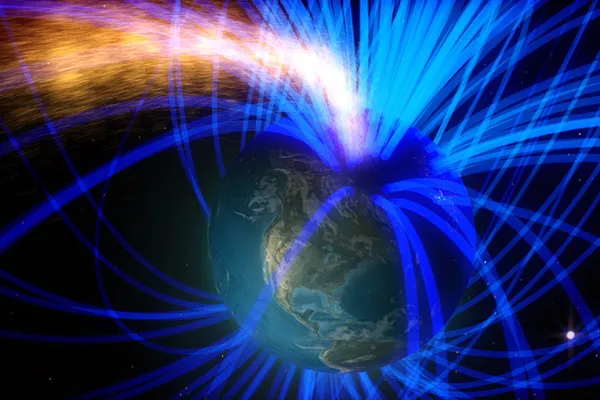
In animals, magnetic orientation is not one single mechanism. Classic experiments demonstrated a magnetic compass in European robins.6 Magnetite particles have been investigated as one possible receptor material.9 Cryptochrome proteins offer another candidate pathway, especially in light-dependent magnetic sensing.10 Recent work continues to refine how birds and sea turtles may use magnetic information, while also showing how artificial electromagnetic noise can interfere with orientation.5,11
For humans, the careful answer is different. In a 2019 controlled EEG study, Connie X. Wang and colleagues, including Joseph L. Kirschvink, reported that rotations of Earth-strength magnetic fields produced a repeatable decrease in alpha-band activity for some field directions.12 The result was a brain response, not proof of a conscious magnetic sense, not proof that people navigate magnetically, and not a settled mechanism. Later studies have reported behavioral or neural effects under particular conditions, but the field still needs independent replication, clearer mechanisms, and a better account of individual differences.13,14
- 3.
Human EEG alpha response under Earth-strength field rotations
Published finding
A repeatable decrease in alpha-band activity for some field directions, under controlled conditions.12
That uncertainty does not make the question less compelling. It makes it a real question.
What else reaches the nervous system without becoming part of ordinary conscious experience? Which signals are present but ignored? Which ones are learned? Which ones could be made usable through training, translation, or technology?
I explored some of these questions through art and research collaborations that I described in “True Art Is Always Pioneering”: EEG and fMRI experiments around meditation, nanoscale microscopy translated into virtual space, heart-rate biofeedback, and works that tried to make normally invisible processes perceptible. This essay follows one thread from that work. It is not about proving that one hidden sense will save us. It is about asking what happens when we stop treating the present limits of an interface as the limits of a human being.
Fitness, truth, and the experience itself
I often return to the work of Donald Hoffman because it offers a provocation, even if I do not accept all of its conclusions. Hoffman’s interface theory does not say that our experience is the most truthful picture of objective reality. It argues almost the opposite: perception may have evolved to guide fitness and action rather than to reveal reality exactly as it is.15 His broader theory of conscious agents goes much further and remains speculative rather than scientific consensus.
Still, the provocation matters. If perception is an interface, what are we optimizing the interface for? Survival? Reproduction? Profit? Speed? Attention capture? Care? Curiosity? A meaningful life?
What if experience itself is already a meaning of life, or maybe the meaning?
Some people argue that the expansion of consciousness or awareness is a purpose of the universe. You can also say God: that God created something and became a universe that expands, learns, is curious, cares for its own existence and for others, and allows them to expand as well. I cannot present that as a scientific conclusion. I also do not want to erase it because it is metaphysical. It is an open question that science alone may not close.
It ties into longevity. It ties into survival and expansion. But it also ties into something as simple as curiosity, or conscious expansion: a childlike play with reality.
Doesn’t it make us happy to be playful as a child? To explore the world? Don’t we often become more hardened, more stressed, more anti-life, or depressed when we do not embody curiosity, play, and care anymore—or when they are temporarily halted by circumstances?
Research does not justify a slogan that curiosity automatically makes everyone happy. A recent review of seventy years of curiosity research connects curiosity with learning, memory, reward, and possible pathways toward flourishing, while also being explicit that the proposed framework needs more empirical testing.16 A meta-analysis of prosociality and well-being finds a positive relationship, with important differences across types of kindness and measures of well-being.17 These findings do not prove a universal philosophy. They do support the possibility that curiosity and care are not decorative extras. They are part of how a life opens.
Can technology re-spark a sense?
What if we use technology not only to compensate for sensory loss and not only to intensify the senses we already exploit, but to learn with our senses and support them?
There are already clues. The feelSpace belt continuously indicates magnetic north through vibration around the waist. After extended use, participants described changes in spatial perception and navigation strategies: not a magical new organ, but learned sensorimotor relationships created through a new channel.18 Sensory-substitution research has translated visual information into touch or sound. Haptic interfaces distribute information away from the already crowded screen. Artists have turned heartbeats, breath, brain activity, environmental data, and microscopic structures into light, sound, motion, and space.
So what could we actually build? Imagine a soft wearable that does not buzz whenever somebody wants something from you, but lets you feel north, distance, air quality, or the rhythm of another living system. Imagine glasses that do not add another visual feed, but quietly translate something outside our visual range into sound or vibration. Imagine a room in which changes in carbon dioxide are not hidden inside a number on an app, but become a subtle change you can learn to recognize before the room feels stale.
Direction → touch
A soft belt that renders direction as gentle pressure.
Environmental signal → haptic cue
Glasses that translate something outside our visual range into sound or vibration, rather than adding another feed.
Or imagine technology helping us rediscover a sense that is already there. A breath interface could first make breathing visible, then slowly make the display less important as interoception becomes clearer. A balance environment could work with the vestibular system. A posture system could help somebody notice weight, asymmetry, and movement through proprioception instead of only telling them that they are “wrong.” A heartbeat could become light, sound, or movement, not to reduce an emotion to a pulse number, but to create another way into the experience.
Which of these become genuinely useful? Which are only interesting for five minutes? Which become art? Which become medicine? Which become an accessibility tool, a learning practice, or a new kind of communication? Those distinctions need experiments, and different people will answer differently.
We should also learn from people who already navigate outside the visual default. Sensory substitution and accessibility are not futuristic side stories. Blind and Deaf communities, neurodivergent people, dancers, musicians, craftspeople, athletes, meditators, and many others already show that attention can be trained and that one sensory channel can change the meaning of another. A future technology should not claim to invent that human adaptability. It should meet it with respect.
The point is not to attach more alerts to the body. We have enough alerts. The point is to ask whether a signal can become meaningful without becoming another demand.
That requires time. A sense is not only a sensor. It is a relationship among receptors, the nervous system, movement, memory, attention, environment, and learning. If a wearable tells me that my heart rate changed, it has measured something. If, over time, I learn how breathing, posture, thought, temperature, social context, and movement relate to that change, I may develop a richer relationship to myself. The display is not the sense. The learning is part of the sense.
It also requires consent. Physiological data can reveal intimate patterns and become more revealing when combined with location, behavior, or other records. Researchers in physiological computing have already raised questions about privacy, context, interpretation, and the ethics of sharing signals between people.19,20 A bioadaptive home that responds to me could be caring. The same home, if it reports my state to an employer, insurer, advertiser, landlord, or government, could become unbearable.
Bio-personalization without agency is surveillance. The person has to remain able to understand, choose, correct, pause, and delete.
A day in a bio-personalized world
What if we actually lived in smart homes that helped us learn with our senses—not only our visual senses?
In the morning, the home might use gradual light, sound, temperature, airflow, and perhaps scent to support waking. It might respond to sleep timing, breathing, movement, and a preference I have actively chosen rather than a profile silently inferred for someone else’s benefit. The light would not simply become brighter. It would change with time of day and with what my body needs to do next.
- Morning: light · air · temperature
Light research already gives this scenario a serious foundation, and also shows why “bright light is bad” is the wrong conclusion. Light affects circadian rhythms, sleep, alertness, mood, and cognition. Many people receive too little bright light during the day and too much light in the evening and at night. An expert consensus recommends stronger daytime light and much lower evening and nighttime light exposure, with timing and individual context at the center.21
Imagine living and working all day under harsh neon-bright light. Would you feel at peace? Maybe not. But a dim room at the wrong time can also make you less alert. The answer is not one universally calming atmosphere. It is an environment that understands rhythm.
While I make breakfast or take a shower, the environment could help me become more focused and alert in a healthy, balanced way. It could also notice air quality. Controlled research in office environments has found that ventilation, carbon dioxide, and volatile organic compound exposure can affect cognitive performance.22 The future sensory home is not only a wall that changes color. It is air, heat, humidity, acoustics, texture, movement, and the internal signals of the people living there.
Then I step into a car. The car may sense which sound, airflow, temperature, seat vibration, or scent helps me remain alert without pushing me into agitation. It could reduce visual clutter and move appropriate information into audio or haptic channels. A scent might help in a specific setting, but the evidence is not strong enough to promise that a fragrance prevents road rage or keeps drivers awake. That should be tested, not marketed as fact.
- Seat cue
- Airflow
- Low-clutter display
There is also no good basis for claiming that perceiving something faster on a screen automatically means fewer accidents. The safety question is whether the right information reaches the driver, at the right time, without distraction or overload. In the United States, crashes involving distracted drivers killed 3,208 people and injured an estimated 315,167 in 2024.23 Multisensory warnings may help in some tasks, but they have to be designed around attention rather than novelty.
And what about self-driving cars? The honest answer is that there is no credible date when fully automated driving will simply arrive everywhere. NHTSA distinguishes Level 2 driver assistance, which requires the driver’s full attention, from Level 3 conditional automation, where the driver must remain available to take over; Level 4 systems handle driving within defined operating conditions, while Level 5 describes automation under all driving conditions.24
That makes the transition period especially important. If a car sometimes drives and sometimes requires a person to take over, the interior cannot treat attention like an on-off switch. Haptic cues, sound, posture, gaze, temperature, and the rhythm of transition may all matter. When driving truly is automated in a defined environment, the same space could support sleep, work, conversation, or recovery—but those are different modes, and the person should know which one is active.
Then we come home. The light becomes warmer and lower. Sound no longer competes for attention. Air and temperature support rest. The system may guide breathing, or it may become quiet. It does not decide that calm is always the goal. Sometimes we need activation. Sometimes grief needs space rather than optimization. Sometimes joy is loud.
- Evening: lower light · quieter sound · personal control
Whenever we talk with voice assistants or AI assistants, their voices could be adaptive to each of us—not merely “personalized” through a name and a recommendation history, but bio-personalized through timing, cadence, volume, vocabulary, and permission. Smart speakers are already ordinary in many homes: Ofcom reported them in 40 percent of U.K. households in the first quarter of 2025.25 Yet personalization of voice is still mostly built around convenience and content. A more careful system might ask when to speak, when to wait, and when not to interpret silence.
Again: I do not want a home that performs empathy while extracting everything. I want technology that helps us become more receptive—to ourselves, to each other, and to the world.
Consent → legibility → local control → pause → deletion
Morning home
Possible inputs: time of day, light, sleep timing, breath and movement, chosen intention
Possible outputs: gradual light, sound, temperature, airflow, pacing
Mobility
Possible inputs: alertness, posture, cabin air, route demand
Possible outputs: sound, airflow, seat haptics, reduced visual clutter
Work and creation
Possible inputs: air quality, temperature, interruption pattern, heart and breath signals
Possible outputs: ventilation, acoustics, light, silence between tasks
Evening home
Possible inputs: time, accumulated load, user-set intention
Possible outputs: warmer and lower light, quieter sound, gentle pacing
Sleep
Possible inputs: light history, temperature, breathing
Possible outputs: very low light, stable temperature, no interruption
Consent → legibility → local control → pause → deletion
Calm is not the same as passive
Are we more receptive when we are at peace? Is “at peace” the right phrase, or is it regulated, grounded, safe enough, attentive?
The nervous system is not a productivity button with “fight or flight” on one side and “calm” on the other. Acute stress can impair working memory and cognitive flexibility, but its effects vary with timing, intensity, task, and the person.26 Activation can help us respond to immediate demands. Chronic overload is different. A regulated state is not a permanently low-arousal state. It is the capacity to move, respond, and recover without becoming trapped.
This is where current interfaces often work against us. Notifications interrupt. Feeds remove stopping cues. Social comparison, conflict, and uncertain reward can keep attention circulating long after the information has stopped being useful. A five-week field study found relationships between patterns of phone notifications and self-reported affect, while experimental work has shown that allowing phone interruptions can increase reported inattention and hyperactivity symptoms in a non-clinical sample.27,28 These studies do not mean that every notification causes a medical stress response. They do show that design choices shape the conditions of attention.
What if the system did not ask, “How do we get Hannes to respond faster?” What if it asked, “Is this the right moment to interrupt him at all?”
There is also evidence linking positive affect with performance, but it has to be used carefully. In controlled experiments using piece-rate tasks, happiness interventions raised productivity by roughly 12 percent.29 That does not mean every company can manufacture happiness and extract 12 percent more labor. The deeper possibility is that well-being and meaningful work do not have to be opponents. A humane environment can support attention and aliveness at the same time.
How much information are we missing?
There is no single responsible number for how much of “the world’s data” a human perceives. A nervous system does not receive a neutral database and then discard a known percentage. Receptors sample particular energies. Neural systems compress, predict, select, and integrate. Attention changes what becomes available for report. Meaning changes what matters.
So I would rather draw a map than invent a number.
There is the physically available world: electromagnetic radiation, pressure waves, molecules, temperature, chemical gradients, gravity, electric and magnetic fields, and signals we have not learned to use. There is what a particular body can transduce. There is what its nervous system processes. There is what reaches conscious awareness. There is what language and culture teach it to notice. And there is what today’s interface selects again from that already narrow field.
At every layer, something becomes possible and something disappears.
AI and automation can intensify that selection. A model can decide which message, image, person, task, or risk enters my field next. That can be helpful. It can also automate the current limitation: more visual prediction, more behavioral targeting, more speed, more of the same reductionistic view of the world amplified.
But AI could also help translate among senses. It could turn air quality into subtle sound, long-term stress patterns into a changing texture, ecological data into a spatial experience, or microscopic structures into a place one can enter. It could learn not merely which content keeps me engaged, but which conditions help me notice, recover, connect, and choose.
Accelerated reduction
- more content
- fewer dominant channels
- more interruption
- narrower attention
- more behavioural optimization
Bioadaptive expansion
- more kinds of signals
- translation across senses
- reflection and learning
- agency
- connection and recovery
Design choices can move a system in either direction.
The design question is not only, “What can the model infer?” It is, “What relationship does the inference create?”
We already have more
It is not kitschy to say that we already have abundance and still fail to align it with care.
In 2022, 1.05 billion tonnes of food were wasted at retail, food-service, and household levels—almost one fifth of food available to consumers—while 783 million people were affected by hunger.30 That does not prove that logistics are simple or that all food can be moved to anyone who needs it. It shows a profound contradiction: scarcity and excess are produced together.
It is similar with technology. There were 9.1 billion mobile-cellular subscriptions worldwide in 2024, more subscriptions than people, although subscriptions are not the same as physical phones and access remains unequal.31 Four out of five people aged ten and older owned a mobile phone.32 At the same time, the world generated 62 million tonnes of electronic waste in 2022; only 22.3 percent was documented as properly collected and recycled, and the total is projected to reach 82 million tonnes by 2030.33
Does it need to be this many devices, replaced this often, built around nearly identical visual rectangles?
What if the goal were not another “personalized” phone that better predicts what I will click, but fewer and longer-lived technologies that adapt to what different bodies need? A device could change its sensory emphasis, interaction speed, contrast, sound, haptics, and interruption pattern. It could reveal how it is adapting. It could let the person refuse. It could be repaired rather than discarded.
Bio-personalization cannot mean an expensive new object for every preference. That would repeat the same extraction with softer language. It should mean using materials, computation, and data more carefully, for longer, with more agency.
How do we rediscover what is already here?
Not every expansion needs a new device.
We can practice attention to breath without a sensor. We can walk in darkness and notice how hearing and balance reorganize space. We can close our eyes while moving slowly and feel proprioception become more explicit. We can learn from craft, music, dance, somatic practices, meditation, wilderness knowledge, disability culture, and the expertise of people whose lives already challenge the assumption that vision is the default interface.
Technology can support these practices without replacing them. A biofeedback system can make a pattern visible or audible and then get out of the way. A haptic compass can reveal how orientation might become embodied. A mixed-reality artwork can let us move through nanoscale forms. A smart room can teach us which light helps us wake and then return control to us.
This is not about becoming post-human. It is about becoming more available to being human—and about remembering that “human” has never meant one standardized body.
How can we build lifestyles, technologies, and institutions that help us become more at peace with ourselves and others, while still more focused and attentive? How can that happen in a harmonious, balanced way, without turning harmony into obedience or attention into productivity alone?
We can build this. I truly believe this is the next frontier: creating bio-personalized technologies that adapt to our needs in real time and are centered around humans, rather than accelerating and amplifying a reductionistic view of the world.
That reduction cannot continue forever. It is doomed to crash into the complexity it excludes.
So there is a huge opening. Let’s take it.
Let’s explore it with care. With curiosity. And with compassion.
Research & Sources
Numbered sources support the factual claims marked in the text. Open questions in the essay remain open questions; the references qualify them rather than resolving them.
- 1.Thomas Brandt, Marianne Dieterich & Doreen Huppert, “Human senses and sensors from Aristotle to the present,” Frontiers in Neurology 15 (2024): 1404720
- 2.NASA Science, “Visible Light,” Electromagnetic Spectrum
- 3.Adriana D. Briscoe & Lars Chittka, “The Evolution of Color Vision in Insects,” Annual Review of Entomology 46 (2001): 471–510 — supports bee ultraviolet vision
- 4.Elena O. Gracheva et al., “Molecular Basis of Infrared Detection by Snakes,” Nature 464 (2010): 1006–1011
- 5.Kayla M. Goforth et al., “Learned magnetic map cues and two mechanisms of magnetoreception in turtles,” Nature (2025)
- 6.Wolfgang Wiltschko & Roswitha Wiltschko, “Magnetic compass of European robins,” Science 176 (1972): 62–64
- 7.Wen G. Chen et al., “The Emerging Science of Interoception: Sensing, Integrating, Interpreting, and Regulating Signals within the Self,” Trends in Neurosciences 44, no. 1 (2021): 3–16
- 8.Gary G. Berntson & Sahib S. Khalsa, “Neural Circuits of Interoception,” Trends in Neurosciences 44, no. 1 (2021): 17–28
- 9.Joseph L. Kirschvink, Atsuko Kobayashi-Kirschvink & Barbara J. Woodford, “Magnetite biomineralization in the human brain,” PNAS 89, no. 16 (1992): 7683–7687
- 10.Lauren E. Foley, Robert J. Gegear & Steven M. Reppert, “Human cryptochrome exhibits light-dependent magnetosensitivity,” Nature Communications 2 (2011): 356
- 11.Svenja Engels et al., “Anthropogenic electromagnetic noise disrupts magnetic compass orientation in a migratory bird,” Nature 509 (2014): 353–356
- 12.Connie X. Wang et al., “Transduction of the Geomagnetic Field as Evidenced from Alpha-Band Activity in the Human Brain,” eNeuro 6, no. 2 (2019): ENEURO.0483-18.2019
- 13.Kwon-Seok Chae, Soo-Chan Kim, Hye-Jin Kwon & Yongkuk Kim, “Human magnetic sense is mediated by a light and magnetic field resonance-dependent mechanism,” Scientific Reports 12 (2022): 8997
- 14.In-Taek Oh, Soo-Chan Kim, Yongkuk Kim, Yong-Hwan Kim & Kwon-Seok Chae, “Magnetic sense-dependent probabilistic decision-making in humans,” Frontiers in Neuroscience 19 (2025): 1497021; corrigendum, Frontiers in Neuroscience, 25 March 2025 (doi:10.3389/fnins.2025.1591645)
- 15.Donald D. Hoffman, Manish Singh & Chetan Prakash, “The Interface Theory of Perception,” Psychonomic Bulletin & Review 22 (2015): 1480–1506
- 16.Anne-Laure Le Cunff, “Systematic Curiosity as an Integrative Tool for Human Flourishing: A Conceptual Review and Framework,” Integrative Psychological and Behavioral Science 58, no. 4 (2024): 1876–1894. The proposed pathways toward flourishing remain a framework for further testing.
- 17.Bryant P. H. Hui et al., “Rewards of Kindness? A Meta-Analysis of the Link Between Prosociality and Well-Being,” Psychological Bulletin 146, no. 12 (2020): 1084–1116
- 18.Sabine U. König et al., “Learning New Sensorimotor Contingencies: Effects of Long-Term Use of a Sensory Augmentation Device on the Brain and Conscious Perception,” PLOS ONE 11, no. 12 (2016): e0166647
- 19.Clara Moge, Katherine Wang & Youngjun Cho, “Shared User Interfaces of Physiological Data: Systematic Review of Social Biofeedback Systems and Contexts in HCI,” CHI Conference on Human Factors in Computing Systems (CHI ’22), doi:10.1145/3491102.3517495
- 20.Keith Davis & Tuukka Ruotsalo, “Physiological Data: Challenges for Privacy and Ethics,” arXiv:2405.15272 (2024); published in IEEE Computer 58, no. 1 (2025): 33–44. An ethics perspective, not evidence of a clinical effect.
- 21.Timothy M. Brown et al., “Recommendations for Daytime, Evening, and Nighttime Indoor Light Exposure to Best Support Physiology, Sleep, and Wakefulness in Healthy Adults,” PLOS Biology 20, no. 3 (2022): e3001571
- 22.Joseph G. Allen et al., “Associations of Cognitive Function Scores with Carbon Dioxide, Ventilation, and Volatile Organic Compound Exposures in Office Workers,” Environmental Health Perspectives 124, no. 6 (2016): 805–812
- 23.U.S. National Highway Traffic Safety Administration, “Distracted Driving,” 2024 crash estimates (figures as reported in DOT HS 813 790, Distracted Driving in 2024)
- 24.U.S. National Highway Traffic Safety Administration, “Automated Vehicle Safety” and “Levels of Automation”
- 25.Ofcom, Media Nations 2025: UK Report, p. 91 — 40% of U.K. households had a smart speaker in Q1 2025
- 26.Grant S. Shields, Matthew A. Sazma & Andrew P. Yonelinas, “The Effects of Acute Stress on Core Executive Functions: A Meta-Analysis and Comparison with Cortisol,” Neuroscience & Biobehavioral Reviews 68 (2016): 651–668
- 27.Eiman Kanjo, Daria J. Kuss & Chee Siang Ang, “NotiMind: Utilizing Responses to Smart Phone Notifications as Affective Sensors,” IEEE Access 5 (2017), doi:10.1109/ACCESS.2017.2755661
- 28.Kostadin Kushlev, Jason Proulx & Elizabeth W. Dunn, “Silence Your Phones: Smartphone Notifications Increase Inattention and Hyperactivity Symptoms,” CHI ’16, doi:10.1145/2858036.2858359
- 29.Andrew J. Oswald, Eugenio Proto & Daniel Sgroi, “Happiness and Productivity,” Journal of Labor Economics 33, no. 4 (2015): 789–822
- 30.United Nations Environment Programme, “World Squanders Over 1 Billion Meals a Day,” reporting the Food Waste Index Report 2024
- 31.International Telecommunication Union, “Subscriptions,” Facts and Figures 2024
- 32.International Telecommunication Union, “Mobile Phone Ownership,” Facts and Figures 2024
- 33.UNITAR & International Telecommunication Union, The Global E-waste Monitor 2024
- 34.Dennis Evangelista et al., “Honeybee navigation: critically examining the role of the polarization compass,” Philosophical Transactions of the Royal Society B 369 (2014): 20130037 — polarized-light cues in bee navigation
- 35.Donald R. Griffin & Robert Galambos, “The sensory basis of obstacle avoidance by flying bats,” Journal of Experimental Zoology 86, no. 3 (1941): 481–506, and Griffin, “Bat sounds under natural conditions, with evidence for echolocation of insect prey,” Journal of Experimental Zoology 123, no. 3 (1953): 435–465
- 36.Adrianus J. Kalmijn, “The electric sense of sharks and rays,” Journal of Experimental Biology 55 (1971): 371–383
Further reading on magnetoreception
- Robin Baker, “Goal orientation by blindfolded humans after long-distance displacement: possible involvement of a magnetic sense,” Science 210 (1980): 555–557
The 1980 claim of human magnetic homing that started the modern debate.
- G. W. Westby & K. J. Partridge, “Human homing: still no evidence despite geomagnetic controls,” Journal of Experimental Biology 120 (1986): 325–331
One of the later tests that could not reproduce it.
- J. Xu et al., “Magnetic sensitivity of cryptochrome 4 from a migratory songbird,” Nature 594 (2021): 535–540
Laboratory evidence for the leading candidate molecule behind the birds’ light-dependent compass.
- P. J. Hore & Henrik Mouritsen, “The radical-pair mechanism of magnetoreception,” Annual Review of Biophysics 45 (2016): 299–344
The standard review of the “quantum compass” hypothesis.
- Henrik Mouritsen, “Long-distance navigation and magnetoreception in migratory animals,” Nature 558 (2018): 50–59
A review arguing that no single cue explains long-distance navigation.
- Sönke Johnsen & Kenneth J. Lohmann, “The physics and neurobiology of magnetoreception,” Nature Reviews Neuroscience 6 (2005): 703–712
A classic overview of the candidate mechanisms.
- Caltech, “Evidence for a Human Geomagnetic Sense,” news release, March 2019
The institution’s own announcement of the 2019 study.
Image credits
- Joseph Kirschvink in the Caltech test chamber — photograph by Spencer Lowell for Science.
- Visualization of Earth’s magnetic field — NASA’s Goddard Space Flight Center.
- Electromagnetic spectrum diagram (Figure 2) — diagram by Hannes Bend; visible-light reference NASA Science.
- Western honey bee (Apis mellifera) on an aster. — photograph by John Severns, via Wikimedia Commons, Public domain. Resized and converted for web; uncropped.
- Large-scaled pit viper (Trimeresurus macrolepis) on a mossy rock. — photograph by Davidvraju, via Wikimedia Commons, CC0 1.0. Resized and converted for web; uncropped.
- Townsend’s big-eared bat (Corynorhinus townsendii), a handled portrait. — photograph by Ann Froschauer / U.S. Fish and Wildlife Service, via Wikimedia Commons, CC BY 2.0. Resized and converted for web; uncropped.
- Blacktip reef shark (Carcharhinus melanopterus). — photograph by Memurubu, via Wikimedia Commons, CC BY-SA 4.0. Resized and converted for web; uncropped.
- Loggerhead sea turtle (Caretta caretta); the photograph shows the turtle only. — photograph by Brian Gratwicke, via Wikimedia Commons, CC BY 2.0. Resized and converted for web; uncropped.
- Opening thermal image — supplied by Hannes Bend.
- Greenhouse photograph — supplied by Hannes Bend.
- Concept scenes (soft belt, glasses, morning and evening room, car interior, and the walk outdoors) — AI-generated concept illustrations made for this article. They illustrate the ideas described in the text; they are not photographs of existing products, and not documentation of the cited research or devices.