Research
Research & Patents
What research and patents has Hannes Bend published?
Hannes Bend is a named inventor on two issued US patents in one family, both titled "Adaptive interface for screen-based interactions": US 10,423,893 (issued 24 September 2019; pre-grant publication US 2019/0042981 A1) and US 11,561,806 (issued 24 January 2023). He presented "Mindful Technologies: Research and Developments in Science and Art" at the AAAI 2016 Spring Symposium and collaborated with neuroscience researchers at the University of Oregon on breathing and attention. Each item below links to its primary bibliographic or patent record so the claim can be verified independently.
Hannes Bend's research originates in artistic and humanities-based questions about perception, consciousness, symbols, matter, embodiment, and mediated reality. It later expanded into neuroscience, VR, physiological computing, rPPG, and patented bio-adaptive AI systems. For how these fields relate, read Somatic AI vs. embodied AI, affective computing and bioadaptive interfaces, and the moral case for bio-personalized technology.
Patent records list the inventor as Hannes Bendfeldt, the legal name of Hannes Bend. See the biography and the dated research timeline.
Issued patents
Two issued US patents in one family — “Adaptive interface for screen-based interactions” — naming Hannes Bend (legal name Hannes Bendfeldt) as inventor. Systems that adapt digital environments using machine learning on physiological signals.
Full page: Adaptive interface patents — scope, jurisdictions and official records →
Adaptive interface for screen-based interactions
US 11,561,806 B2 — issued 24 January 2023
Continuously adapts screen content using machine learning on sensor-captured bio-signals, adjusting visuals and audio in response to breathing and pulse-related measurements.
Adaptive interface for screen-based interactions
US 10,423,893 B2 — issued 24 September 2019
Captures sensor data and applies machine learning to personalize digital output in real time. The claims describe mechanism — capture, model, adaptation — not diagnosis.
The Association for the Advancement of Artificial Intelligence (AAAI) Spring Symposium Series 2016
Stanford University · Part of Association for the Advancement of Artificial Intelligence (AAAI) Spring Symposium Series (not main AAAI annual conference)
Symposium: Well-Being Computing: AI Meets Health and Happiness Science
Paper: Mindful Technologies: Research and Developments in Science and Art
🏆 Best Presentation Award
Read Paper (PDF)Full page: Mindful Technologies, AAAI Spring Symposium 2016 →
ACM IUI 2021 Workshops
Workshop: HEALTHI — Healthy Interfaces Workshop
Paper: Adaptive Interfaces for Personalized Digital Wellbeing
Read Paper (CEUR-WS Vol-2903)TSC 2016 — Science of Consciousness Conference
University of Arizona
Presentation: Metaverses / mYndful VR biofeedback system
TSC 2016 Proceedings (PDF page 112)
a2ru GroundWorks National Conference 2015
Virginia Tech · Alliance for the Arts in Research Universities · 8–11 November 2015
Project: Metaverses / Seecular — presented 10 November 2015 in the parallel critique session “Exploring Peer Review for Transdisciplinary Work” at the Cube, Moss Arts Center, as one of six transdisciplinary exemplar projects. The official programme publishes a project text describing the work.
Official conference programme and project text (PDF)Interdisciplinary Research (2014–2016)
Metaverses / Seecular
Full page: Metaverses / Seecular, University of Oregon (2014–2016) →
University of Oregon · 2014–2016
Visiting Scholar · Artist-in-Residence · Quantum & Neuroscience Collaboration
"Metaverses/Seecular" (2014–2016) was an interdisciplinary art–science research collaboration at the University of Oregon, where Hannes Bend was a visiting scholar at the Benjamín Alemán Laboratory for Quantum and Nanoscale Physics and an artist-in-residence with the Institute of Neuroscience in the Robert and Beverly Lewis Integrative Science Building.
The project was conducted in collaboration with:
- ·Benjamín Alemán Laboratory (Quantum and Nanoscale Physics), University of Oregon
- ·Dr. Michael Posner — Professor Emeritus of Psychology, Institute of Cognitive and Decision Sciences, University of Oregon
- ·Matt Larsen (Computer Science)
- ·David Miller (Physics)
- ·Cooper Boydston (Physics)
- ·Ben McMorran (Physics)
- ·Nancy Kelley
- ·Richard Taylor
- ·Kahli Burke
- ·Jordan Pierce
Research components included:
- ·EEG study: "Correlation between Visual Stimuli and Brain States" (lab of Edward Vogel)
- ·fMRI study: "Neural Mechanisms of Multiple Meditation Techniques within Practitioners" — Lewis Center for Neuroimaging
- ·Development of "Seecular" visualization environments informed by neuroscience and physics
- ·Early human–machine interface and biofeedback exploration
Positioning: This foundational research directly informed the development of bioadaptive interfaces, neuroadaptive systems, and human-centered AI environments.
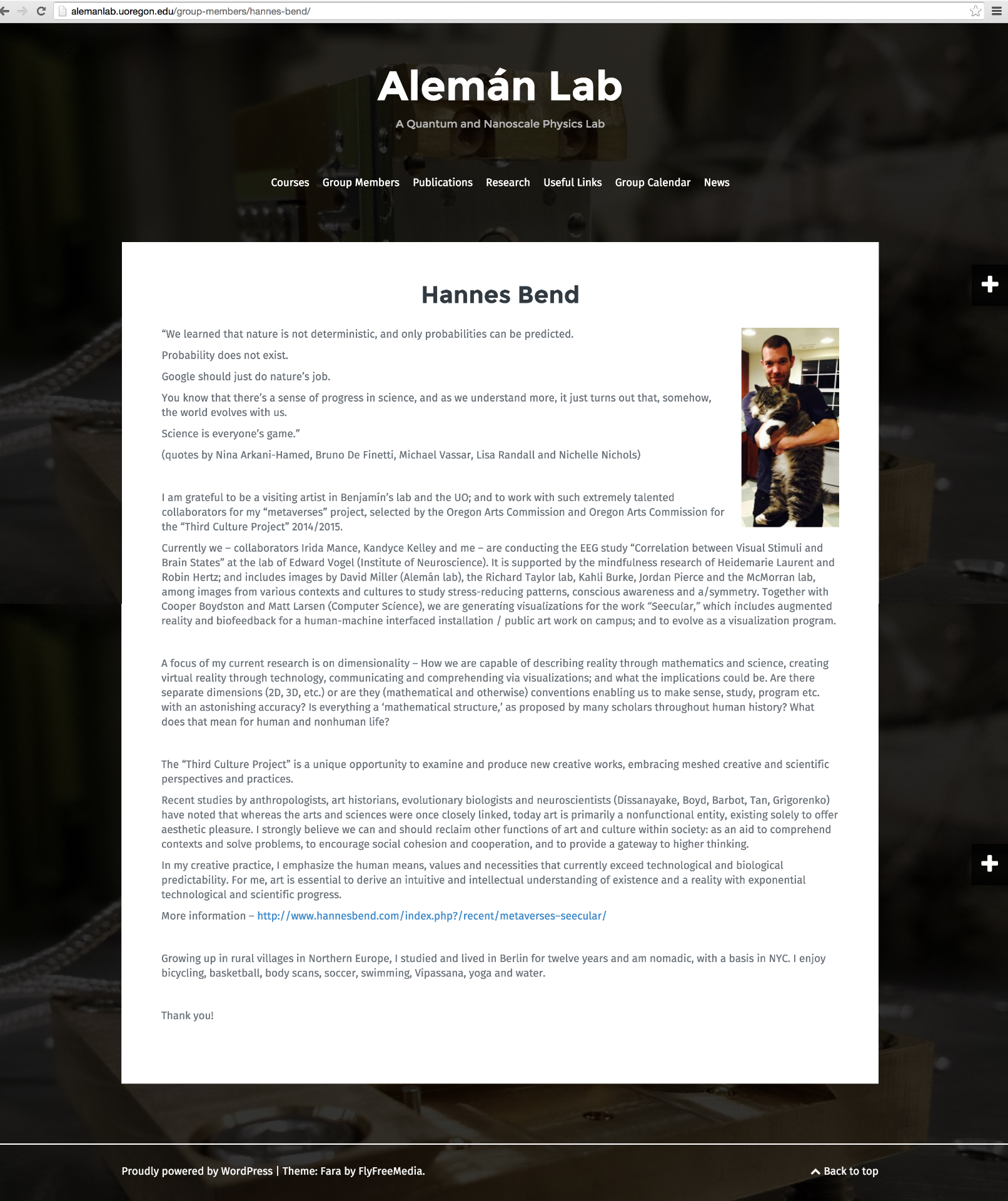
Hannes Bend profile at the Alemán Lab (Quantum & Nanoscale Physics), University of Oregon in 2014-16
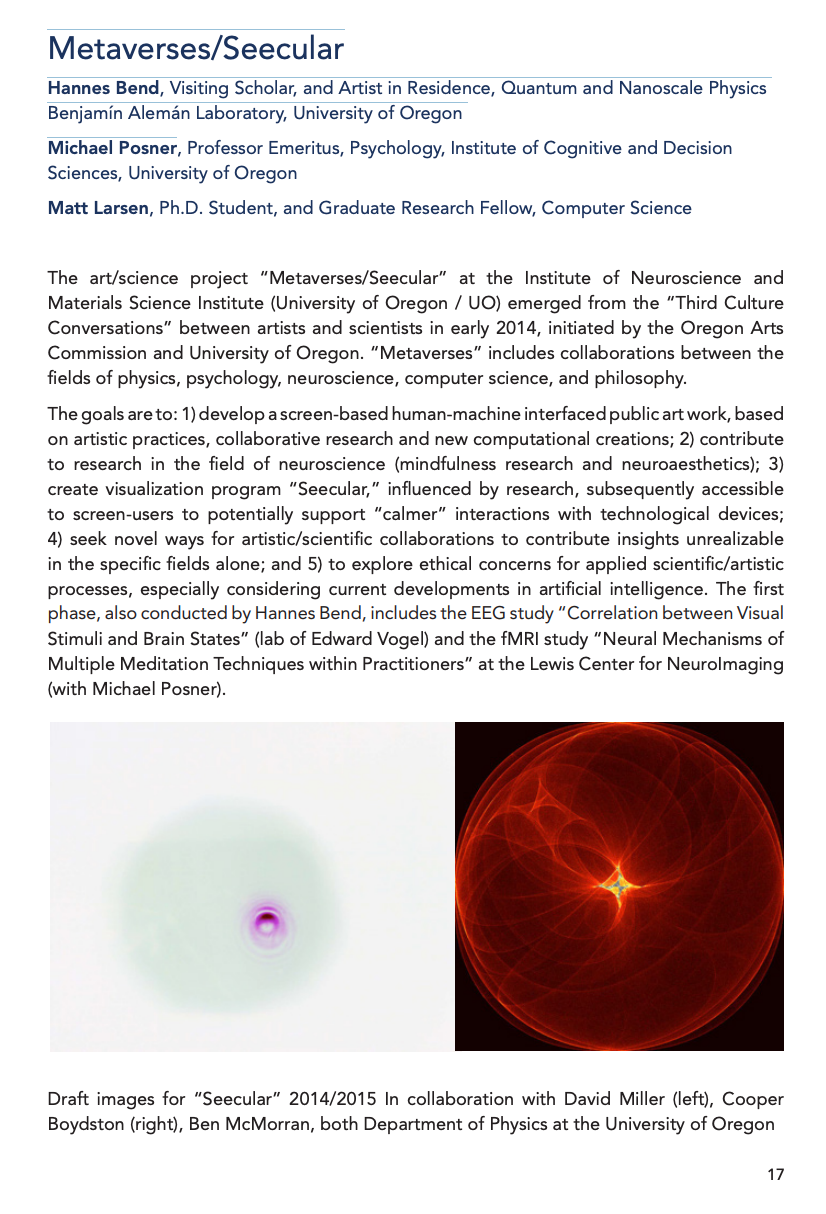
Metaverses/Seecular interdisciplinary physics/neuroscience collaboration 2014-2016.
Publications & Presentations
- ·Association for the Advancement of Artificial Intelligence (AAAI) — "Mindful Technologies: Research and Developments in Science and Art"
- ·The Science of Consciousness 2016 (University of Arizona)
- ·a2ru GroundWorks National Conference 2015 (Virginia Tech) — programme PDF
- ·Public Presentation (YouTube)
Research support
Conference participation and travel in 2014 and 2015 were funded through National Science Foundation-supported SLSA (Society for Literature, Science, and the Arts) grant support. Research residency and visiting-scholar work took place at the University of Oregon (2014–2016), and biofeedback research continued through the ThoughtWorks Arts Residency (2017). Selected grants, fellowships and support.