2014–2016 · University of Oregon
Metaverses / Seecular
Visiting Scholar · Artist-in-Residence · Quantum & Neuroscience Collaboration
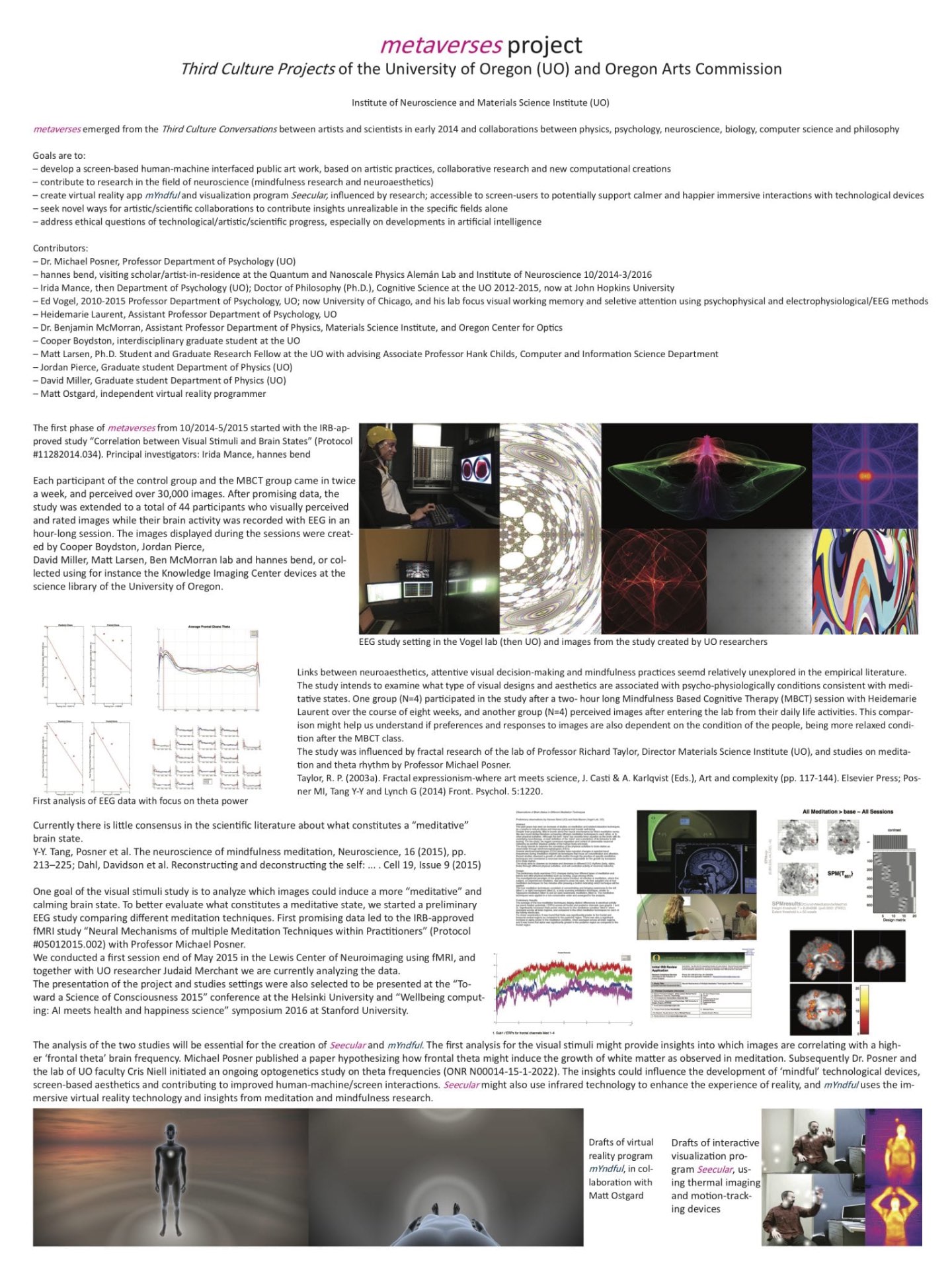
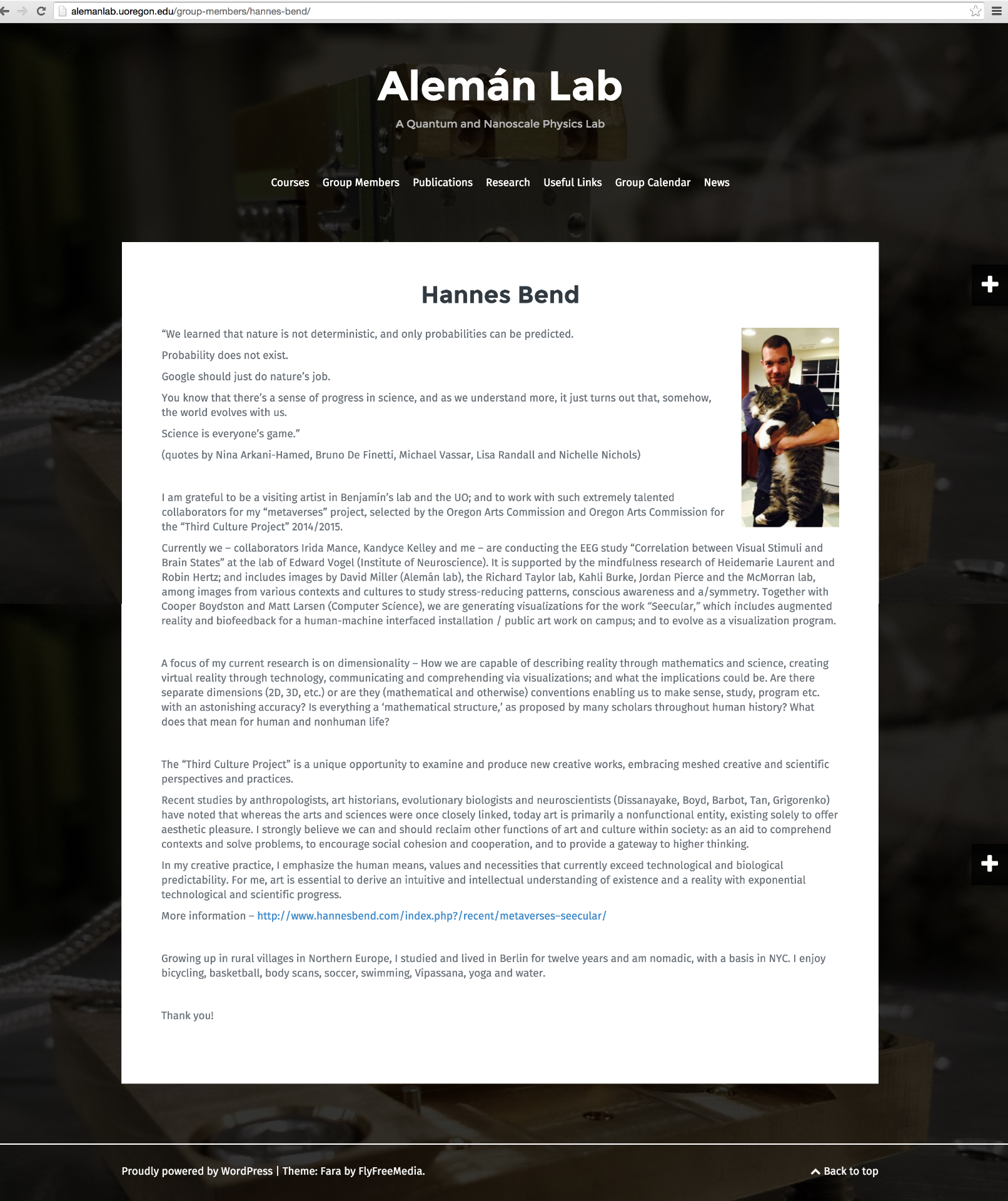
Metaverses/Seecular (2014–2016) was an interdisciplinary art–science research collaboration at the University of Oregon. Hannes Bend was a visiting scholar at the Benjamín Alemán Laboratory for Quantum and Nanoscale Physics and an artist-in-residence with the Institute of Neuroscience in the Robert and Beverly Lewis Integrative Science Building, developing visualization environments together with physicists, neuroscientists and computer scientists.
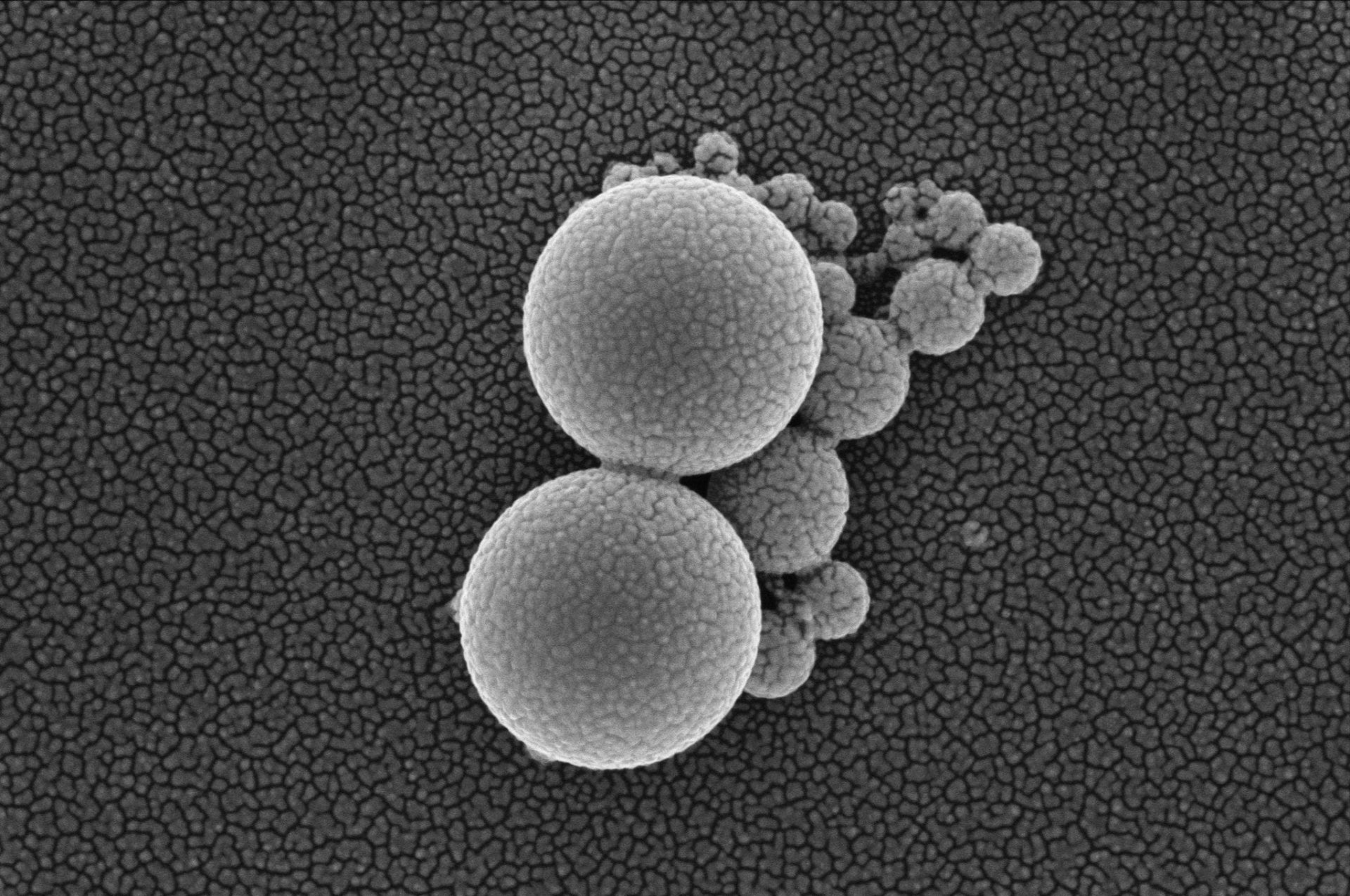
The project connected nanoscale electron microscopy, attention and meditation research, and immersive visualization into a single working programme. Its applied outcome was mYndful — the VR biofeedback modules — and its methodological outcome was the 2016 AAAI symposium paper documenting the approach.
Collaborators
- ·Benjamín Alemán Laboratory for Quantum and Nanoscale Physics, University of Oregon
- ·Dr. Michael Posner — Professor Emeritus of Psychology, Institute of Cognitive and Decision Sciences, University of Oregon
- ·Matt Larsen (Computer Science)
- ·David Miller (Physics)
- ·Cooper Boydston (Physics)
- ·Ben McMorran (Physics)
- ·Nancy Kelley
- ·Richard Taylor
- ·Kahli Burke
- ·Jordan Pierce
Research components
- ·EEG study: "Correlation between Visual Stimuli and Brain States" (lab of Edward Vogel)
- ·fMRI study: "Neural Mechanisms of Multiple Meditation Techniques within Practitioners" — Lewis Center for Neuroimaging
- ·Development of "Seecular" visualization environments informed by neuroscience and physics
- ·Early human–machine interface and biofeedback exploration
a2ru GroundWorks National Conference, 2015
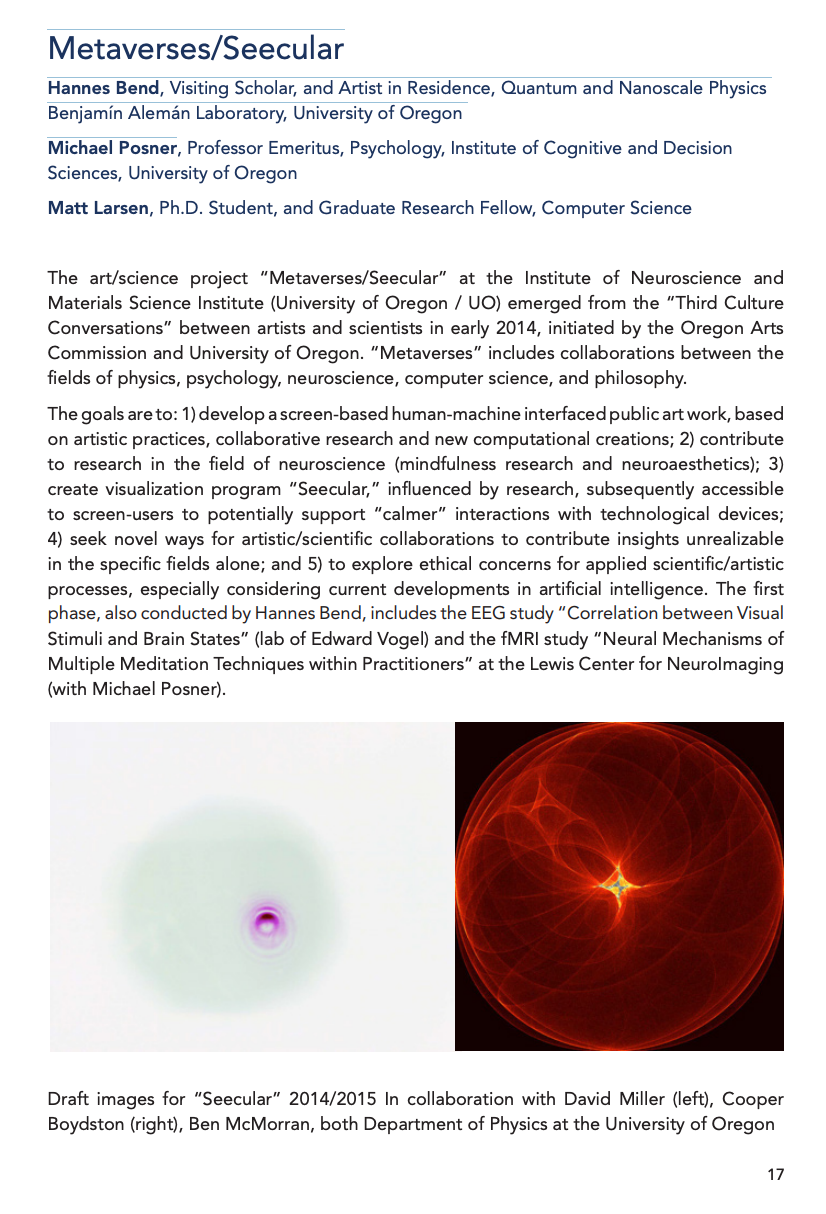
Metaverses/Seecular was presented at the Alliance for the Arts in Research Universities (a2ru) GroundWorks National Conference at Virginia Tech, 8–11 November 2015, as one of six transdisciplinary exemplar projects selected for the conference. The presentation took place on 10 November in the parallel critique session “Exploring Peer Review for Transdisciplinary Work,” held at the Cube, Moss Arts Center.
The official programme publishes a project text describing the work as a University of Oregon art/science collaboration linking physics, psychology, neuroscience, computer science and philosophy — a documentary record of the project as it was presented at the time.
- Dates
- 2014–2016
- Institution
- University of Oregon — Benjamín Alemán Laboratory for Quantum and Nanoscale Physics; Institute of Neuroscience, Robert and Beverly Lewis Integrative Science Building
- Role of Hannes Bend
- Visiting scholar at the Benjamín Alemán Laboratory for Quantum and Nanoscale Physics and artist-in-residence with the Institute of Neuroscience in the Robert and Beverly Lewis Integrative Science Building; project lead for Metaverses/Seecular
- Methods
- Electron microscopy imagery, EEG, fMRI, immersive visualization, biofeedback prototyping
- Applied outcome
- mYndful VR biofeedback modules
- Positioning
- This research informed the later development of bioadaptive interfaces and human-centered AI environments; the studies were exploratory and are not a diagnosis, with no clinical outcome claimed.
Publications & presentations
The Science of Consciousness 2016, University of Arizona (proceedings PDF, p. 112)
This early biofeedback exploration is the conceptual origin of the bioadaptive AI loop demonstrated on the site.