Bioadaptive AI — somatic interfaces
AI that adapts to the person — not only the prompt.
Since 2014, Hannes Bend has developed biofeedback artworks and research prototypes that led to granted adaptive-interface patents and a portfolio of ventures. The work explores how measured signals, context and explicit feedback can adapt screens, audio and responsive environments.
Named inventor
Hannes Bendfeldt
2 US + 1 CN grants
AAAI Best Presentation
Stanford, 2016
ACM IUI HEALTHI Workshop
2021
Techstars Roux Institute
2021 accelerator cohort
Patent drawings
What the patents actually disclose
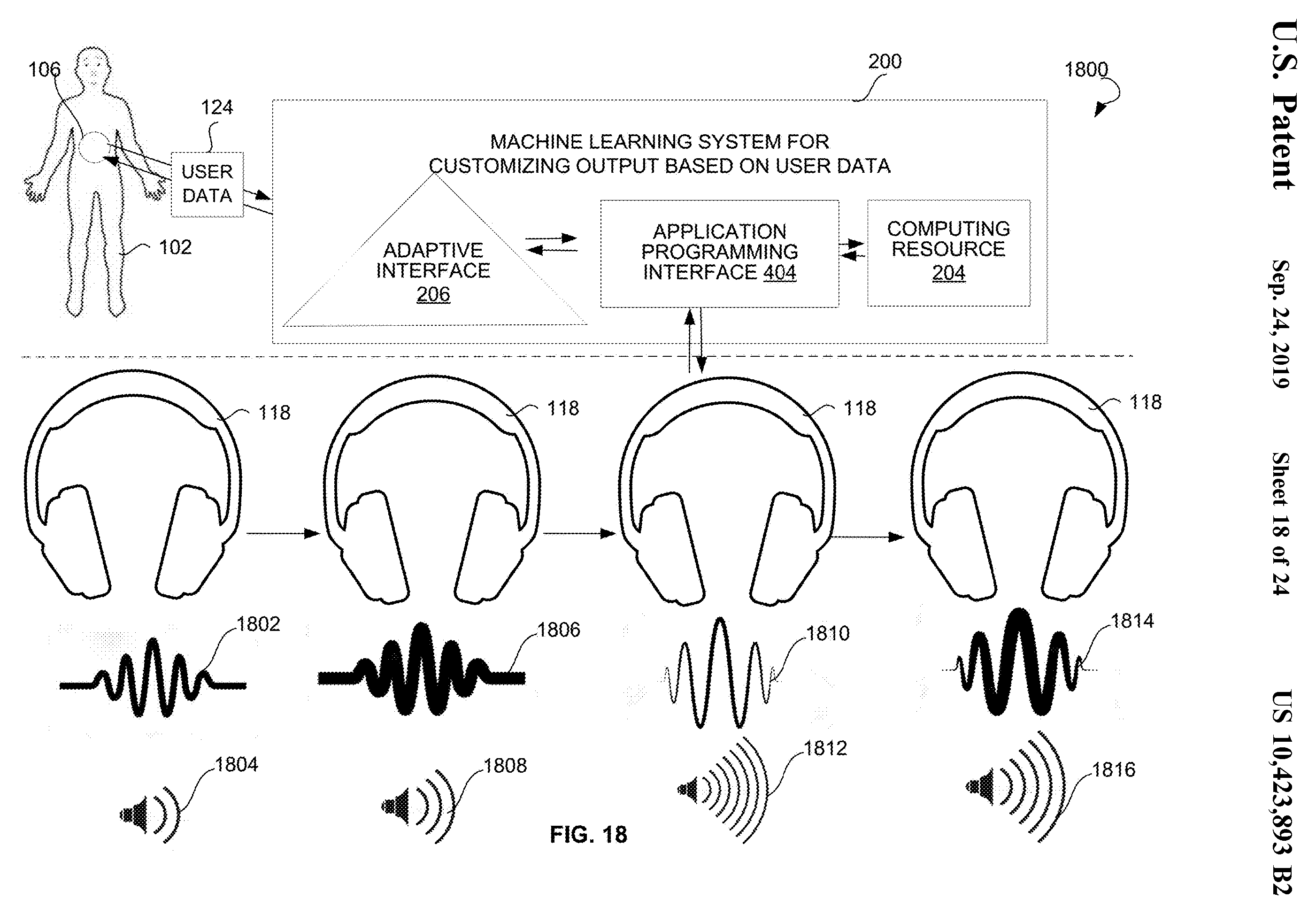
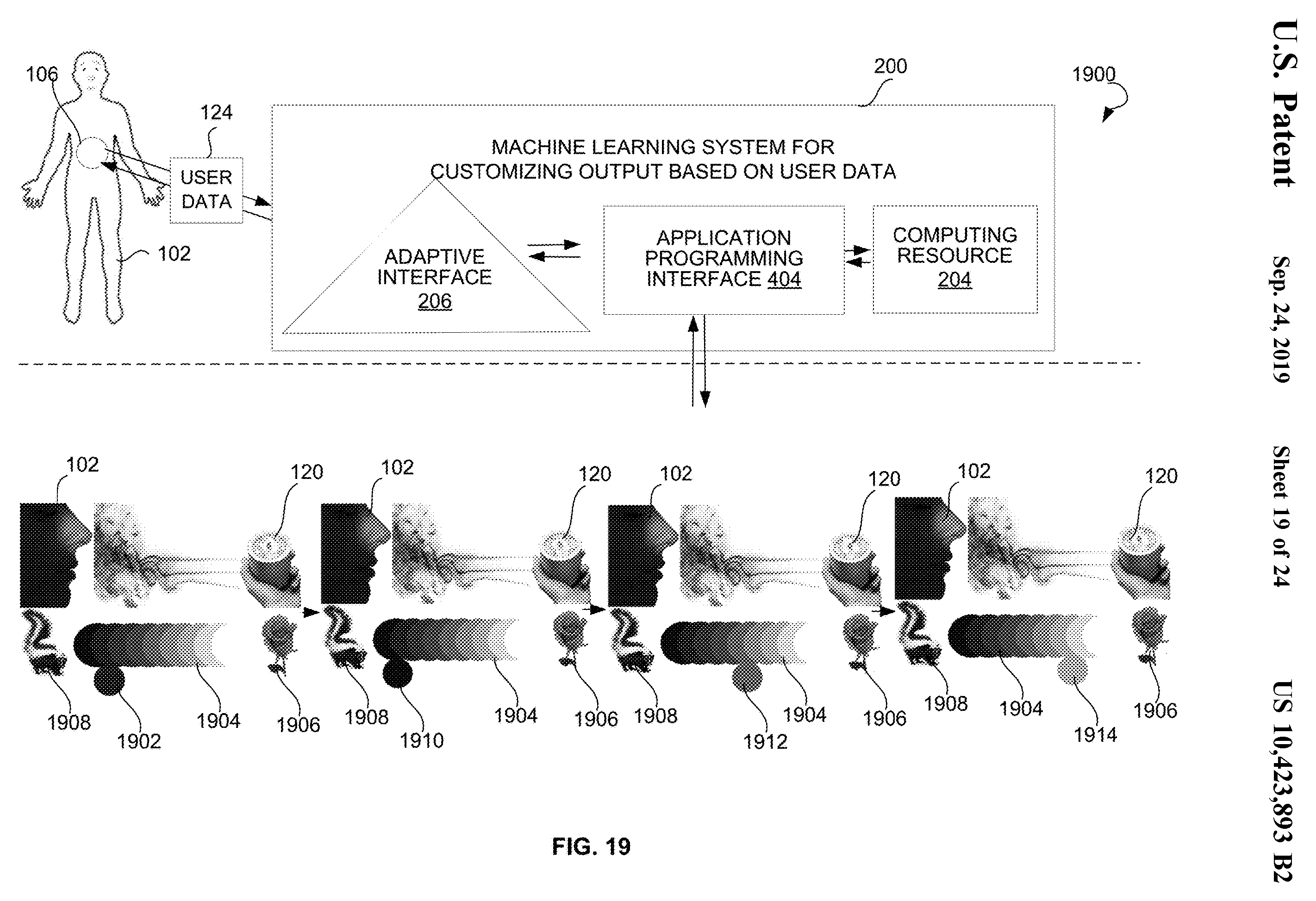
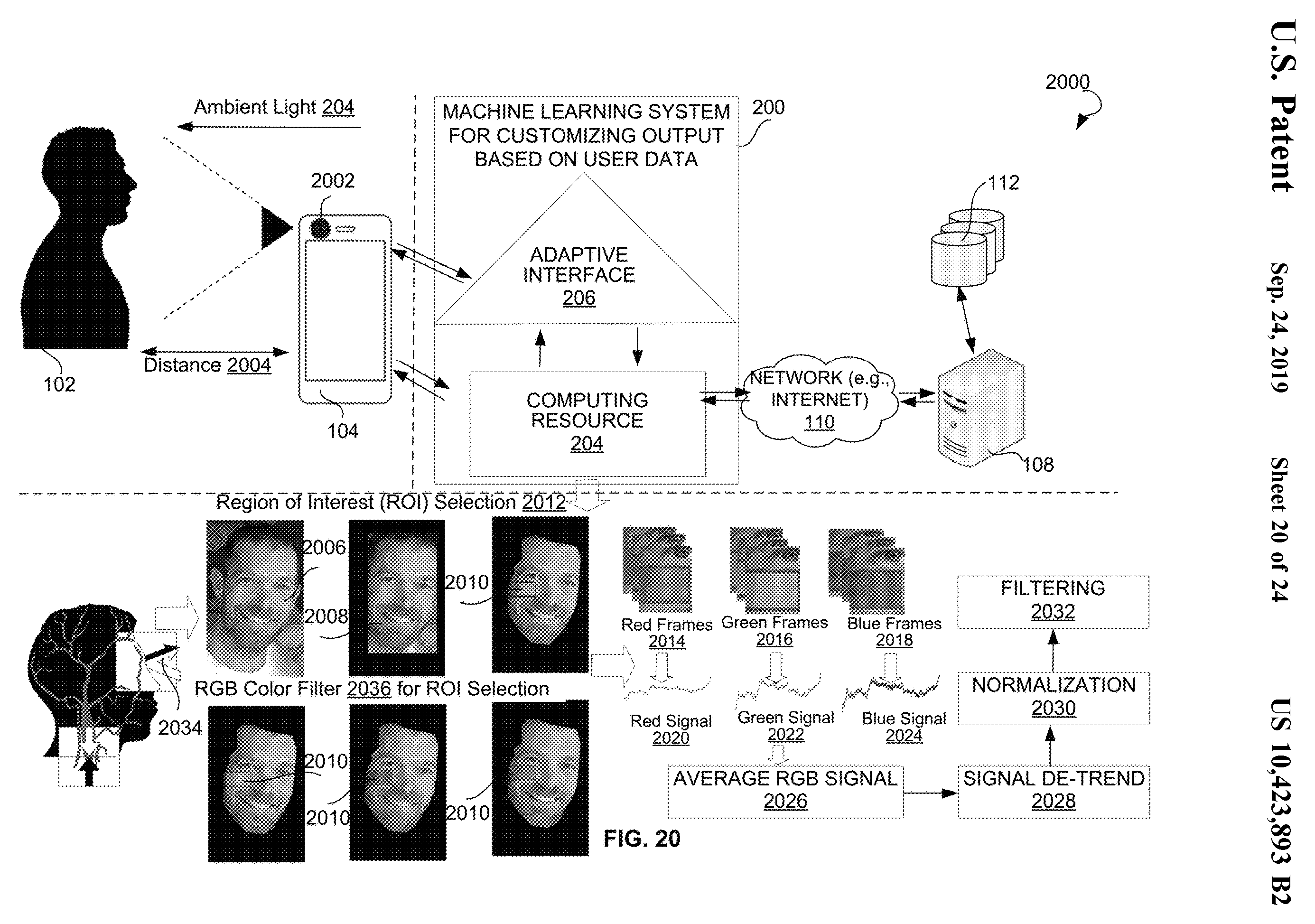
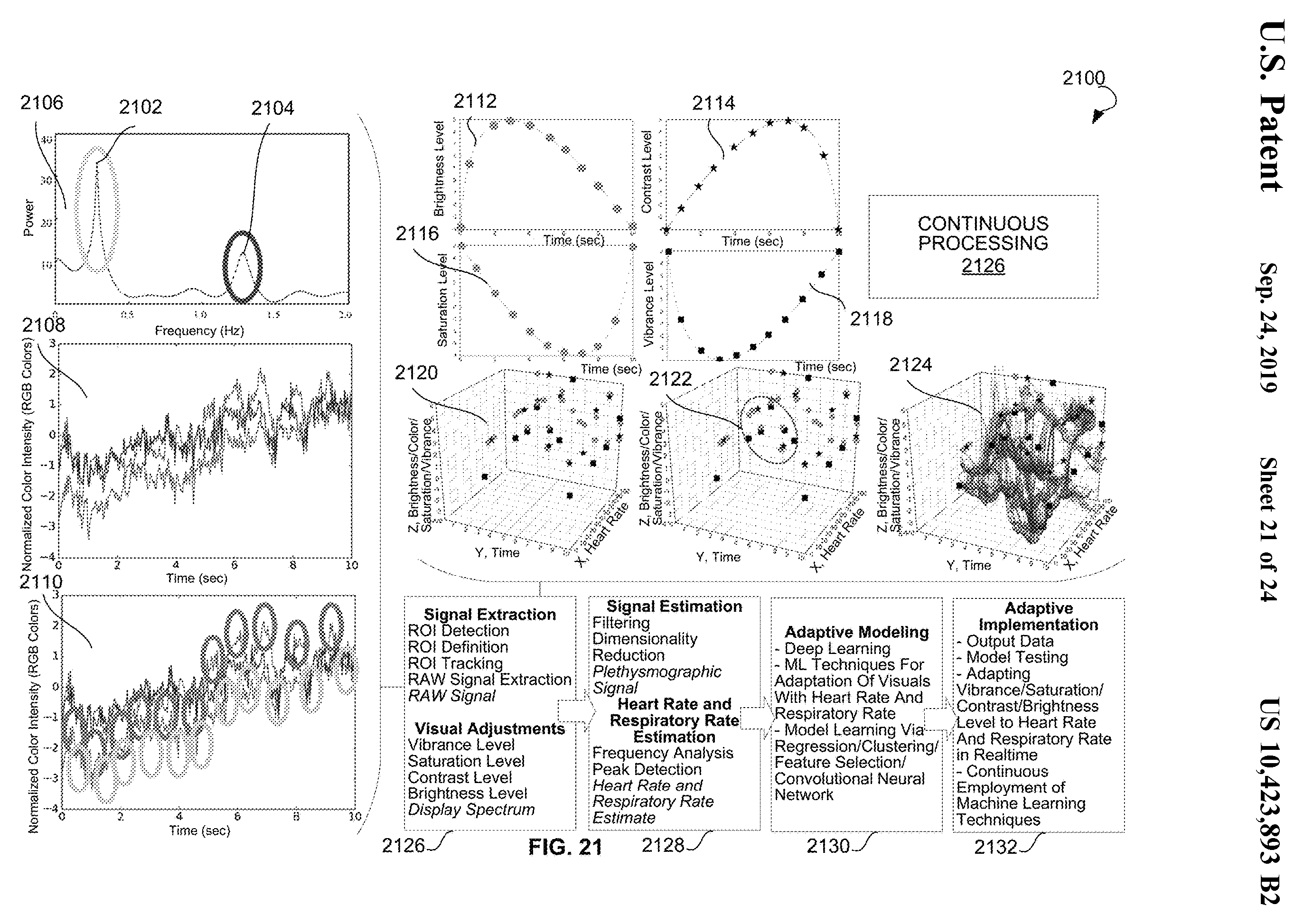
Examples disclosed in US 10,423,893 B2.
The patent describes intended system behaviour and technical scope; disclosure does not show that the described outcomes were demonstrated, clinically validated or effective in a product.
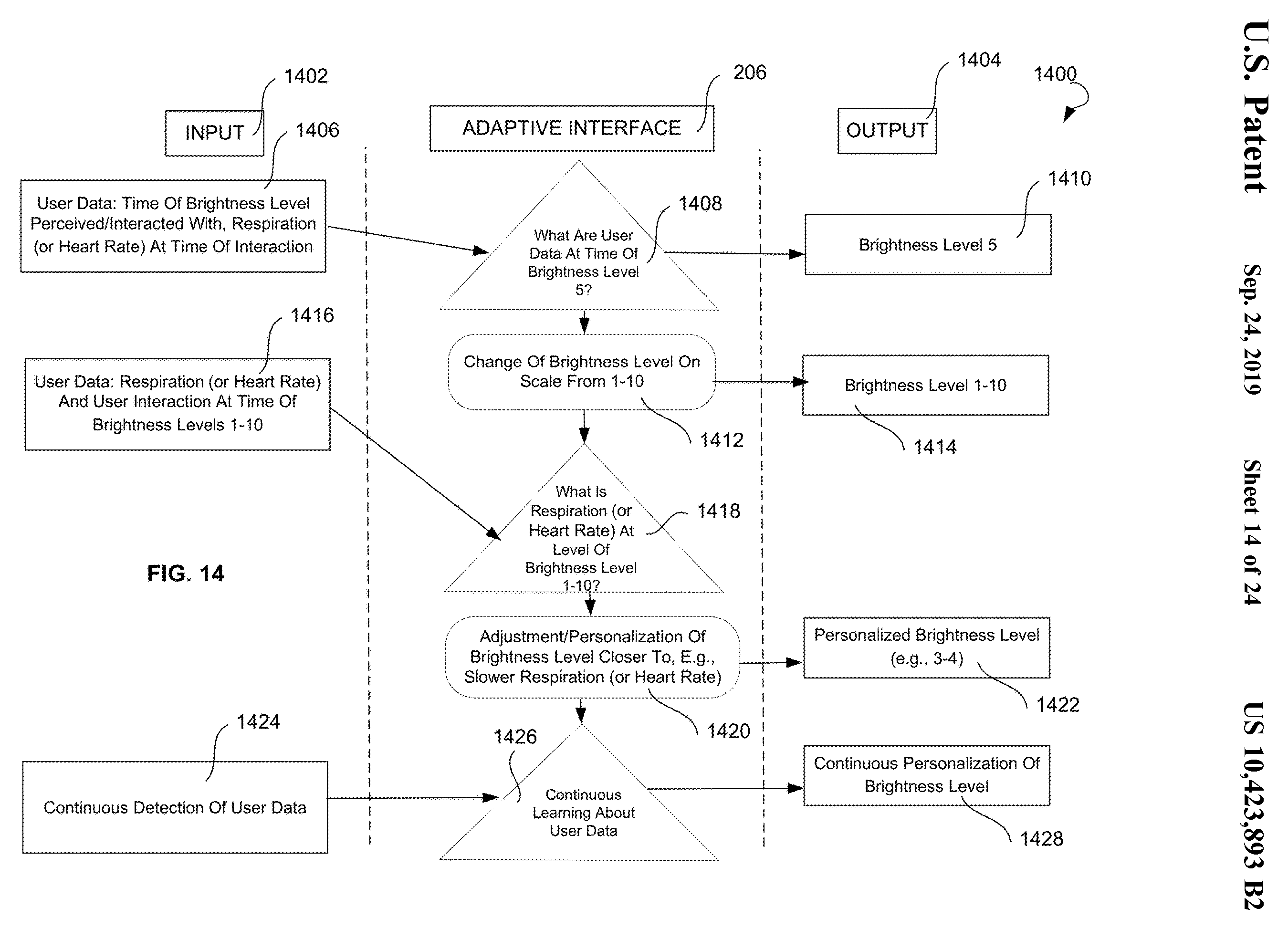
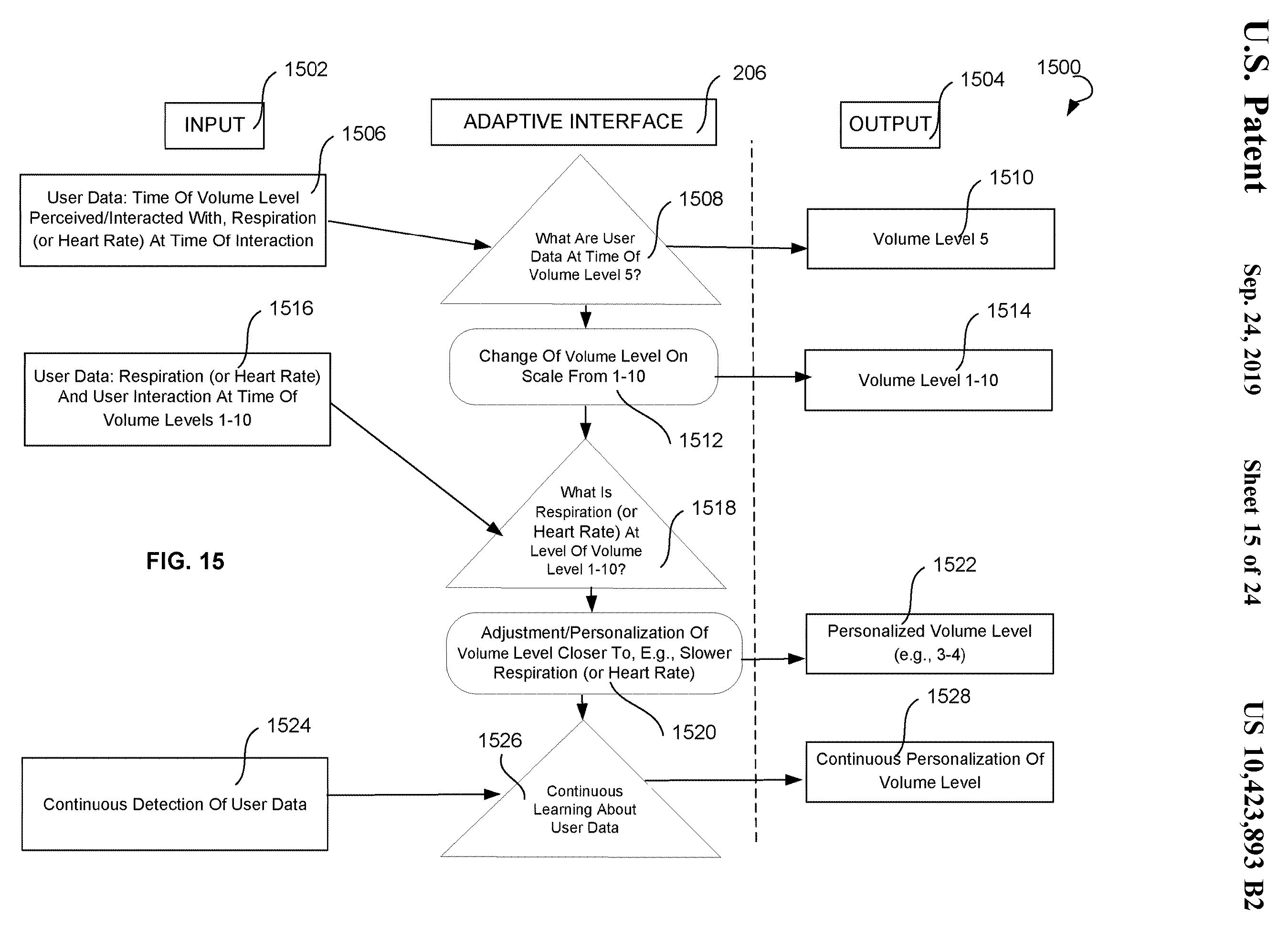
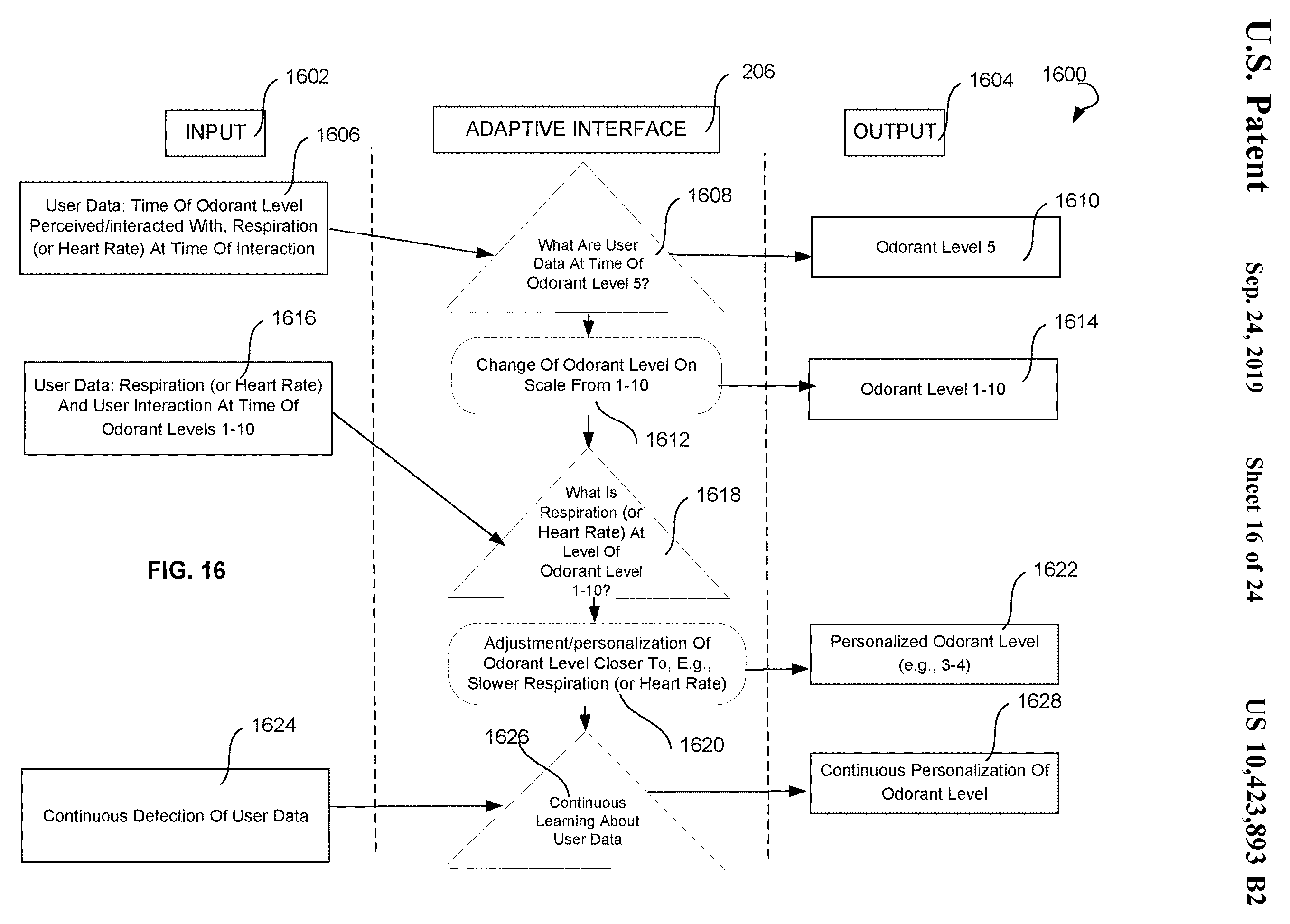
Outputs — Figures 14–16
Brightness, volume and odorant-level personalization
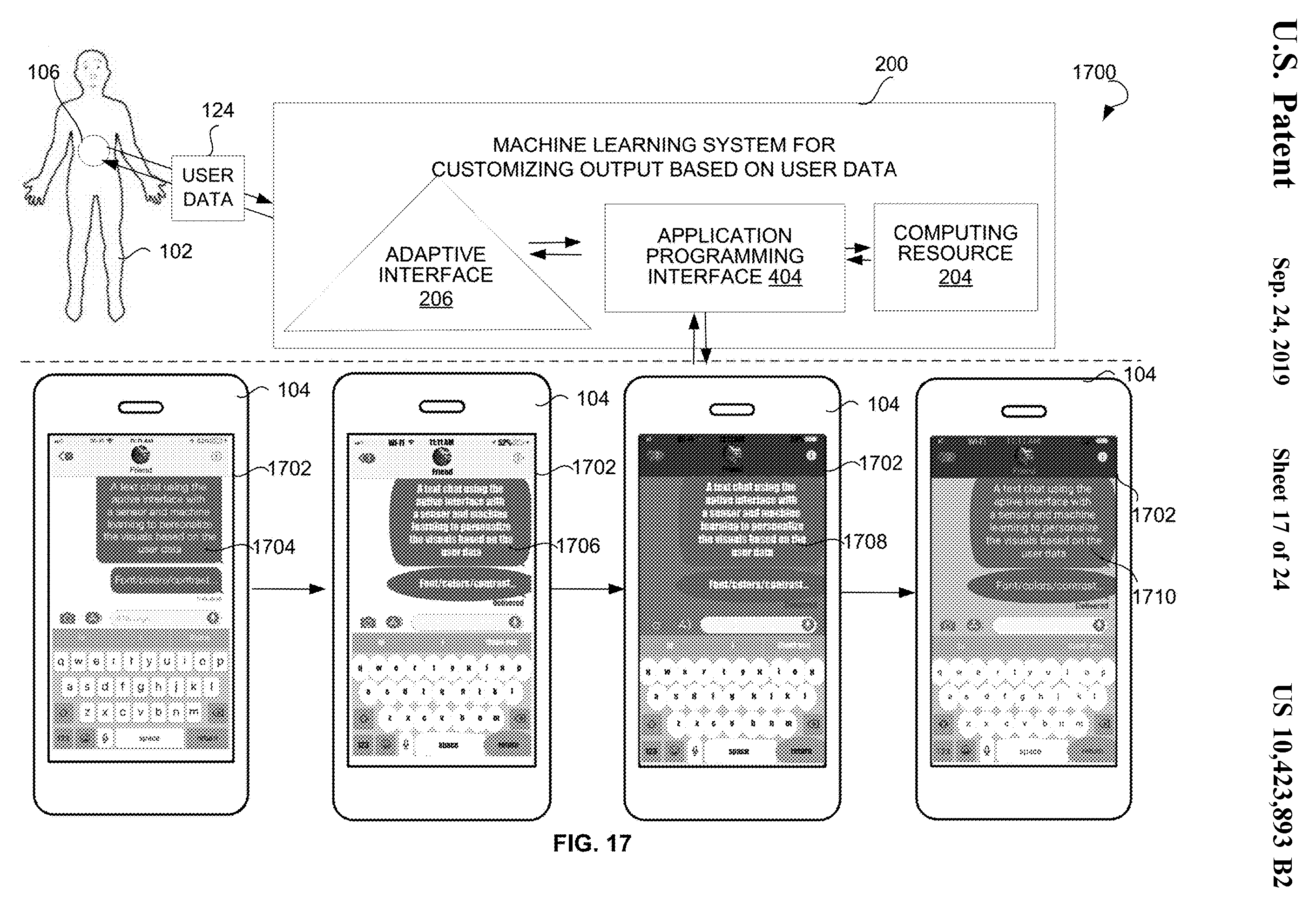
Devices — Figures 17–19
Mobile interface, headphones and artificial olfaction
Loop — Figures 20–22
Camera capture, analysis and continuously adapted output
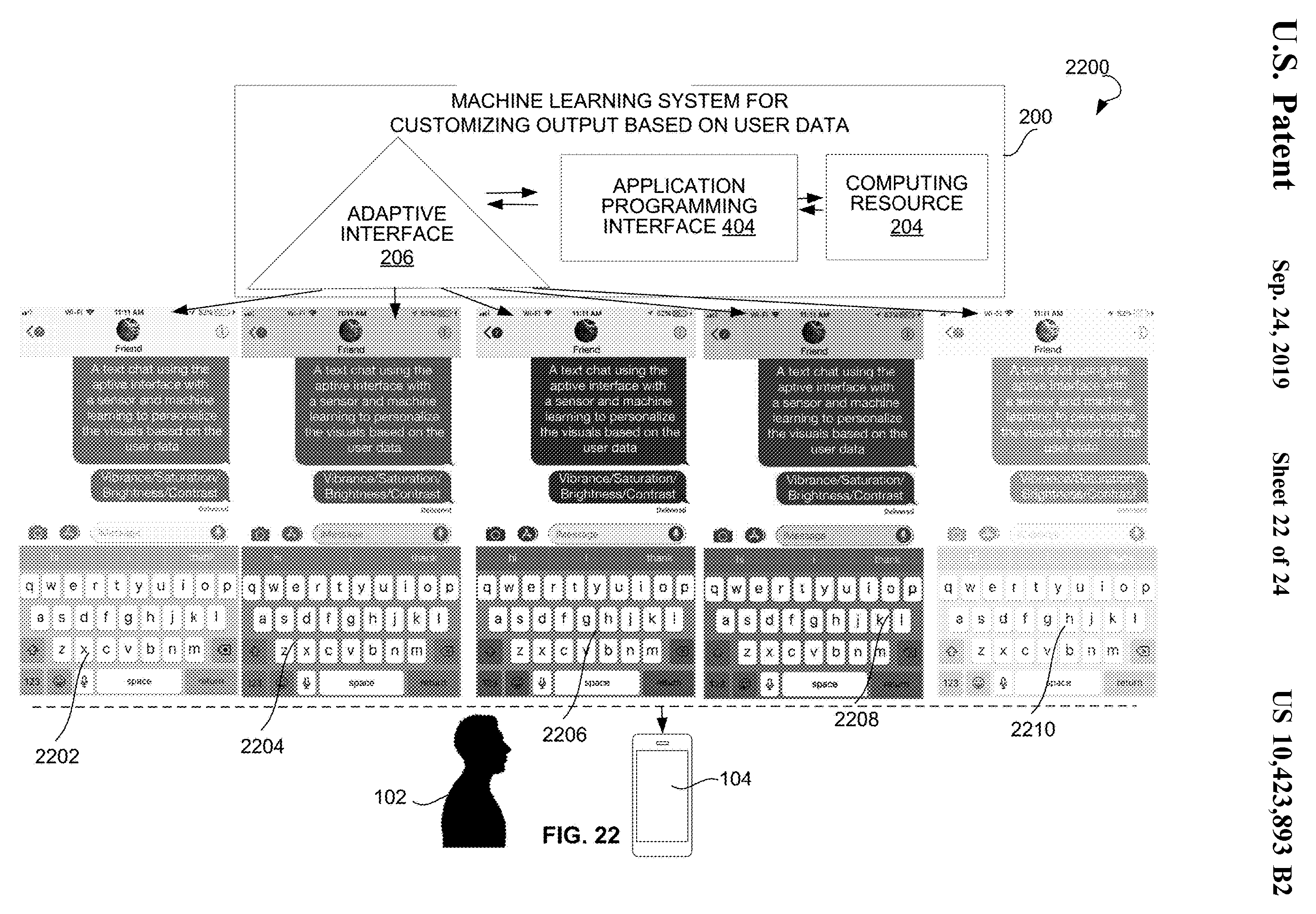
Thumbnails are reduced for page weight. Select any drawing to open the full-resolution plate, where the figure numbers and the US 10,423,893 B2 identifier are legible.
The full record is available at US 10,423,893 B2.
Architecture
How the loop works — and where measurement can fail
A bioadaptive interface should not jump from a signal to a conclusion. It checks signal quality, makes one bounded and reversible change, and asks whether that change should be kept.
Four words are used identically here and in the Application Lab, with the same colours: Signal, Quality check, Response, Feedback.
A pulse-rate estimate is a signal. Stress, focus or emotion are higher-level interpretations requiring separate validation. When confidence is low, the system should pause rather than guess: the gate has two branches, and one of them does nothing.
A measurement problem worth naming
Illumination and feedback
Camera-based estimation depends on the light reaching the skin. Screen-driven illumination changes, mixed or flickering light sources and low light all degrade the recovered signal — and an adapting screen can itself alter the illumination it is measuring under.
Motion
Head movement, speech and posture shifts introduce artefacts that are difficult to separate from the underlying pulse waveform.
Camera pipeline
Compression, auto-exposure, auto-white-balance, frame-rate variability and sensor differences all change what reaches the algorithm. The same person on two devices is not the same input.
Demographic and dataset limits
Published evaluations report performance differences across skin tone and demographic groups, and widely used public datasets are themselves demographically unbalanced. Performance measured on one population does not transfer automatically to another.
- Liu, Wang and Wang (2014) — “The Effect of Light Conditions on Photoplethysmographic Image Acquisition Using a Commercial Camera,” IEEE Journal of Translational Engineering in Health and Medicine 2, 1–11 DOI · Open access
- Nowara, McDuff and Veeraraghavan (CVPRW 2020) — skin tone and gender meta-analysis CVF paper · DOI
- Dasari et al. (npj Digital Medicine 2021) — evaluation of bias in rPPG measurements Nature · Open access
- Bondarenko, Menon and Elgendi (npj Digital Medicine 2025) — demographic bias in public rPPG datasets Nature
Boundary: Higher-level inferences are treated as uncertain and never diagnostic.
See this loop in action in the Application Lab — directly below.
Application Lab
Screen, voice and room — made concrete
Interactive simulation
See one interface learn which response one person keeps.
Signals and outcomes are simulated. The Lab tries one bounded response, shows the next simulated reading and learns from explicit feedback. Nothing is measured from you.
The Lab illustrates the closed loop described in the granted adaptive-interface patent family and developed through the research since 2014. It is an illustration of the loop, not an implementation of the patents.
Ventures
Four ventures from one bioadaptive research trajectory
TransformingAI
Research and commercialization work around adaptive-interface systems.
Breathing AI
Guided breathing, biofeedback and screen-mediated product work.
VitalSign AI
Camera-based physiological signal work and its developer-facing surface.
OptimizingAI
Applied work on interfaces and environments that respond to measured context.
Market opportunity
One adaptive layer across devices, vehicles and rooms.
Biopersonalization is a software-and-IP layer across products that already combine sensors, on-device intelligence and controllable outputs. These adjacent-market figures show platform scale. They are not additive.
Smartphones
$613B
2026 smartphone market value
Wearables
693.2M
wearable devices forecast to ship in 2030
One capability layer
BIOPERSONALIZATION LAYER
Consented signals → uncertainty gate → bounded, reversible adaptation
Connected cars
>500M
connected-car sales forecast cumulatively, 2024–30
Smart homes
$207B
global smart-home market estimate, 2026
The four product arenas above are independent market-scale indicators in different units and periods. They are not added together and are not drawn to a common scale.
- Licensing
- Co-development
- Application R&D
From phones to rooms, the opportunity is consented, uncertainty-aware and reversible adaptation.
Patent position — Hannes Bendfeldt is the named inventor and owner of record of US 10,423,893 and US 11,561,806.
Methodology, sources and market signals
Biopersonalization is not yet a standard market category with a trustworthy standalone TAM. These figures are not a revenue forecast for the patents.
Smartphones
- Figure:
- $613B — 2026 smartphone market value
- Period:
- IDC forecast · Aug 2026
- Publisher and direct source:
- IDC smartphone forecast, August 2026
- Why it is relevant:
- Combines screens, audio, sensors and on-device intelligence at global product scale.
- Limitation:
- The market figure does not measure adoption of bioadaptive functionality. IDC forecasts 2026 smartphone unit shipments to fall 16.7% while market value rises, with average selling price increasing 27.6% to $581 amid the memory shortage. The value figure therefore reflects higher pricing rather than unit growth.
Wearables
- Figure:
- 693.2M — wearable devices forecast to ship in 2030
- Period:
- IDC forecast · Jul 2026
- Publisher and direct source:
- IDC worldwide wearables forecast, July 2026
- Why it is relevant:
- Provides a large surface for consented physiological signals and personal feedback.
- Limitation:
- Wearable shipment volume does not prove that those devices adapt interfaces or environments. IDC periodically updates this market-insights page; 693.2 million was the published forecast on the page's check date and may change when IDC refreshes the page.
Connected cars
- Figure:
- >500M — connected-car sales forecast cumulatively, 2024–30
- Period:
- Counterpoint forecast · Apr 2024
- Publisher and direct source:
- Counterpoint connected-car sales forecast, April 2024
- Why it is relevant:
- Combines sensing with controllable audio, lighting, climate and other cabin outputs.
- Limitation:
- The forecast covers connected cars broadly, not the share using bioadaptive cabins.
Smart homes
- Figure:
- $207B — global smart-home market estimate, 2026
- Period:
- Grand View Research · Jun 2026
- Publisher and direct source:
- Grand View Research smart-homes industry analysis, June 2026
- Why it is relevant:
- Includes controllable room-scale lighting, audio, climate and responsive environments.
- Limitation:
- The market estimate is not a measure of biometric or physiological personalization.
These figures describe adjacent product arenas in different units and periods. They are shown independently and must not be added together.
The IDC smartphone forecast also projects just over one billion smartphone shipments in 2026.
In a 2021 consumer study, McKinsey reported that 71% of respondents expected personalized interactions and 76% were frustrated when they did not receive them. That research concerns personalization generally; it is not evidence of demand for biometric sensing or physiological adaptation. McKinsey — the value of getting personalization right (or wrong) is multiplying.
Commercial paths and diligence
Across these platforms, the product question is how consented signals can support uncertainty-aware, reversible adaptation of screens, audio, lighting and environments. The patents describe architectures for linking sensed data, computational analysis and adaptive outputs. Possible commercial paths include licensing, co-development and application-specific R&D. Market fit, patent status, validity, enforceability and freedom to operate require separate diligence.
Data and source wording checked 30 August 2026. Forecasts and estimates may change.
Evidence ledger
What is disclosed, what is researched, what is validated
The rows below concern US 10,423,893 B2. The patent describes intended system behaviour and technical scope; disclosure does not show that the described outcomes were demonstrated, clinically validated or effective in a product.
| Application | Patent disclosure | Independent evidence | Product validation / safe claim |
|---|---|---|---|
| Screen and typography | US 10,423,893 B2 discloses changes to font, brightness, contrast, colour and screen-interface output. FIGS. 14 and 17 illustrate brightness and screen-interface adaptation. This establishes disclosed technical scope, not demonstrated efficacy. | AdaptiFont found reading-speed gains from individualized font adaptation in a non-biometric study. This supports personalization, not physiology-triggered typography. | No product validation has been supplied for physiology-triggered typography. Individualized and user-controlled readability are supported research directions; biometric triggering remains experimental. |
| Voice and audio | US 10,423,893 B2 discloses changes to volume and other audio characteristics, including pitch, tone, bass and treble. FIGS. 15 and 18 illustrate audio and headphone adaptations. This establishes disclosed technical scope, not demonstrated efficacy. | AdaptiveVoice reports task-specific effects from adapting voice characteristics in a non-biometric study. It does not validate pulse- or breathing-triggered voice adaptation. | No product validation has been supplied for pulse- or breathing-triggered voice delivery. A biometric extension remains experimental; a demonstrated user benefit has not been established. |
| Lighting | US 10,423,893 B2 discusses brightness and illuminance in lux, and FIG. 14 illustrates brightness adaptation. The record does not establish product validation for adaptive room lighting. | The CIE supports integrative lighting recommendations that account for time, context and user needs. This is not validation of physiology-triggered lighting. | No product validation has been supplied for biometric lighting. Current evidence is stronger for adaptation based on time, task, accessibility, explicit preference and user control. |
| Olfactory | US 10,423,893 B2 discloses odorant output and artificial olfaction. FIGS. 16 and 19 illustrate those applications. This establishes disclosed technical scope, not demonstrated efficacy. | Holloman and Crawford review olfactory-display technology, use cases and constraints. Their review does not establish efficacy for a bioadaptive olfactory product. | No product-specific outcome validation has been supplied. Any implementation remains experimental, opt-in, exposure-aware, immediately stoppable and off by default. |
| rPPG pulse estimate | US 10,423,893 B2 depicts image capture, analysis and continuously adapted output in FIGS. 20–22, and its specification discusses pulse and respiration sensing. This establishes disclosed scope, not a universal measurement claim. | Camera-based pulse estimation is supported as a measurement method under constrained conditions. Published studies document sensitivity to motion, lighting, camera pipelines, skin presentation and dataset demographics. Nowara et al. (2020) · Dasari et al. (2021) · Bondarenko et al. (2025) | Validation is device-, lighting-, motion-, compression- and population-specific. No single accuracy figure transfers across settings. No product-level validation package has been supplied for publication on this page. |
| Emotion, discrete stress and blood pressure | US 10,423,893 B2 mentions stress level and blood pressure among possible measurements or inferences. Patent disclosure describes intended system behaviour; it is not evidence of validated emotion, stress or blood-pressure measurement. | Siegel et al. (Open-access copy) and Barrett et al. (Open-access copy) document limits on inferring discrete emotion categories from physiological signals. Their findings come from an overlapping research programme and do not constitute independent convergence from unrelated programmes. Blood-pressure accuracy requires separate product- and population-specific validation. | This work does not claim detection of emotion categories or discrete stress states, and it does not claim blood-pressure measurement. Higher-level inferences are treated as uncertain and non-diagnostic. |
Research and IP
Primary records
A related adaptive-interface patent portfolio originating from 2017 priority work includes two US grants and one Chinese grant. Hannes Bendfeldt is the named inventor and owner of record of US 10,423,893 and US 11,561,806. Prospective transactions should confirm current register status as part of ordinary diligence.
Lineage
It started in the artwork
The sensing and adaptation logic came out of installations and immersive works made with participants in museums and public space, where the body was always the input. See the artwork archive or the chronology.
Definition
Somatic AI, defined after the evidence
Somatic AI names a category of systems whose primary input is the physiological and behavioural state of the human body, and whose primary output is a bounded adaptive response calibrated to that state. Bioadaptive is used here as an adjective: the work adapts screens, audio and environments. The category argument lives on its own page — what is Somatic AI? — alongside the mechanism explainer at bioadaptive interfaces.
Next
Build, license or investigate an application
Advisory and consulting
Design, claim review and technical direction for bioadaptive systems.
Research collaboration
Joint studies on sensing, uncertainty handling and bounded adaptation.
Investment and ventures
Conversations about the venture portfolio and its research base.
Speaking
Keynotes and workshops on adaptive interfaces and honest claims.
Art and exhibitions
Exhibition, commission and collection enquiries for the artwork lineage.