2014–2016 · VR biofeedback · Metaverses, University of Oregon
mYndful
mYndful is a group of immersive biofeedback environments developed within Metaverses, the interdisciplinary project Hannes Bend initiated and led at the University of Oregon. The work grew from visual-stimuli research begun in 2014 into the biofeedback environments that followed. Its development drew on EEG research into responses to visual stimuli in Edward Vogel's laboratory, exploratory fMRI and EEG work on meditation with Michael Posner and collaborators, and electron microscopy at CAMCOR. Heart-rate and breathing signals became material for real-time image, sound and interaction: a way to investigate how a body participates in constructing its environment.
The research was presented at the Association for the Advancement of Artificial Intelligence (AAAI), 2016 Spring Symposium Series — Well-Being Computing: AI Meets Health and Happiness Science, held at Stanford University, where the presentation received a Best Presentation Award.
Role: Visiting scholar in the Benjamín Alemán Laboratory for Quantum and Nanoscale Physics and artist-in-residence with the Institute of Neuroscience, University of Oregon. Hannes initiated and led Metaverses and first-authored the 2016 AAAI proceedings paper; co-authors are credited in the paper record.
University of Oregon · VR biofeedback · First-author AAAI symposium paper, 2016
Paper and posters
Paper · 2016 · 3 pages
Mindful Technologies: Research and Developments in Science and Art
Hannes Bend and co-authors, AAAI Spring Symposium Series, 2016.
Symposium poster · 2016
Mindful Technologies — AAAI Spring Symposium poster
Hannes Bend and co-authors; presented at Stanford University, 2016.
Project poster · 2014–2016
Metaverses — University of Oregon project poster
Metaverses project, University of Oregon, with its collaborators.
Modules poster · 2015–2016
Immersive Mindful Technologies — mYndful VR modules
Hannes Bend, Metaverses, University of Oregon.
The paper and the posters are separate records. Previews are for recognition; open the original to read poster text at its available resolution. Paper record and sources.
Research and development
Four strands fed the environments. In Edward Vogel's laboratory, visual-stimulus EEG research recorded responses to images; the 2016 paper reports 44 participants and more than 30,000 image ratings across the study. Separately, exploratory meditation research combining EEG and within-person fMRI was developed with Michael Posner and collaborators. CAMCOR electron microscopy supplied source imagery (below). The physiological-feedback environments then used heart-rate and breathing signals — not EEG in every module. The programme included two IRB-approved studies. This research was exploratory: it informed the artwork and does not demonstrate a clinical or therapeutic outcome.
From CAMCOR microscopy to Nanoscape
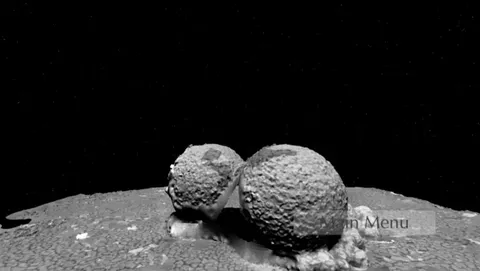
At CAMCOR — the Center for Advanced Materials Characterization in Oregon — electron microscopes produced images of structures far below the scale of vision. In Nanoscape, those source images were rendered at human scale as an interior landscape a participant could move through, with physiological feedback shaping the environment.
The biofeedback environments
Each environment follows the same loop: a physiological input — respiration, pulse or heart-rate variability — is mapped through custom parameters to changes in image and/or sound, and the participant encounters that feedback while continuing to breathe and respond. The paper discusses EEG as a possible neurofeedback extension; it did not drive every deployed module, and the software did not diagnose emotions.
Presentations
Event types are listed as recorded: a conference talk is not described as a live VR demonstration, and an institutional appearance is not described as an exhibition.
- 2015 · Conference presentation and critique programme — Metaverses/Seecular at the a2ru GroundWorks National Conference, Virginia Tech, including the transdisciplinary critique session. Official programme (PDF)
- 2015 · Conference presentation — Toward a Science of Consciousness, Helsinki — the earlier visual-stimuli art–science research.
- 2015 · Research presentation — Society for Literature, Science and the Arts (SLSA), Rice University.
- 2016 · Proceedings paper, presentation and award — AAAI Spring Symposium on Well-Being Computing, hosted at Stanford University: first-authored paper “Mindful Technologies: Research and Developments in Science and Art”, presentation and Best Presentation Award; attendees also tried the VR. Paper (PDF)
- 2016 · Conference presentation — “Metaverses/Myndful,” UCSB Interdisciplinary Humanities Center conference. Conference page
- 2016 · Conference presentation — The Science of Consciousness, Tucson — VR meditation environments and physiological feedback.
- 2016 · Institutional appearance — Bell Labs, New Jersey, in the context of Experiments in Art and Technology.
- 2016 · Public demonstration — Jamaica Flux, Queens, New York.
- 2016 · Public demonstration — Further Future 002, Mojave Desert.
- 2017 · Group exhibition — Disarming Geometries, Dorsky Gallery Curatorial Programs, Long Island City, curated by Gabriel de Guzman — mYndful shown with the painting mUltiverseS. Gallery brochure (PDF)
Further records are on the Metaverses research page and in the essay True Art Is Always Pioneering.
What followed
The same loop — sensing a physiological state and adapting an environment to it — continued, with different collaborators and contexts, in Biofields, SEAing Breath and AWERE; in the proposed shared space of FORMLITH; and later in adaptive-interface research and patents.
- Date
- 2014–2016 (visual-stimuli research from 2014; biofeedback environments 2015–2016)
- Medium
- Virtual reality, heart-rate and breath biofeedback, sonification
- Status
- Exhibited and presented as research demonstration
- Developed within
- Metaverses, University of Oregon (2014–2016)
- Hannes Bend's role
- Visiting scholar in the Benjamín Alemán Laboratory for Quantum and Nanoscale Physics and artist-in-residence with the Institute of Neuroscience, University of Oregon.
- Presented
- AAAI 2016 Spring Symposium (Well-Being Computing), Stanford University · UCSB Interdisciplinary Humanities Center, 2016 · Jamaica Flux, Queens, 2016 · Further Future 002, Mojave Desert, 2016 · Disarming Geometries, Dorsky Gallery Curatorial Programs, 2017
- Credits
- Hannes Bend, with collaborators at the Alemán Quantum and Nanoscale Physics Lab and the Institute of Neuroscience, University of Oregon; paper authors: Hannes Bend, Shawn Slater, Benjamin Knapp, Nuo Ma, Robert Alexander, Bella Shah and Ryan Jayne
Sources
- Mindful Technologies: Research and Developments in Science and Art — full paper (PDF)
- Mindful Technologies: Research and Developments in Science and Art — AAAI 2016
- Publisher PDF — AAAI
- DBLP record — Bend et al., AAAI Spring Symposium 2016
- mYndful — walkthrough, 3:00 (YouTube)
- mYndful — VR program demonstration, 1:07 (YouTube)
Related
- True Art Is Always Pioneering (essay)
- Metaverses / Seecular — University of Oregon
- Mindful Technologies, AAAI 2016
- SEAing Breath, 2017–2018
- Adaptive interface patents