
Virtual Realizations · 2013 / 2026
Walking on VateR
What happens when real water, recorded water and water generated by artificial intelligence occupy the same perceptual space?
Walking on VateR began in 2013 under the working title Water Walk. The original proposal imagined a modular, walkable floor built from sealed, water-filled plastic cells: a surface that could be crossed, but never crossed twice in the same state. Each visitor's weight displaces real water inside the cells, so the ground continuously deforms under the people standing on it. The work was never built.
The 2026 realization extends that floor into the whole architecture. Documentary films of oceans, lakes, rivers, rain and reservoirs move slowly across the walls and the ceiling. Beside them, water generated by artificial intelligence appears. Some of the generated water is physically credible and would pass unremarked in any nature documentary. Other passages contain almost imperceptibly impossible currents, gravity, reflections, scales or wave structures — a river that gathers speed as it flattens, a reflection that answers a source not present in the frame, a swell whose size never resolves.
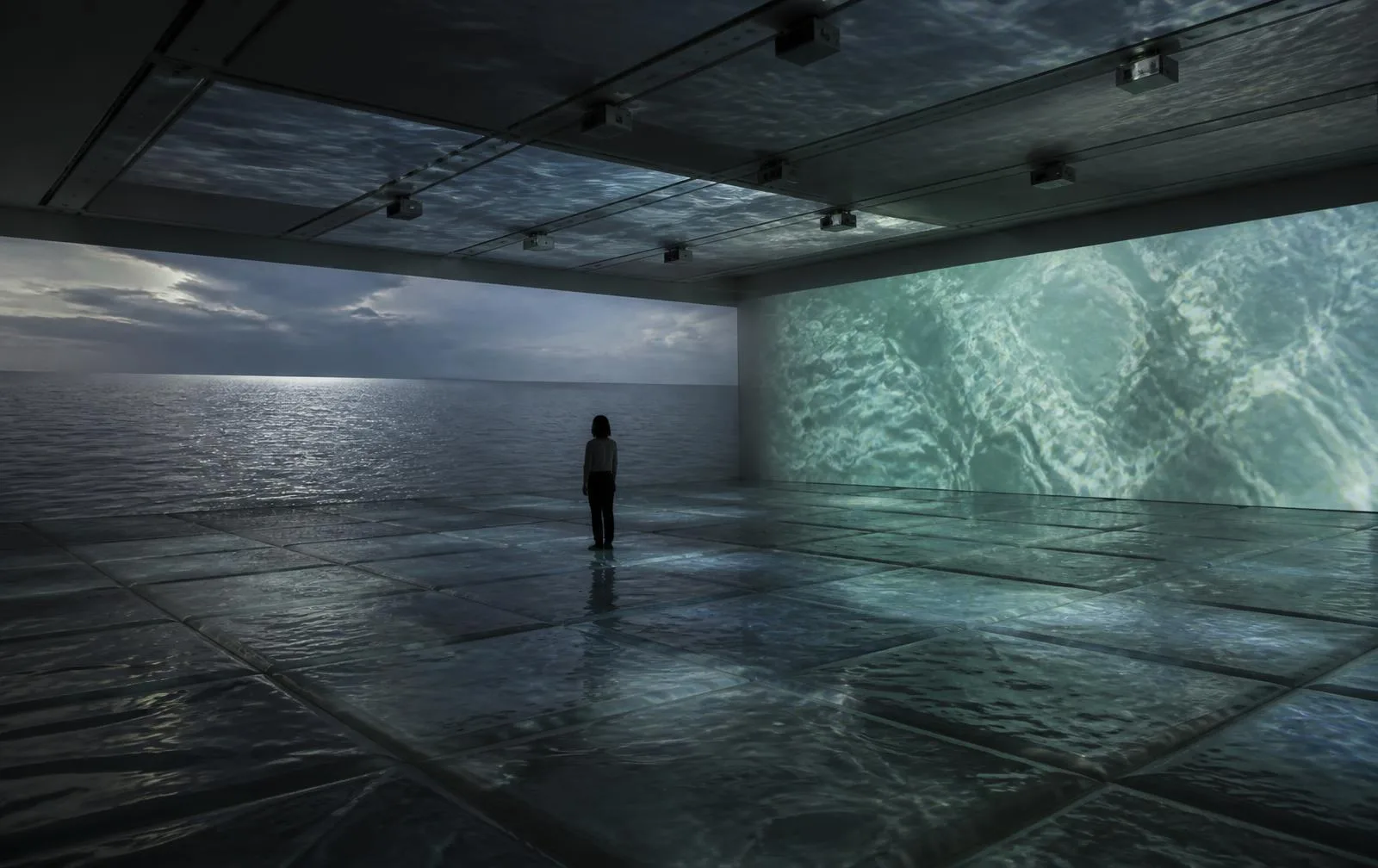
The work does not label which water is recorded and which is synthetic. There is no wall text separating the two, no key, no moment of disclosure. The moving imagery reflects down onto the actual water contained beneath the visitors' feet, and physical movement across the floor distorts both the real reflections and the projected images. Floor, walls and ceiling become one continuous but unreliable water environment.
Virtual reality here is distributed through architecture rather than isolated inside a headset. The visitor is not sealed into a private simulation; they remain physically present, aware of the temperature of the room, of the give of the surface underfoot, and of the other bodies whose steps are altering parts of the floor they cannot see. The image environment is shared, and it is jointly disturbed.
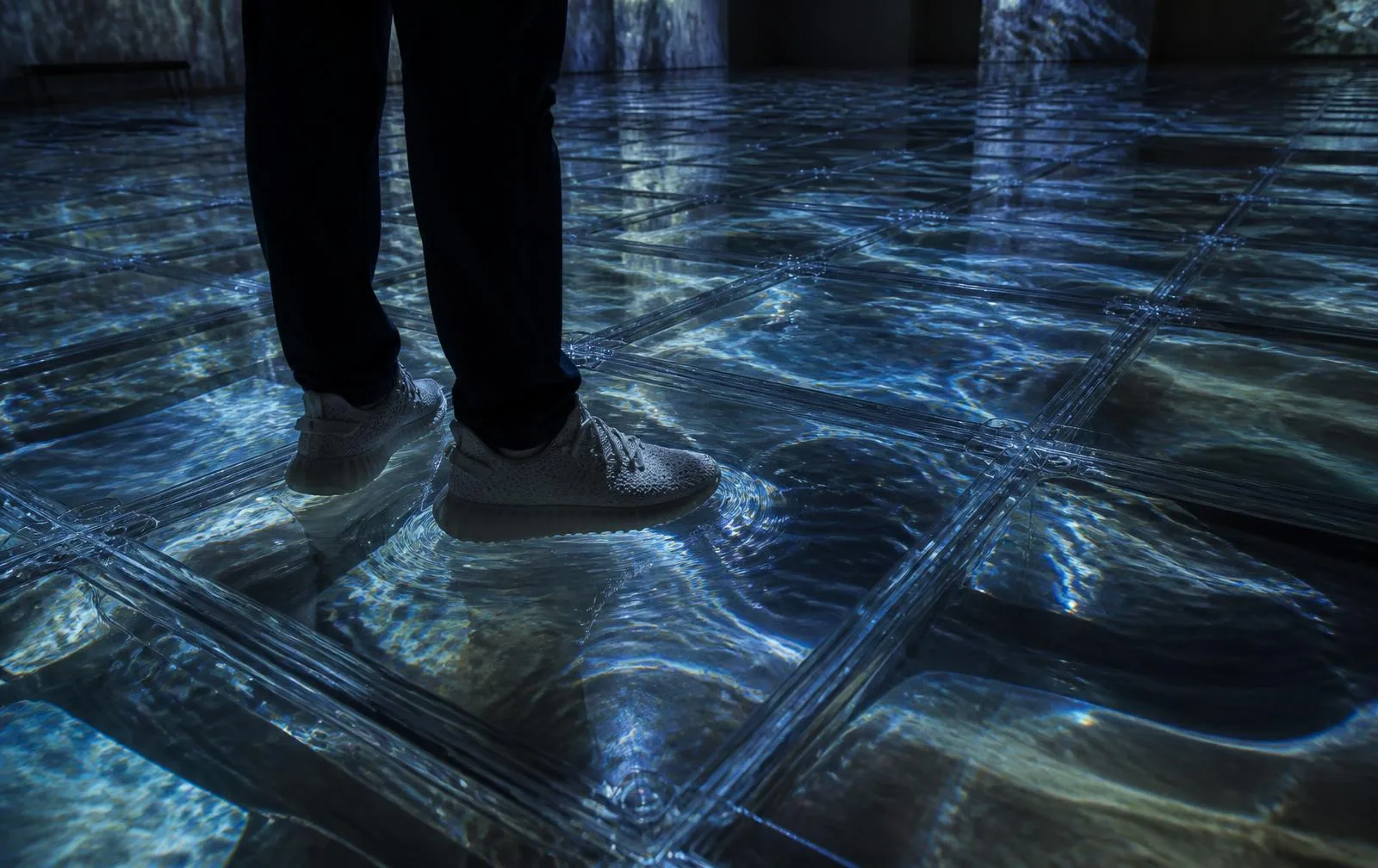
The installation asks when an image of nature becomes indistinguishable from a fabricated one — and, more uncomfortably, how synthetic images reshape the perception of actual ecological environments. Once a generated ocean is as legible as a recorded one, the recorded one is no longer received as evidence. It is received as another image among images, and the water underfoot becomes the only part of the room that cannot be authored.
That asymmetry is the material argument of the work. The projections can claim anything; the cells cannot. They hold a finite quantity of water that responds only to weight, temperature and time. Standing between the two, the visitor is asked to notice which of the two they trust, and how quickly that trust migrates toward the brighter surface.
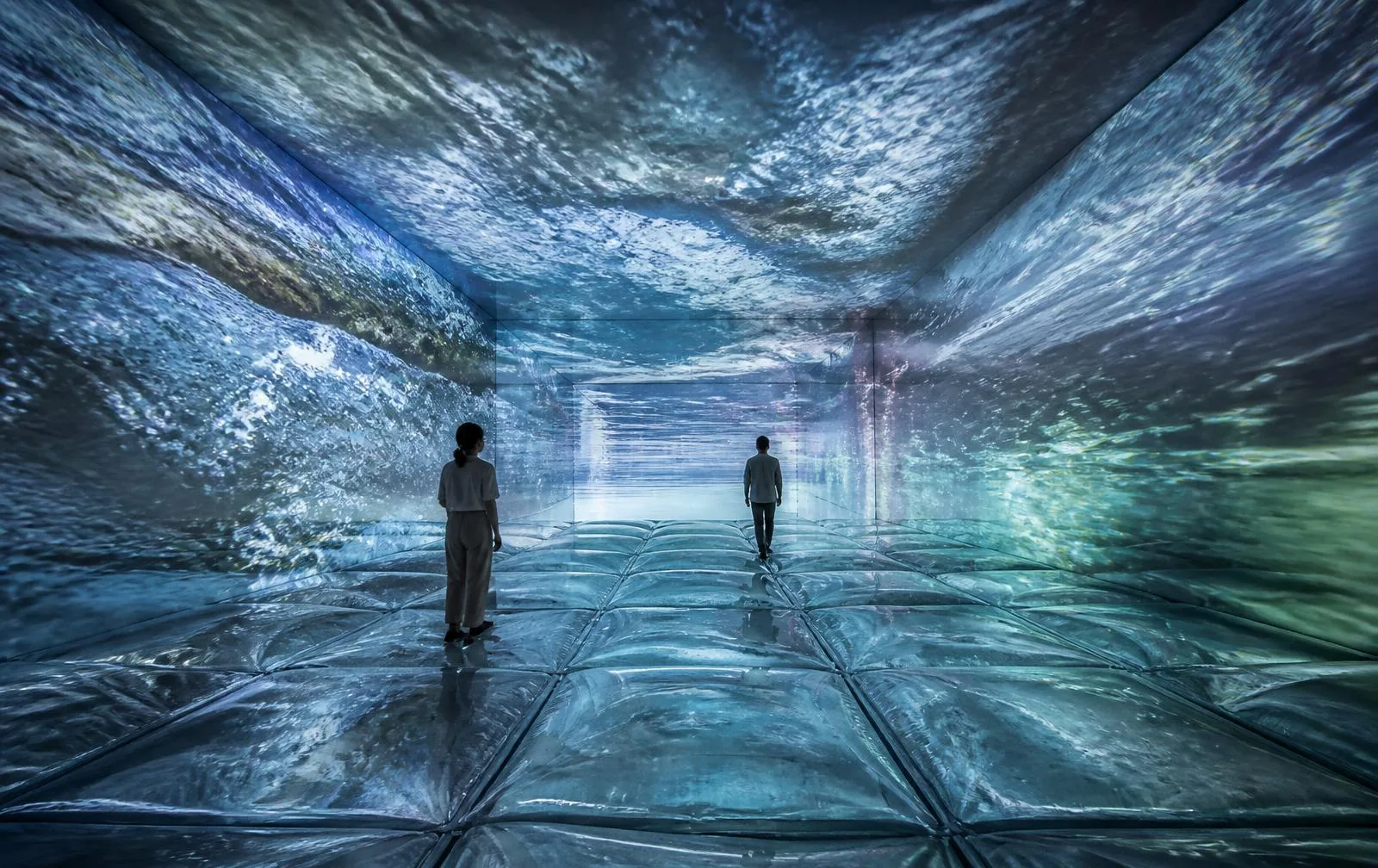
Virtual realization, 2026
Walking on VateR remains unrealized as a physical installation. The moving-image study below was generated in 2026 to communicate the spatial logic of the proposal: the modular floor, the wrap of documentary and generated water across walls and ceiling, and the way bodies moving through the room disturb the image on both sides of the surface.
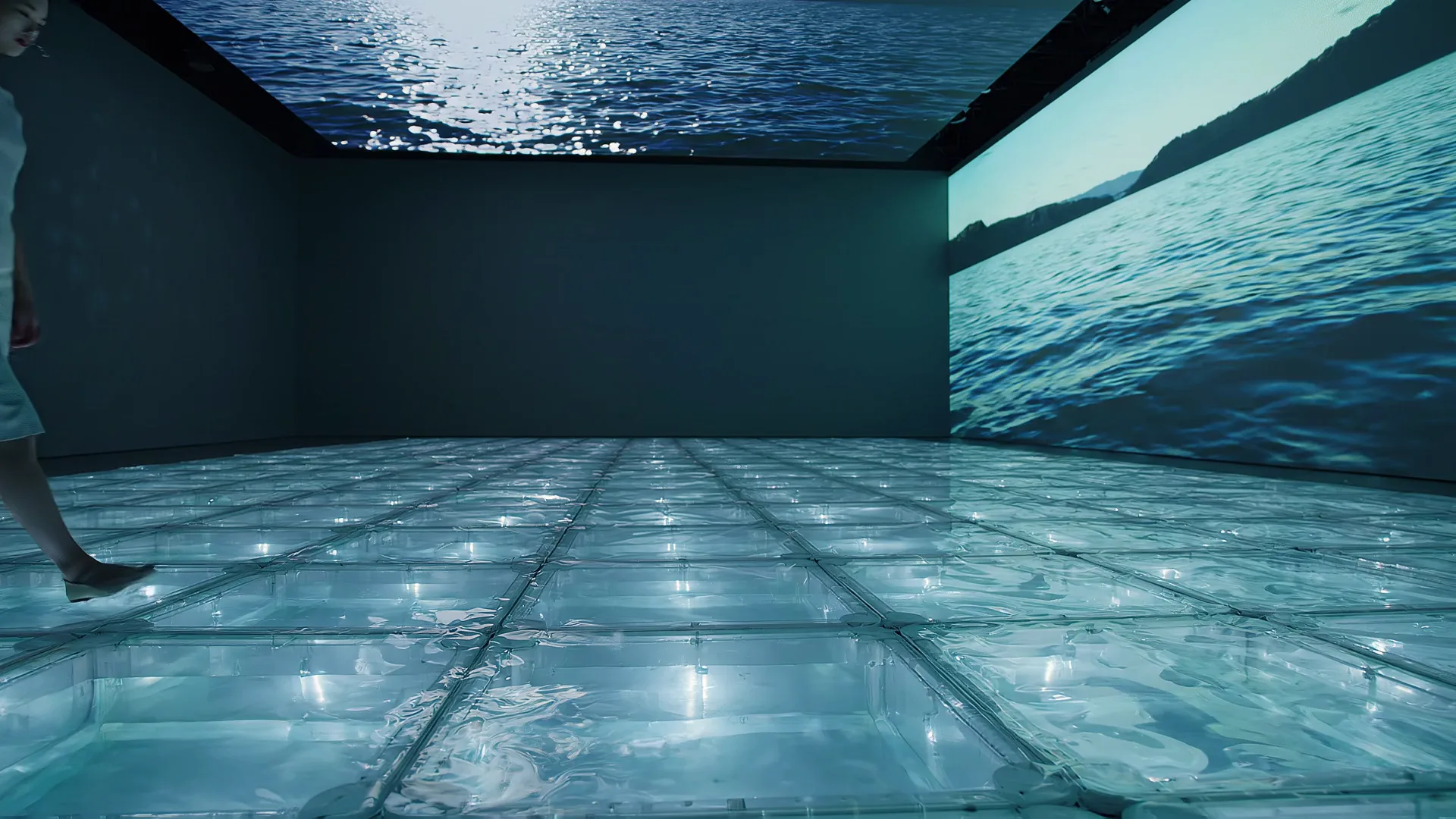
Walking on VateR becomes a temporary world in which water is material, recorded, reflected and generated—and no longer fully separable into any one of them.
- Concept
- 2013
- Visualization
- 2026
- Status
- Virtual realization of an unrealized immersive installation concept
- Medium
- AI-generated image and video; proposed modular water-filled floor, moving image, projection, light, reflection and sound
- Former working title
- Water Walk
- Collection
- Virtual Realizations
Virtual realization · Original concept 2013 · Digitally visualized 2026 · Unrealized installation