Hannes Bend's art spans over two decades: works exploring conscious perception from the early-2000s, public and sculptural work in Berlin and New York, moving-image and installation projects from 2008 onward, and — from 2014 — XR biofeedback and immersive environments driven by the visitor's own breathing and pulse. Works have been presented at institutions including the Bronx Museum of the Arts, Pérez Art Museum Miami, The Rubin Museum of Art and the Phillip and Patricia Frost Museum of Science.
Curated entry point
Selected Works
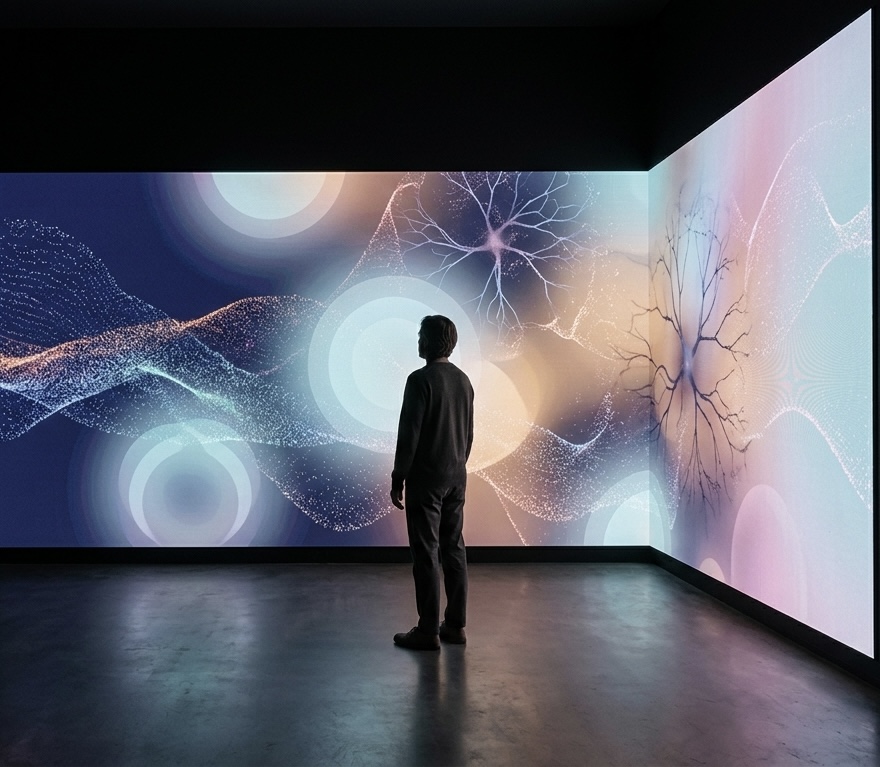
Humans become heat patterns. Breathing becomes pixel-patterns. Patterns become personal reality.
Across installation, thermal imaging, immersive media, environmental projects, and embodied interfaces, the work explores the limits and extensions of human sensing. These projects ask how technologies alter perception, how bodies become interfaces, and how reality is translated through instruments, symbols, and systems.
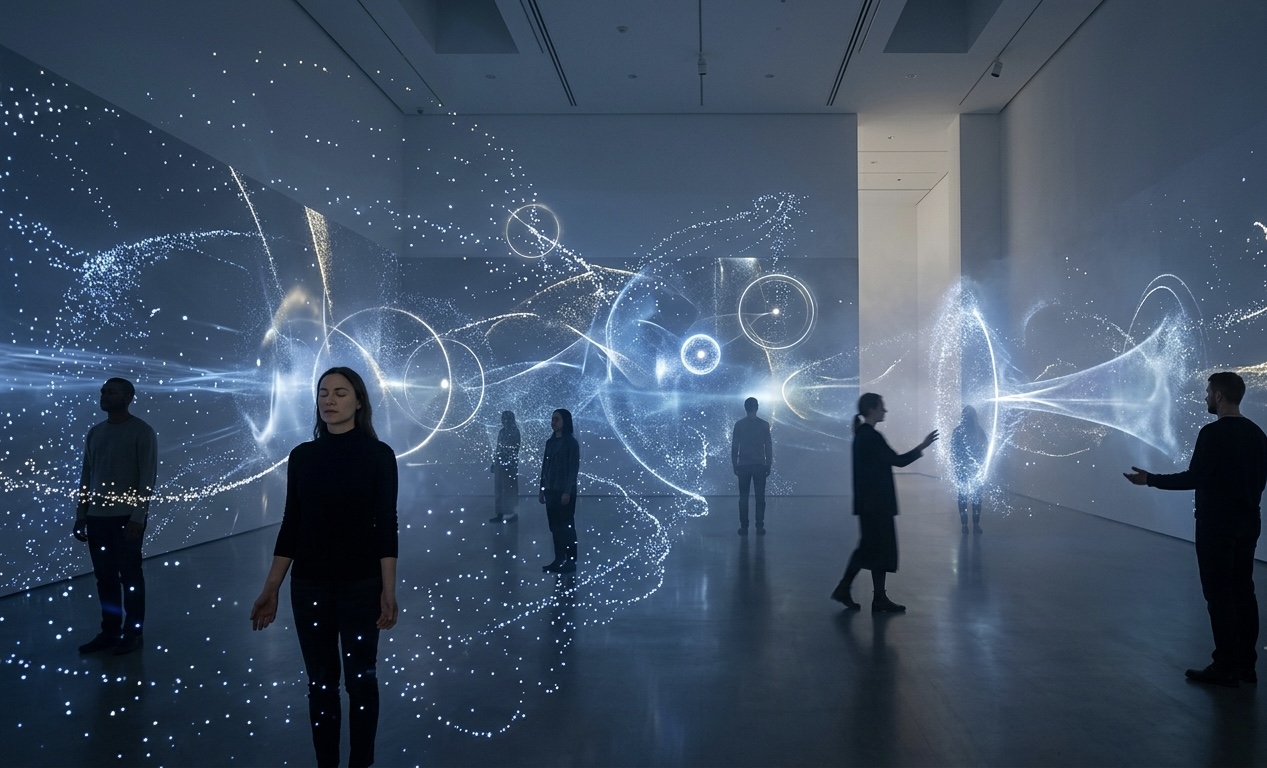
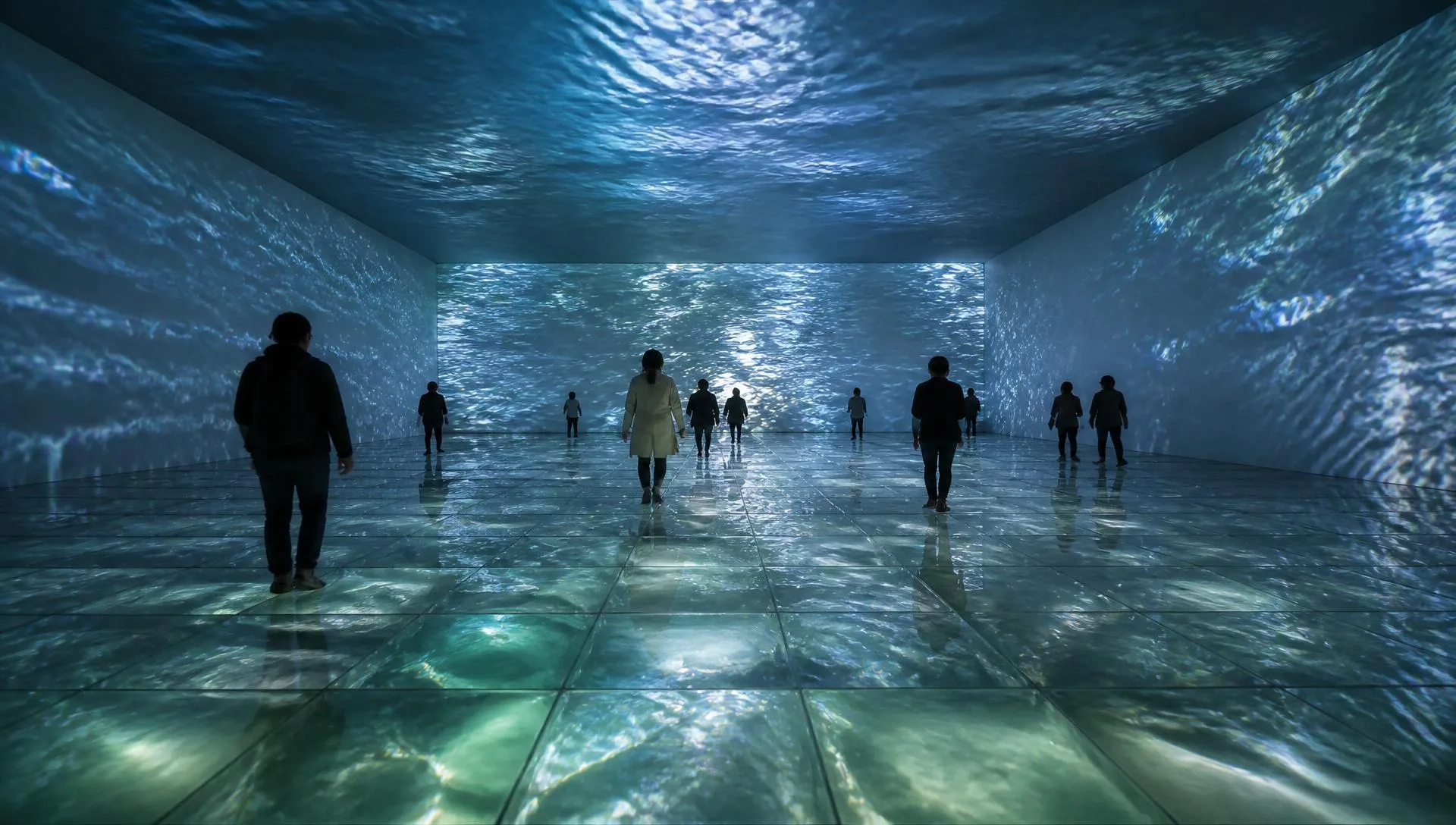
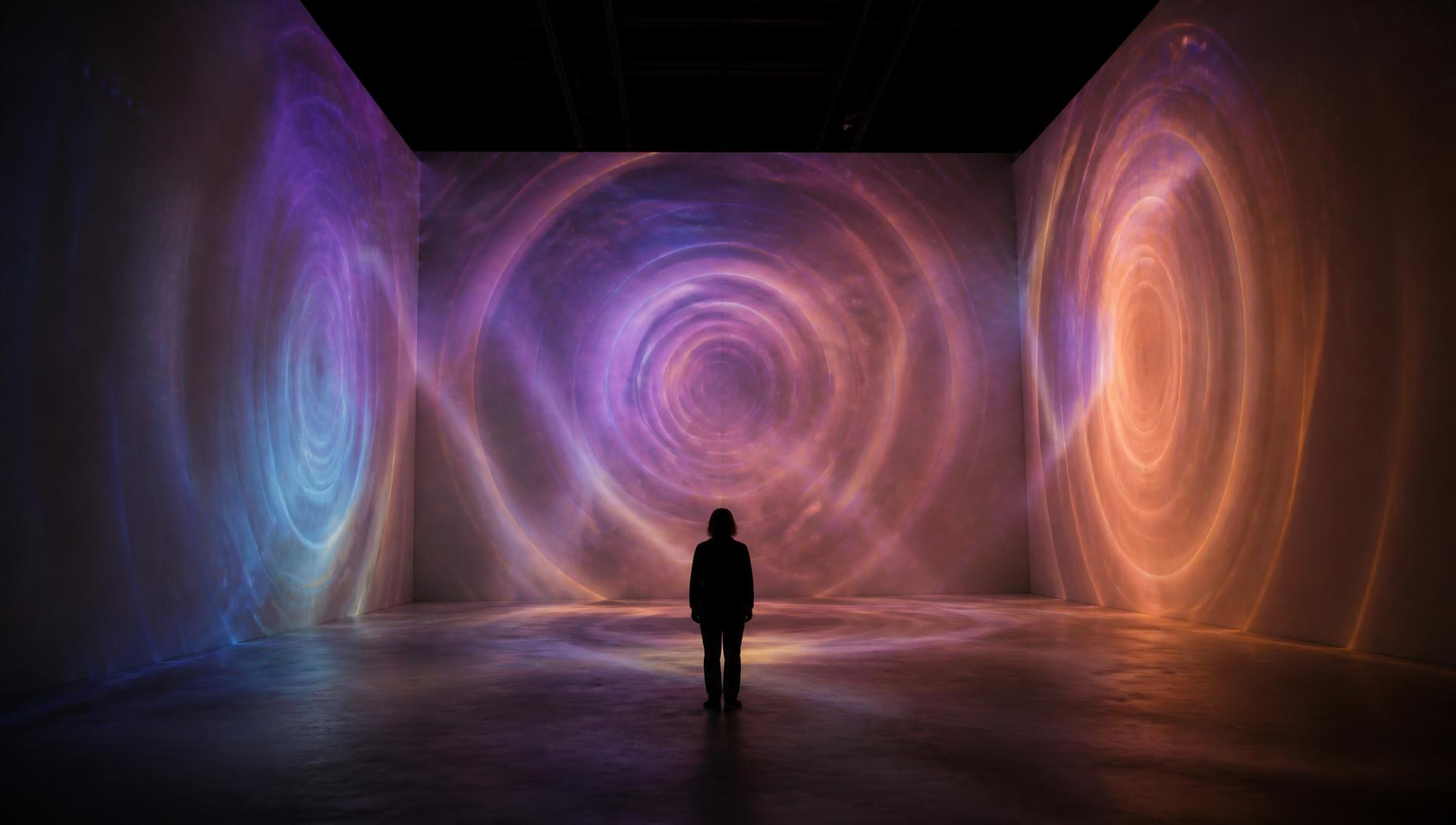
A continuous line of immersive proposals developed between 2013 and 2020 that were never built. Each was documented at the time — in applications, reviews and studio material — and each is realized here in 2026 as a set of visualizations rather than as installation documentation. Read together they form one research arc: the body as sensor, the room as instrument, presence as the material.
Metaverses project poster, 2014–2016 — Third Culture Projects of the University of Oregon and the Oregon Arts Commission; process and development of mYndful VR relaxation and Seecular visualization program.
From 2014 to 2016, Hannes Bend developed Metaverses / mYndful through interdisciplinary work connected to the Alemán Quantum and Nanoscale Physics Lab and the Institute of Neuroscience at the University of Oregon. These projects combined visual stimuli, meditation, VR, biofeedback, and physiological sensing — forming a bridge between contemporary art, humanities-based questions about perception, and later Somatic AI.
The work explored how external stimuli and internal physiological states influence perception, emotion, attention, and embodied experience, and whether digital environments could become responsive to human state rather than merely extractive of human attention. It led into VR heart-rate biofeedback experiments, research presentations, and bio-adaptive interface prototypes that anchor the later AI ventures.
· Alemán Quantum and Nanoscale Physics Lab, University of Oregon
· Institute of Neuroscience, University of Oregon
· Visual stimuli and brain states; meditation and biofeedback
· Foundation for later bio-adaptive and Somatic AI work
2015 — Metaverses/Seecular, a2ru GroundWorks National Conference, Virginia Tech
Presented on 10 November 2015 in a parallel critique session — “Exploring Peer Review for Transdisciplinary Work” — at the Cube, Moss Arts Center, as one of the conference’s six transdisciplinary exemplars. The official programme publishes a project text describing Metaverses/Seecular as a University of Oregon art/science project connecting physics, psychology, neuroscience, computer science and philosophy.
Patent filing describing systems and methods for continuously personalizing visual, audio, and olfactory output based on a user's biodata using machine learning. Signal extraction (ROI detection, raw signal), estimation (filtering, plethysmographic signal, heart-rate and respiratory-rate estimation), adaptive modeling (deep learning, CNN, regression / clustering), and adaptive implementation (real-time vibrance, saturation, contrast, brightness, display spectrum).
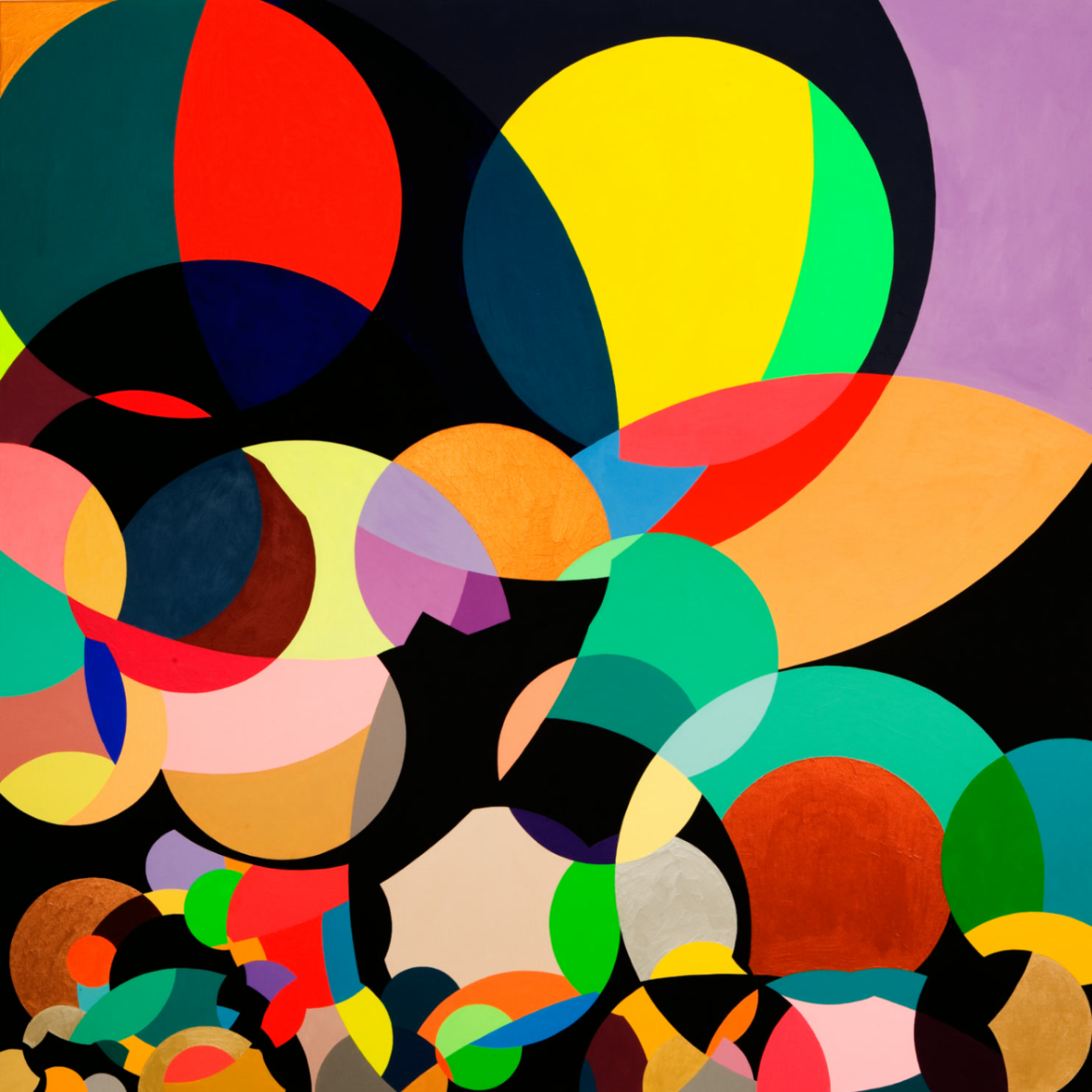
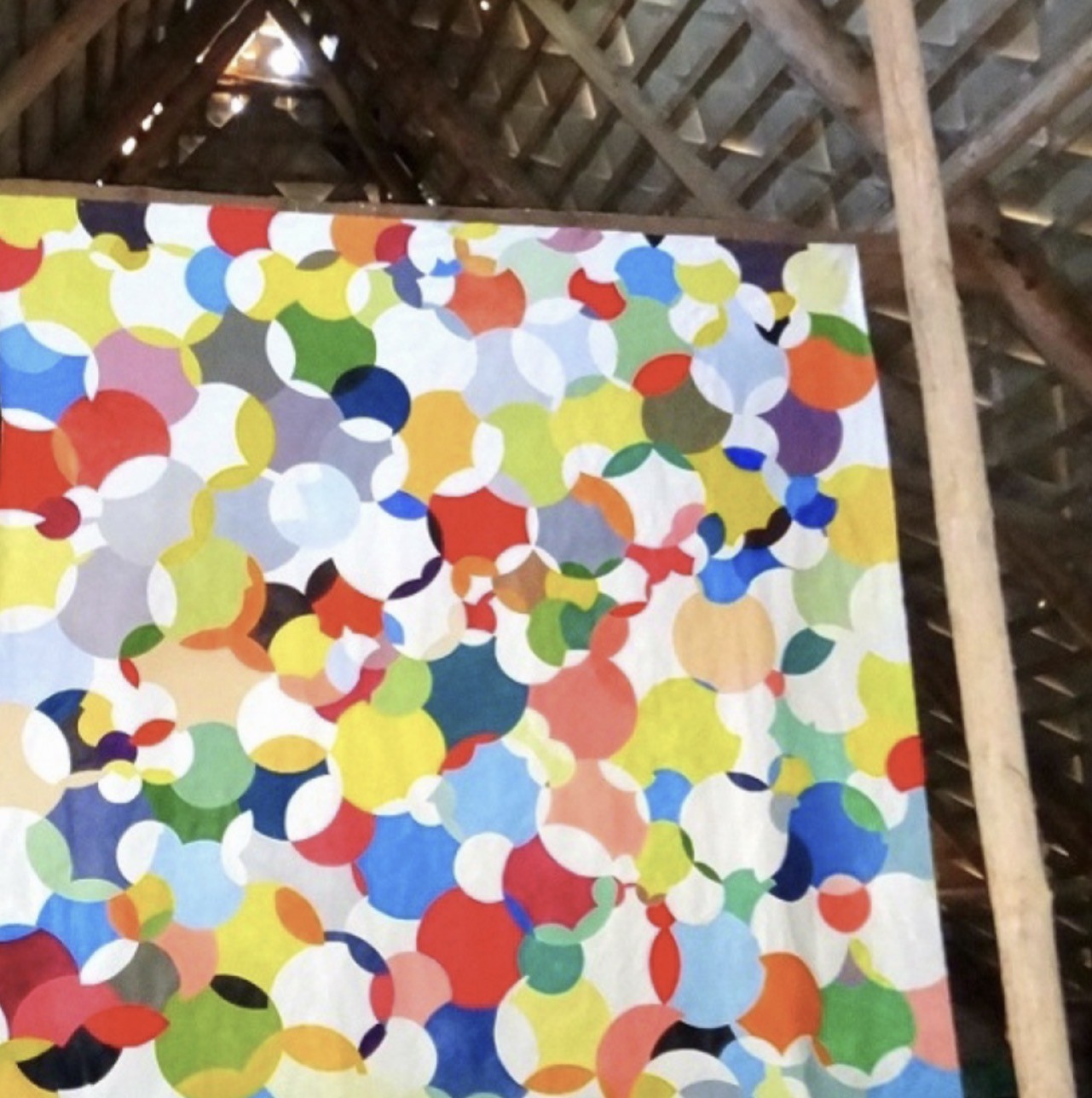
Started in 2003, the CircUlaR Series examines the instability between what is materially present and what is perceptually completed. The paintings never contain a fully closed circle. Instead, fragments, arcs, and partial geometries produce the condition in which the viewer mentally constructs circularity.
The circle appears, but it is not fully there.
The work stages perception as an active event. Vision becomes less a record of reality than a process of inference, projection, recognition, and symbolic completion. The viewer encounters not only painted forms, but the mind's own tendency to organize fragments into signs.
Non-repetitive color structures suggest abundance, frequency, variation, and the irreducible plurality of perception. Within the constraint of circular fragments, color refuses repetition: order and excess coexist, geometry becomes unstable, and abstraction becomes a way of asking how reality is modeled.
The series anticipates questions central to computational culture and artificial intelligence: how patterns are recognized, how data becomes meaning, how labels stand in for reality, and how symbolic systems allow humans and machines to navigate a world that always exceeds its representations.
The capitalization CircUlaR — C, U, R — suggests the relation between seeing, sensing, and being. The viewer completes the work perceptually.
2007–2018 · CandY Sculptures
CandY Sculptures
Link copied
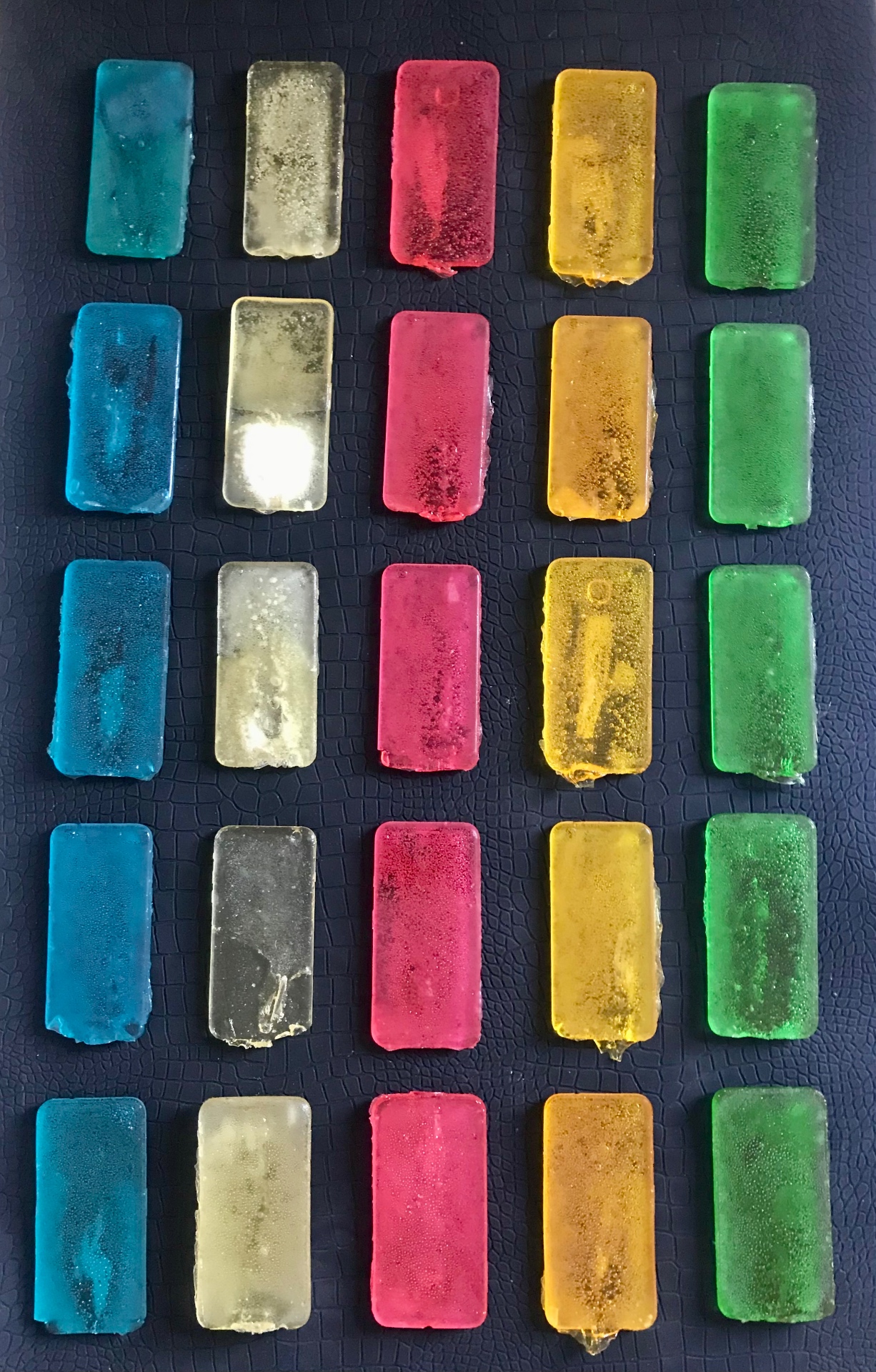
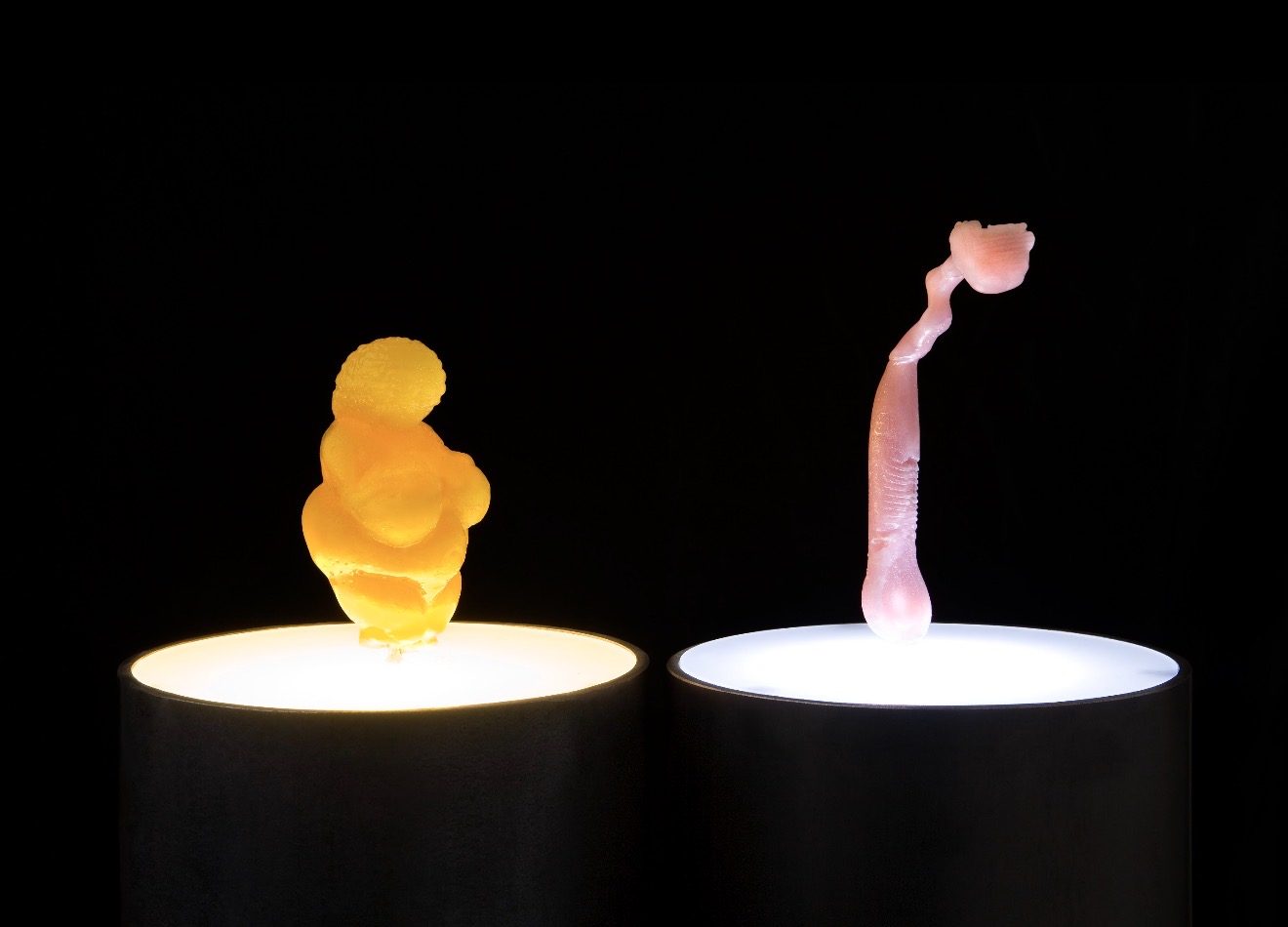
The CandY Sculptures translate emblematic and symbolic forms into cast objects made from hard candy and sugar-based material. Their surfaces are seductive, translucent, and jewel-like, yet the material remains unstable, fragile, and dependent on its environment.
The works create a contradiction between image and substance. Forms associated with tradition, memory, value, or permanence are remade in a material that can soften, decay, melt, or collapse without proper preservation.
Because the sculptures require climate-controlled conditions to survive, they also reveal the hidden infrastructures that sustain art itself. Just as sugar depends on a controlled atmosphere to remain intact, artworks depend on cultural, institutional, and perceptual frameworks in order to be preserved, interpreted, and accepted as art.
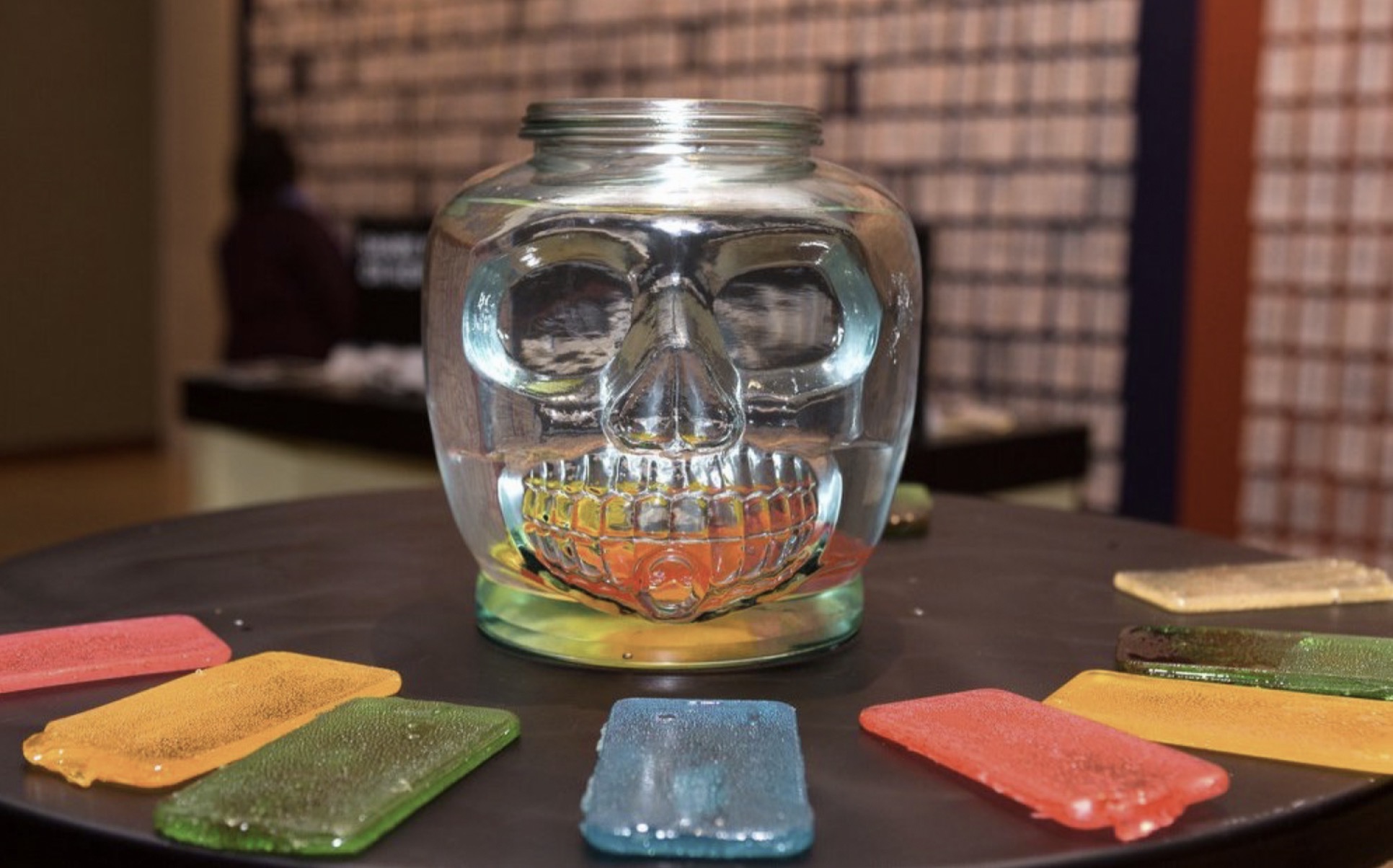
Candy-cast mobile phones submerged in water, allowed to dissolve in real time. The title converts "purification" into "appification," drawing attention to the technological systems through which attention, communication, identity, and even contemplative practice are increasingly mediated. Presented within Smile of Breath at The Rubin Museum of Art, with physician Dr. Payel Gupta.
A candy-cast plastic bottle is staged inside the branded vessel of "pure" spring water. The work folds spiritual liberation, consumer language, plastic containment, sweetness, and dissolution into a deliberately unstable image — nirvana as release from attachment meeting its commercial transformation into a consumable identity.
Video, 1:33 min · Candy cast of a plastic bottle, water, and Nirvana Spring Water bottle.
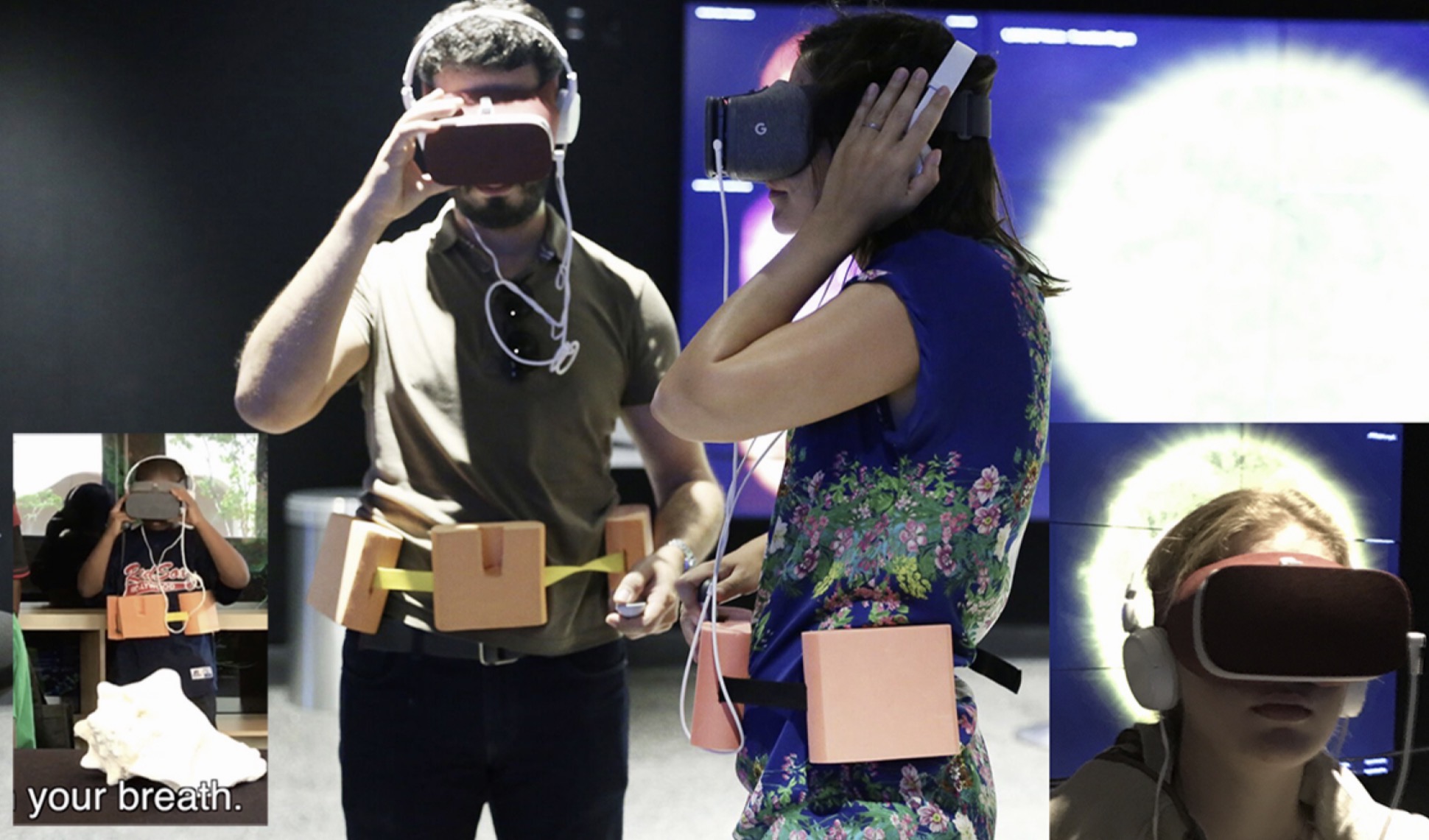
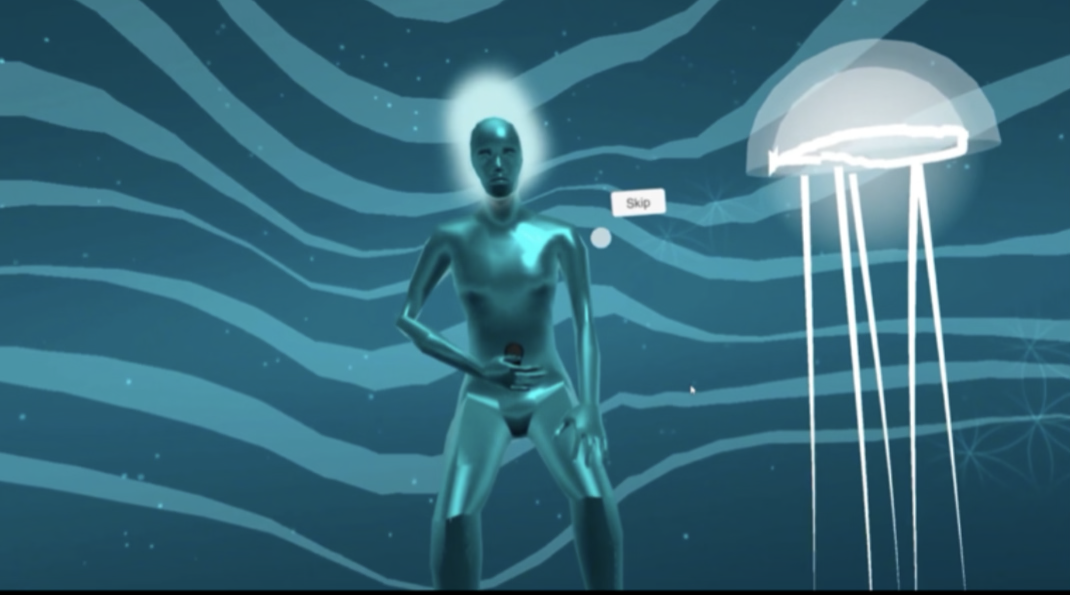
SEAing Breath — SEAing Breath, as in an inhale or exhale of the sea — is a gamified art/science VR project that uses breath biofeedback as an interface. Developed around sea-level rise, climate change, and game-like embodied education, the work lets users experience an adaptive virtual environment that changes with their breathing techniques. Commissioned in relation to the Sea Level Rise Program by Miami-Dade County and the University of Miami.
Rather than presenting climate data as distant information, SEAing Breath turns respiration into navigation, feedback, and relation — making environmental awareness somatic, participatory, and embodied. The piece sits at the intersection of somatic art, immersive virtual reality, and what would later become Hannes Bend's somatic AI and bio-adaptive AI practice: technology that senses the body's state and adapts the environment around it, rather than extracting attention from it.
Presented at the Phillip and Patricia Frost Museum of Science (Blue Mind Life: The Seven Ages of Water, hosted by Dr. Wallace J. Nichols), Pérez Art Museum Miami, Vizcaya Museum and Gardens, HistoryMiami Museum, the Miami Center for Architecture & Design, and in education and public programs across Miami-Dade — used by children and adults alike to embody, through their own inhale and exhale, what changing sea levels feel like from inside the water.
The work operates as game-like, embodied climate education: a breath-biofeedback driven virtual environment in which breathing technique, rather than a controller, moves the participant through rising water — an adaptive, somatic interface used in museum and public-program settings.
SEAing Breath — Blue Mind Life, Frost Science Museum, Miami.SEAing Breath — Students, Frost Museum of Science.SEAing Breath — Visitors, Frost Museum of Science.SEAing Breath — In-VR underwater view with sea-level gauge.SEAing Breath — In-VR underwater view (green light).SEAing Breath — Project overview collage.
SEAing Breath, 2017–2018 — trailer on youtube.com.
2012 — 2018
Selected Projects
Link copied
A selection of projects between 2012 and 2018 spanning patent work, virtual and augmented reality, biofeedback, performance, and environmental installation — the direct lineage between the early art practice and the later bioadaptive AI work.
2017–2018 — with Wim "The Iceman" Hof
Breathing Fields & AWERE
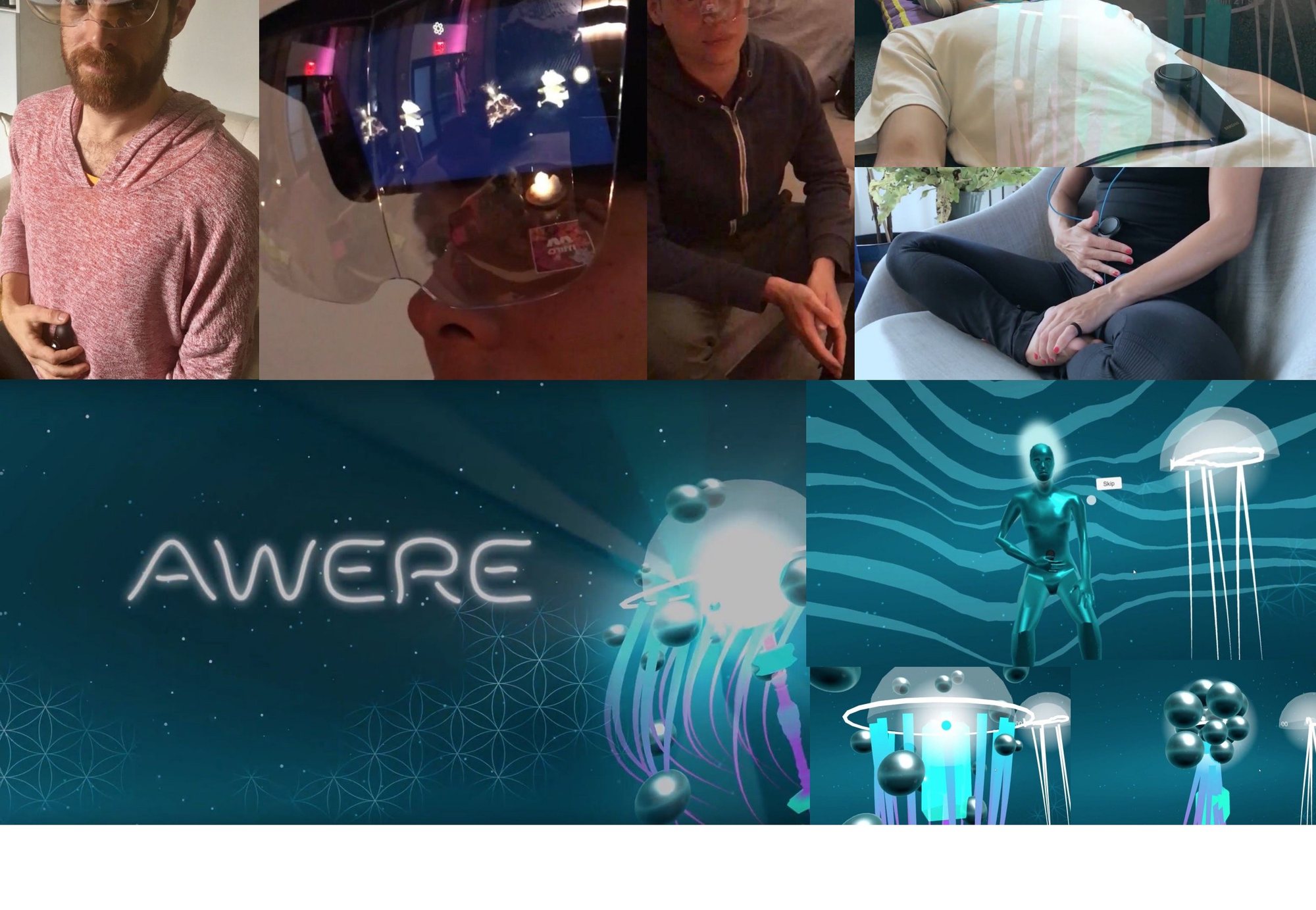
Augmented Reality (Breathing Fields) and Virtual Reality (AWERE) breath-biofeedback projects that visualize breathing patterns in real time next to a guided breathing meditation, including a 360° guided meditation for VR. Developed in collaboration with Wim Hof.
Still from the AWERE VR environment — breath-driven visualization.Breathing Fields & AWERE — AR / VR breath biofeedback overview.
2017–2018 — ThoughtWorks Arts Residency · SPRING/BREAK Art Show 2018
Biofields
Open-source VR framework combining heart-rate and breath biosensors with volumetric and interval-arithmetic simulations to model the felt sense of energy around the body. Maps heart rate to field pulsation, breath to exercise time, HRV to chakra focus, and blood oxygen to pranic intensity. With designer / technologist Lewey Geselowitz.
ThoughtWorks Arts Residency documentation — Hannes Bend (Artist in Residence, Winter 2017) with Lewey Geselowitz (VR Designer). Biofields VR experience and relational metrics diagram.
2018 — The Rubin Museum of Art
Smile of Breath
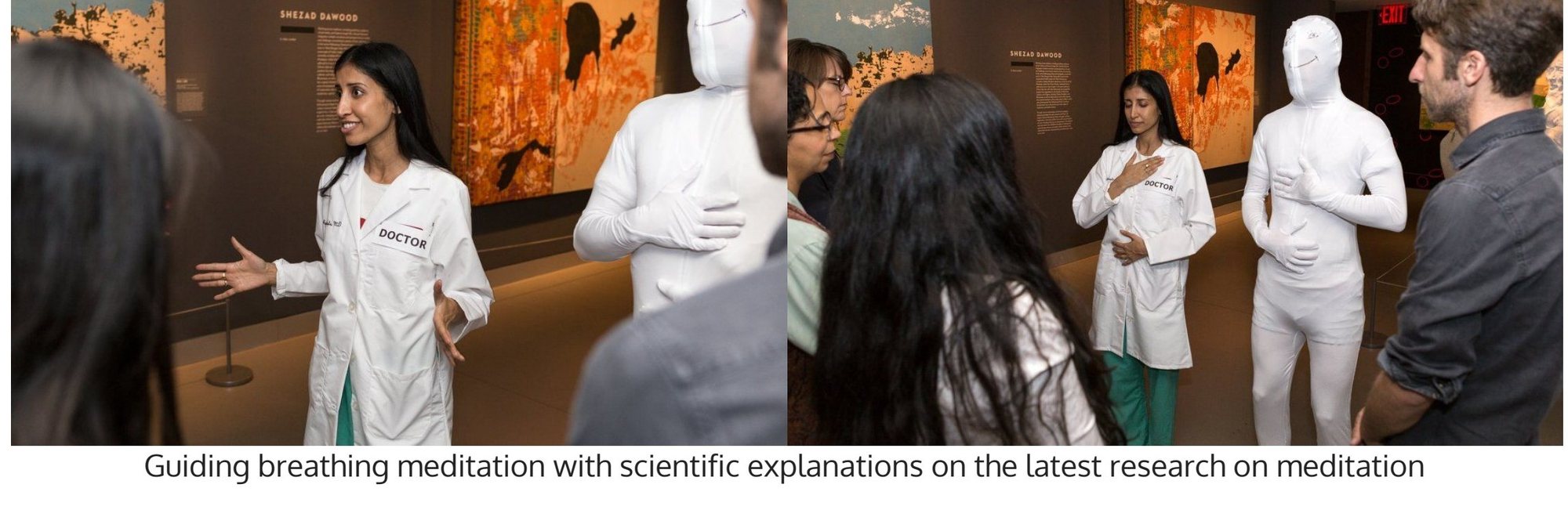
Performance with physician Dr. Payel Gupta guiding breathing meditation alongside accessible scientific explanations of current meditation research, situating somatic attention within the museum as both embodied practice and shared inquiry. Presented with the sculptural installation purAPPification — candy-cast mobile phones dissolving in water inside a glass skull vessel.
Photographic series · Ongoing since 2007
Up…Up…Up…Up…
Link copied
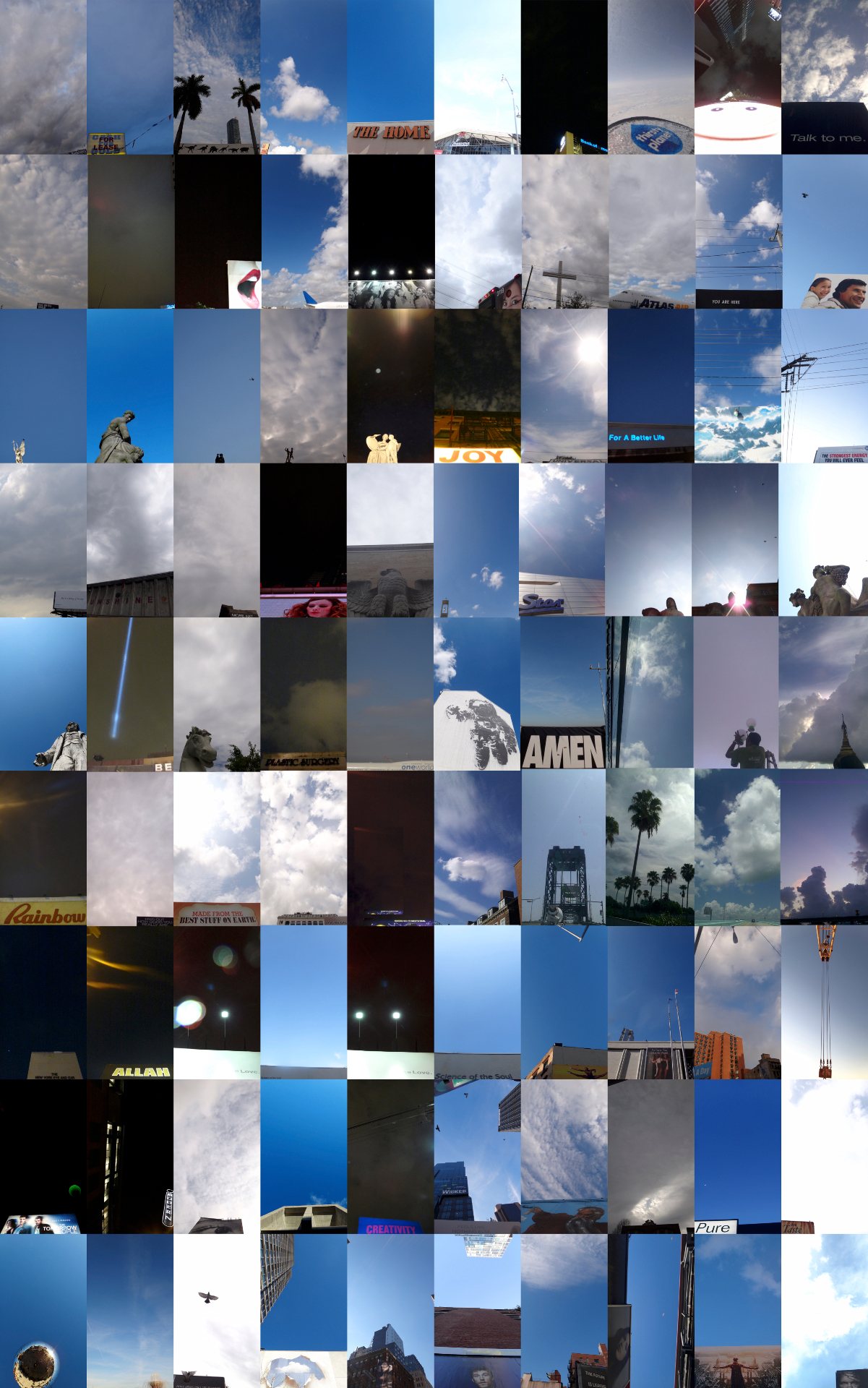
Up…Up…Up…Up… is an ongoing photographic series begun in 2007, comprising over 30,000 images of skyward glances — monuments, signage, weather, architecture, and atmosphere — collected as grids and strips of looking up. The work proposes attention itself as a quiet civic and perceptual practice: a counter-movement to screens that pull the gaze down.
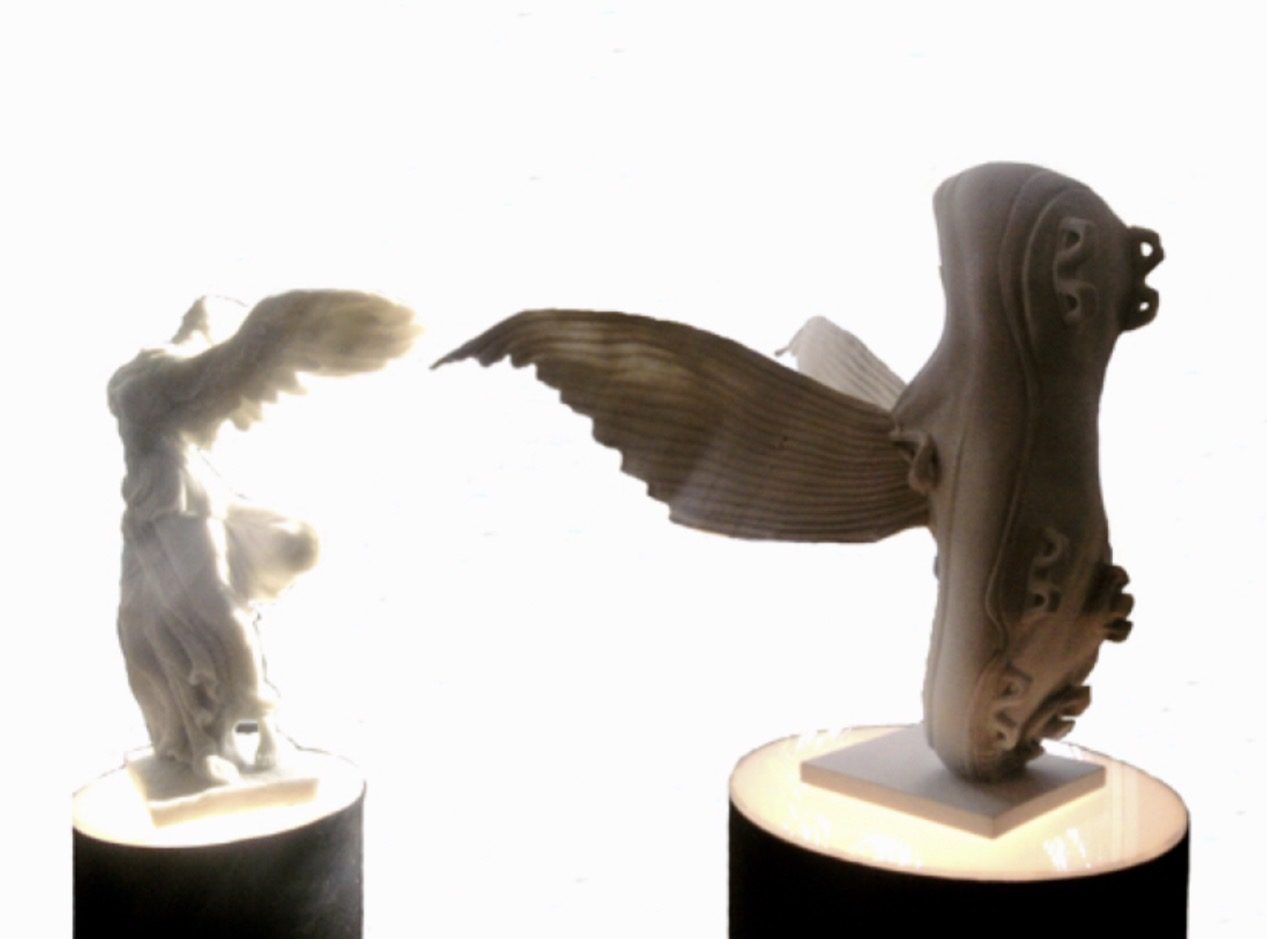
Nike (2010) fuses two icons of flight into a single hybrid form: the Nike Mercurial SuperFly Vapor II football boot and a miniature museum replica of the Nike of Samothrace. 3D-scanned, merged, and output as 3D prints on steel pedestals, the work reads the ancient winged victory through the language of contemporary branding — where a sportswear logo has literally taken the name of the goddess — collapsing classical statuary, product design, and the mythology of speed into one silhouette.
Nike, 2010
3D prints, steel. Installation view on illuminated steel pedestals — life-size shoe scale, approx. 30 × 30 × 12 cm (11.8 × 11.8 × 4.7 in) per element.
1 / 2 · 3D-printed sculptures / installation view
2008 — 2016 · Works on paper
Drawings
Link copied
An ongoing body of works on paper made between 2008 and 2016 — dense, freehand compositions in ink, ballpoint, and colored pencil. All works are Untitled, indexed only by year.
The drawings function as an open notebook running alongside the sculpture, painting, and installation practice — a private space where imagery, mythology, landscape, figures, and half-formed diagrams gather without a fixed frame. Faces, waterfalls, mountains, animals, boats, and cosmological forms appear and dissolve into one another across the page.
The series also includes a virtual drawing from 2016, made in three dimensions using Tilt Brush by Google. Presented first below, the animated thumbnail hints at its spatial nature — open it to step through multiple views of the same VR drawing.
2011–2012 — Alexander Levy Gallery, Berlin · Video / Performance / Installation
Origin is Absent, 2011
Link copied
Origin is Absent was presented at Alexander Levy Gallery, Berlin, in 2012. The installation brought together sculptural fragments, material transformation, and questions of origin, absence, mobility, and reconstructed form. Wings and Wings (Crystallized) were shown within this exhibition context, documenting the same paired automotive form before and after its candy-coated surface crystallized over time.
Origin is Absent, 2011, is a video and performance work in which a black SUV — the archetypal symbol of extraction, mobility, and status — is ritually destroyed at dusk in an industrial parking lot and re-composed, through montage, into desert landscapes, quarries, and forest fires. The vehicle stands in for a whole civilizational engine: the internal-combustion body, the fossil economy, and the fantasy of the untouched frontier that this economy has already erased.
Bend approaches the wreck as a contemporary vanitas: the more the car is opened, dented, and undone, the more the surrounding origin — a stable nature to return to, a clean beginning, a first cause — reveals itself as absent. What remains is a set of images and gestures that re-stage collective destruction as a shared, embodied performance, closer to the CandY sculptures' logic of seductive dissolution than to any spectacle of violence.
The work anticipates the concerns of the later somatic AI practice: perception under acceleration, bodies inside technological objects, and the ecological cost of the interfaces we inhabit.
Wings and Wings (Crystallized) are two documented material states of the same sculpture — paired Jeep Cherokee door sections arranged as a mirrored, wing-like form. Removed from their original mechanical function, the industrial fragments become anatomical and emblematic: damaged structures suspended between mobility, impact, symmetry, and attempted flight.
In its second state, the work was coated in transparent and golden candy that crystallized over time, shifting the surface from exposed industrial remnant toward a mineralized or fossil-like object.
Jeep Cherokee door sections, candy, and mixed media. Approx. 155 × 90 × 15 cm (61 × 35.5 × 6 in); estimated. Dimensions to be confirmed.
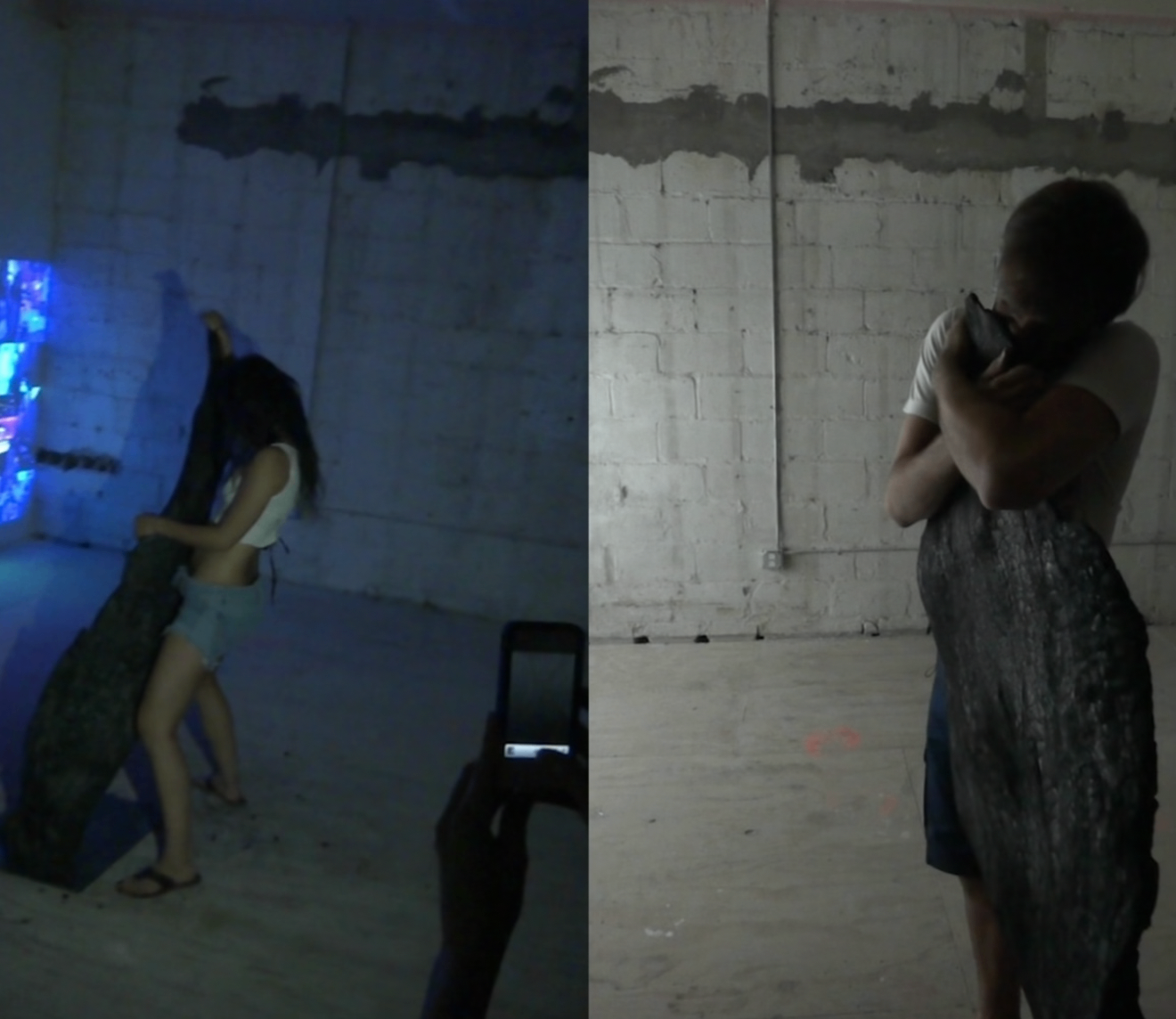
Ultra is a staged reenactment of "The Treehugger," an incident associated with the Ultra Music Festival in Miami. In January 2012, the Senator — a 3,500-year-old pond cypress in Big Tree Park, Florida, and one of the oldest known trees in the world — was destroyed by fire. The performance takes place on remnants associated with the Senator tree, turning viral images of ecstatic contact with nature into an act of mourning, repetition, and uneasy memorialization.
A female and male performer alternately embrace and animate the burned wood. Their gestures move between care, possession, spectacle, and ritual. The work reflects on contemporary relationships between human bodies and damaged environments while questioning the boundaries between natural and artificial experience, private grief and public entertainment.
Presented as part of Situation Range at LegalArt Miami in 2012, the performance incorporated the related video essence, which showed excessive behaviour and destruction within a climate-controlled entertainment environment. Together, the works connect spectacle, environmental loss, intoxication, mediated behaviour, and ritualized contact with a vanished living body.
Performance on burned wood with video documentation and related moving-image work.
essence presents footage of festival participants performing excess, impact, and destruction around vehicles in a climate-controlled entertainment environment. Within Ultra, the video functions as a mediated counter-image to the performers' physical contact with the burned tree form: spectacle and environmental loss appear as interconnected systems of behaviour, representation, and consumption.
Miami New Times — Situation Range at LegalArt, 2012Review of Situation Range at LegalArt discussing Bend's installation with a remnant of the burned Senator tree and the related Treehugger / essence footage.
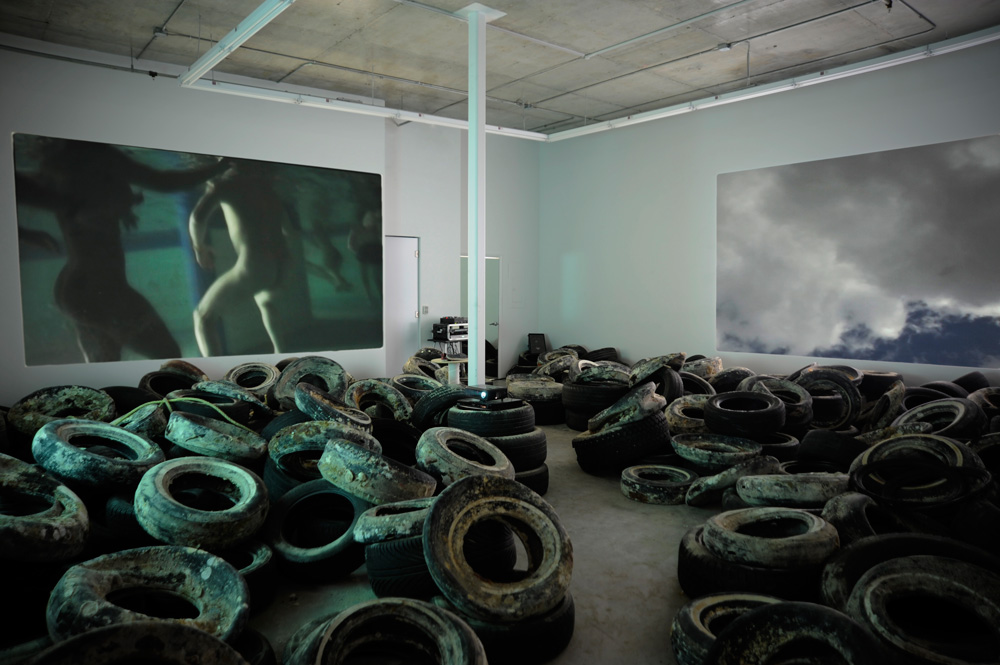
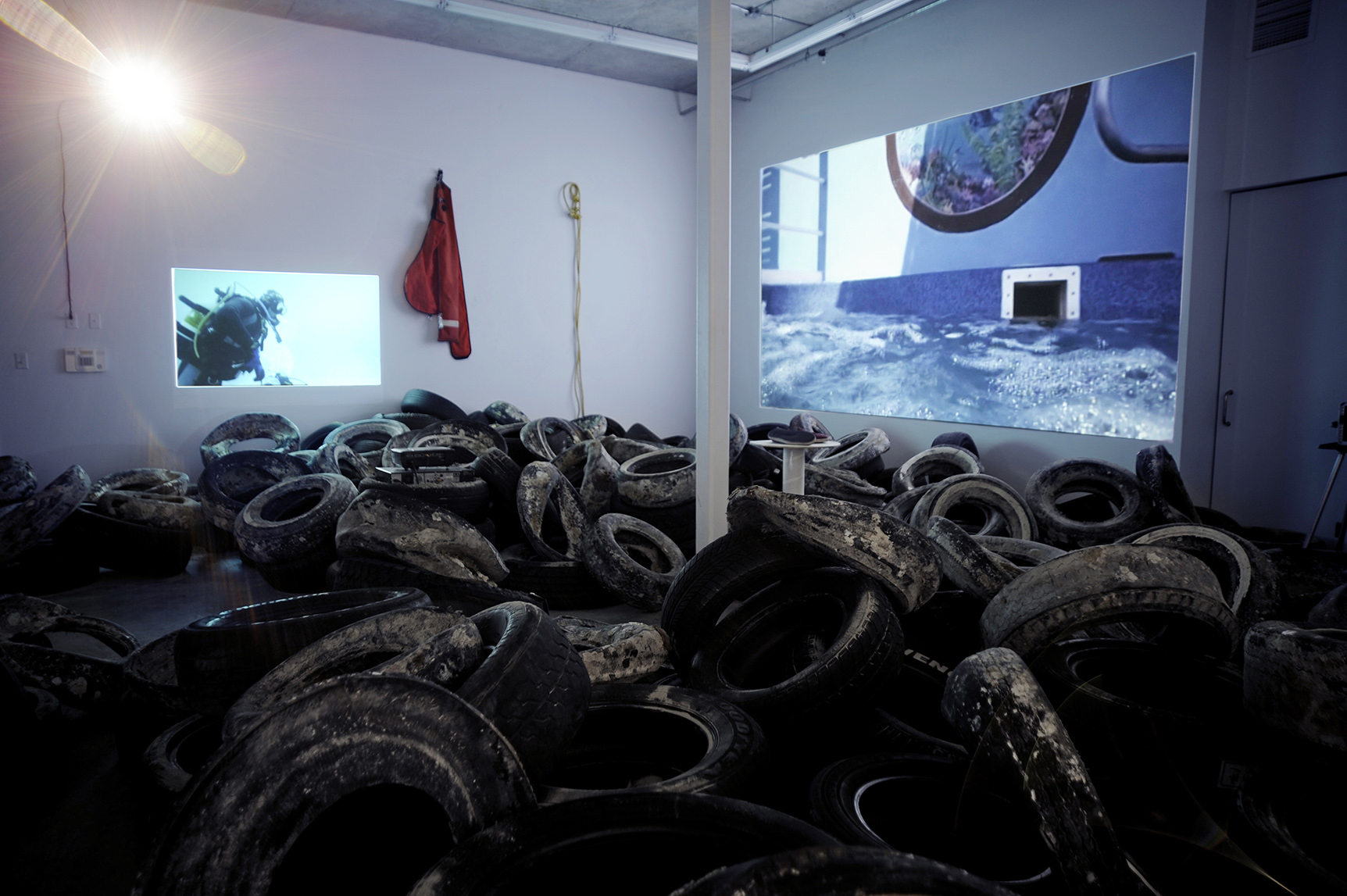
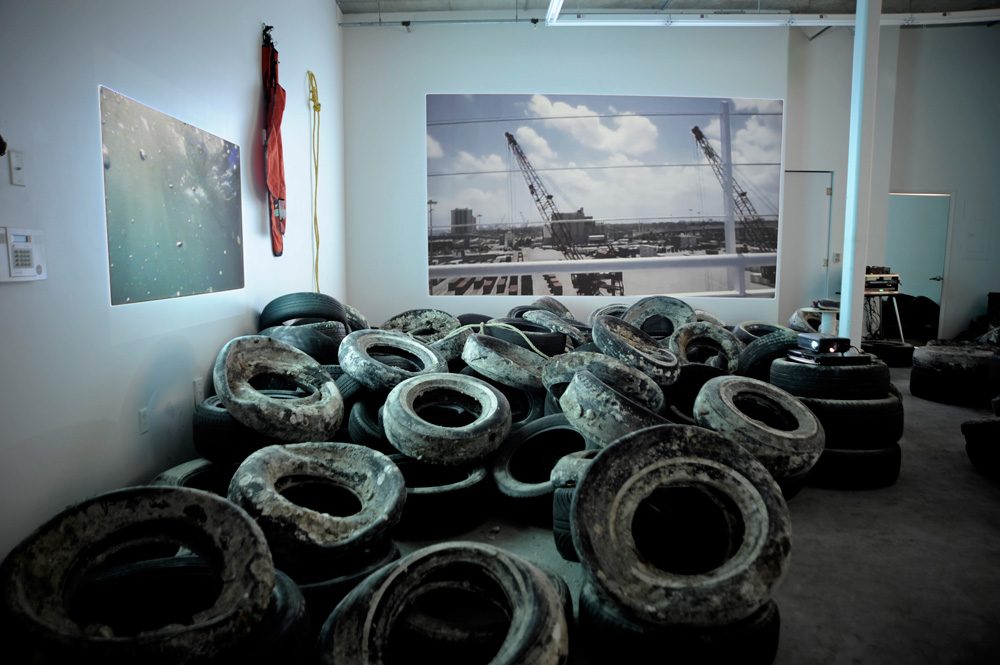
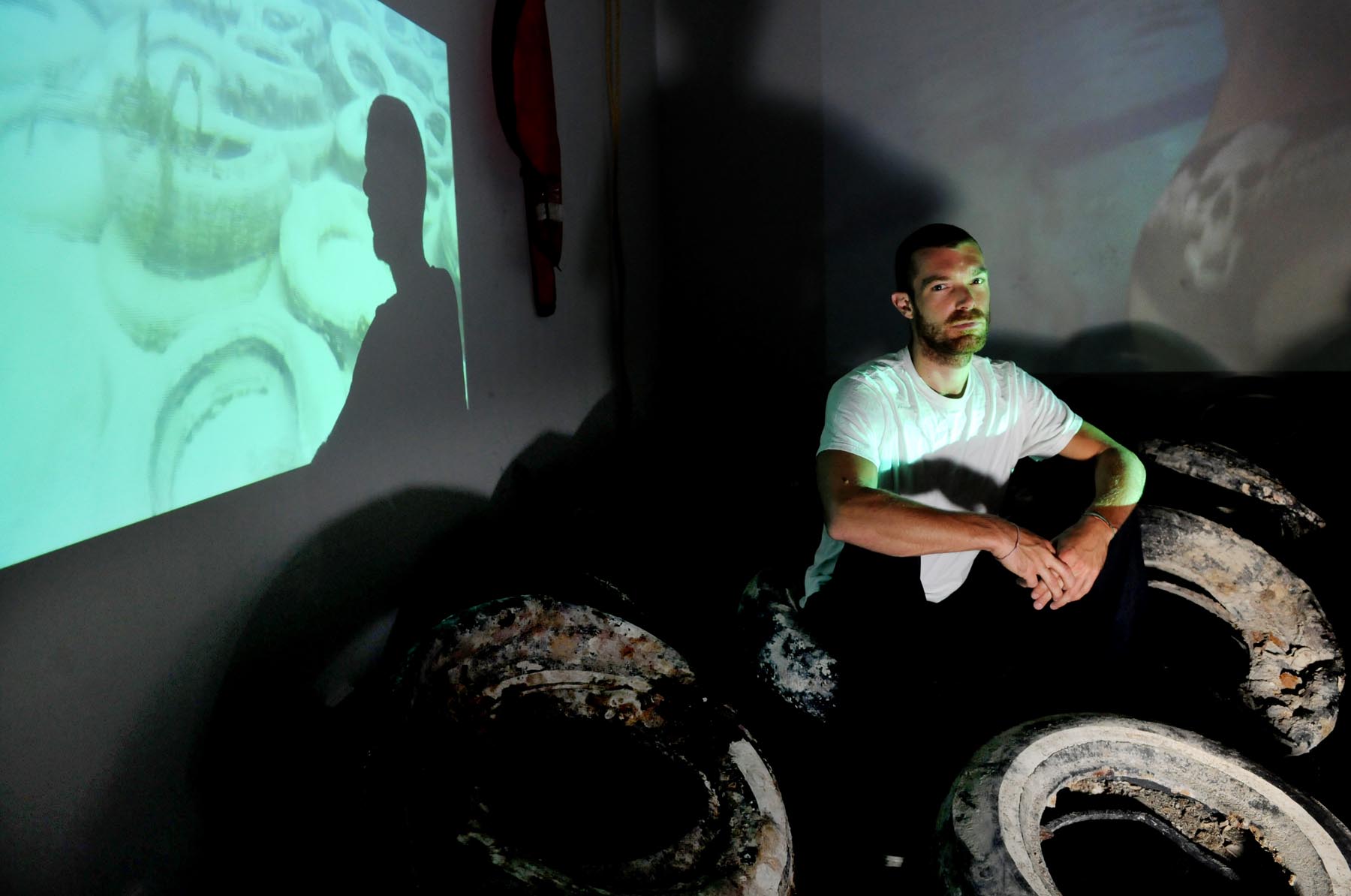
ECLIPSE was Hannes Bend's first solo exhibition in Miami, presented at Charest-Weinberg Gallery in 2012. For the project, Bend dredged up nearly one hundred tires from the failed Osborne Artificial Reef off the coast of Fort Lauderdale — an artificial reef begun in 1972 from between one and two million discarded car tires, which collapsed into one of South Florida's most visible ecological disasters.
The salvaged tires were installed in the gallery alongside underwater video, dive footage, and large-scale projections of sea, sky, and submerged bodies. The installation expanded Bend's practice from painting and sculpture into environmental, research-based work — bringing industrial debris, mediated imagery, and ecological history into a single charged space.
ECLIPSE examined the contemporary sublime not as untouched nature, but as an entanglement of industrial debris, failed human design, ecological consequence, and projection. Perception, in this work, is not neutral: it is historical, material, contaminated, and implicated. The exhibition marks a pivotal transition from object-based practice toward immersive, interdisciplinary, and research-driven work.
Miami Herald · 2012 — “Array of junk tires — and a ray of hope,” by Patricia Sagastume. Tap to open the full-resolution scan.
Moving-image works within ECLIPSE
eclipse, 2012
Link copied
eclipse observes the changing sky as it is repeatedly interrupted by passing cars, industrial machinery, and the underbellies of passenger aircraft. Human industry becomes a brief eclipse across the longer duration of the universe.
Presented as a moving-image work within the wider context of ECLIPSE at Charest-Weinberg Gallery, Miami, 2012.
Aqua Dome, 2012
Link copied
Aqua Dome is a five-minute moving-image work extending ECLIPSE's inquiry into the contemporary sublime — sea, sky, and submerged bodies mediated through projection, debris, and industrial residue.
Presented as a moving-image work within the wider context of ECLIPSE at Charest-Weinberg Gallery, Miami, 2012.
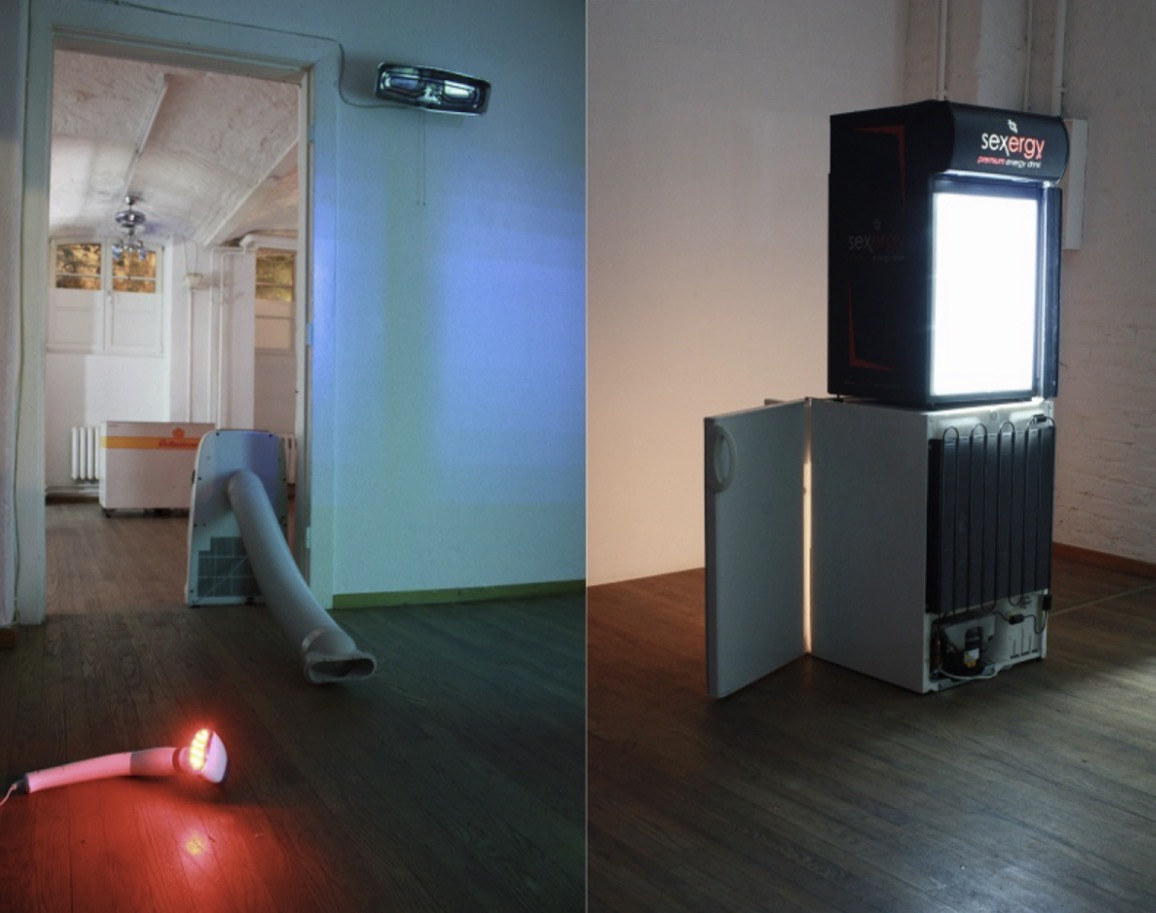
IN & OUT, 2004/2013 was presented at Souterrain Berlin in 2013, curated by Isabel Holert and Felix Laubscher. The title holds two temporalities at once: the work was conceived in 2004 and realized in 2013, allowing the installation to register both the persistence of an idea and the acceleration of the climate, technological, and ideological conditions that made it newly urgent.
Installed across a hot room and a cold room, the project used household appliances, cooling systems, heaters, fans, lights, ducts, and modified domestic devices as if they were already quasi-social actors: infrastructural objects with their own rhythms, emissions, vibrations, and behavioral scripts. One chamber glowed with seductive warmth and heightened chromatic atmosphere; the other withdrew into darkness, refrigeration, and thermal estrangement. Visitors moved between two engineered climates, not simply as viewers, but as bodies being tuned, lured, tested, and metabolically addressed.
In contemporary art terms, the work reads as an environmental diagram of desire. Bend turns climate control into a psychic and political medium, showing how intimacy, exclusion, comfort, resource extraction, and collective fantasy are distributed through technological interiors. The installation makes palpable the way hype and habit pull us toward the over-lit, over-conditioned promise of the “in” room, even when such atmospheres are materially expensive and ecologically untenable. What appears as a set of ordinary appliances begins to behave like a social sculpture about thermoregulation, status, vulnerability, and the feedback loops between bodies, architecture, and planetary systems.
The accompanying press text — assembled from quoted and adapted voices across theory, science, and cultural criticism — extends the installation into a speculative field of language. Air conditioning appears there not as a neutral convenience, but as a modern cosmology: a totalizing aspiration to manage weather, feeling, immunity, and public life through technical systems. The result is both critical and forward-looking: a proposition that climate, science, technology, AI, and emotion are already intertwined, and that any serious future must reckon with the strange liveliness of the systems we have built and the atmospheres they now build around us.
Having the memory of being socially excluded or just feeling “different” from others in a room is enough to change our perception of the environment around us. Such feelings can prime individuals to sense, for example, that a room in which they’re standing is significantly colder than it is. One likely mechanism is through the autonomic nervous system. When people feel excluded, blood vessels at the periphery of the body may narrow, preserving core body heat.
Art institutions are mostly considered to be power structures defining what is included or excluded from public view. Three-dimensional art of any kind is a physical fact. The physicality is its most obvious and expressive content. Where everything in the room talks to everything, the input/output relationship becomes radically ambiguous: what goes in, what goes out, and how does a room begin to function like a body with multiple openings?
Between any urban constructions — private or public — is air. Weather has become a symbolic force defining collective psychology and a city’s sensibility. We name storms as if they were living beings, yet they are self-assembling creatures of the atmosphere: spontaneous, shapely, temporarily stable systems without genes and without a script, organizing themselves through dynamic exchanges of hot and cold.
Weather is also the most common topic of public conversation. It lets the city be felt as a totality, connecting urban life to fate, the heavens, and the universe. From this perspective, air conditioning appears as one of modernity’s most radical technical dreams: the attempt to condition an entire city and dissolve the boundary between private and public climate. By following what technology wants, we imagine ourselves becoming more capable of receiving its gifts.
Yet we derive income from transforming the earth into goods, and that logic cannot continue indefinitely. The twenty-first century is not about accumulating material wealth in the manner of the twentieth; that world is already eroding. Human beings remain radically vulnerable — biologically, socially, juridically, symbolically. Building convincing immune systems, technical and collective, is an ongoing task. There is no way back.
Text compiled from quotes by Peter Sloterdijk, Hans IJzerman and Justin Saddlemyer, Boris Groys, Manuel De Landa, Tino Sehgal, Sol LeWitt, Jan Verwoert, and Kevin Kelly.
Bronx Bit(e)s / sweet streets translated damaged urban infrastructure into a material and participatory public intervention. Molten candy was poured into potholes across New York City, temporarily filling fractures in the street with vivid, unstable matter. The Bronx Museum installation brought documentation of these actions together with candy casts, posters, structural elements and digitally fabricated components. The pothole becomes both wound and mould: an index of urban failure transformed into a fleeting public sculpture.
Candy casts of New York City potholes, silicone moulds, wood, posters, polymer 3D prints, steel, paint and glue. 300 × 255 × 288 cm · 118.11 × 100.39 × 113.38 in.
Research Context
Bronx Bit(e)s / sweet streets investigates the relationship between urban infrastructure, public health, material transformation and digital representation. Throughout New York City, damaged streets became temporary public sculptures through interventions in which molten candy was poured into potholes. These casts transformed absence into form, allowing deteriorated infrastructure to become both sculpture and data.
The project moves between analogue and digital modes of modelling. Street damage was documented through photography, thermal imaging, mobile 3D scanning and physical casting. The negative space of a pothole could be filled directly in the street, translated into a digital model, or reconstructed as a physical 3D print. The work places continuous material processes beside the discrete logic of computational representation.
Thermal imaging extended the documentation beyond the ordinarily visible spectrum. A mobile thermal-imaging device registered the heat distribution, cooling and crystallisation of the molten candy during the public interventions. The resulting images reveal temporary thermal fields that are normally inaccessible to unaided human vision.
The work also addresses socioeconomic conditions. Areas marked by deteriorating street infrastructure often overlap with neighbourhoods facing reduced access to high-quality food and disproportionate exposure to processed sugar. The candy operates simultaneously as sculptural material, temporary infrastructure and social indicator.
The sculptures shifted between liquid and solid states. During production, the candy was poured as a heated liquid and crystallised as it cooled. Its apparent solidity remained conditional. During the Bronx Museum presentation, a malfunctioning air-conditioning system caused parts of the installation to liquefy again, making the exhibition climate an active material agent in the work.
Public Intervention
Between 2014 and 2015, the project developed through repeated walks and bicycle-based explorations across New York City. Potholes and damaged sections of street were identified, photographed, measured and, in selected cases, filled with molten candy. These temporary interventions were undertaken in public space and documented through conventional photography, mobile imaging and thermal recording.
Some interventions were carried out collaboratively with neighbourhood residents and with a participant whom Bend had met while voluntarily teaching yoga at Rikers Island in 2014. The street became a temporary site for sculpture, conversation, observation and collective action.
Research Methods and Media
Thermal imaging · Mobile 3D scanning · 3D modelling · Polymer 3D printing
Silicone mould-making · Candy casting · Public intervention
Photographic documentation · Installation · Material and environmental observation
Bronx Bit(e)s / sweet streets was realised with support from the Bronx Museum of the Arts and the Foundation for Contemporary Arts, and through contributions from collaborators, participants and organisations involved in the project’s public interventions, research and fabrication.
Corydon Cowansage · Valeria Cordero · Kuby Nnamdie · Milan Chapman · Karin Minkin
2016 — apexart, New York · Curatorial
Youniverse
Link copied
Youniverse (November 3 – December 17, 2016, apexart, 291 Church Street, New York) was a participatory exhibition curated and organized by Hannes Bend, bringing contemporary art, technology, science, and contemplative practice into one space. The opening reception was held on November 2, 2016, 6–8 pm.
Alongside the exhibited works, a changing programme of shared experiences made participation central: Robin Arnott's voice-responsive SoundSelf, the Interspecifics Collective's Geobacter Micropulse, opening sessions by Lisa Levine and Malia Kulp, and magnetic sound baths by MJ Caselden reported by Hyperallergic.
Satellites in the Night (March 14 – April 19, 2010, Freies Museum Berlin) was a group exhibition initiated and co-curated by Hannes Bend with co-curators Trong G. Nguyen (New York) and Emilie Trice (Berlin), staged across the three floors of the museum — each roughly 5,000 sq ft. Hannes Bend curated one floor of the project, which framed a New York–Berlin exchange between twenty-three contributing artists and curators.
The exhibition examined the "night-life" of modern technology — transformations induced by science and evolution — using "satellites" to name both tethered, remote objects and the transmissive medium through which data and communication circulate. The title also gestured to the "satellites" of the art world itself: artists and curators located internationally within a larger meshwork of orbital, outer, and inner space — from confined interiors, to environment and vast nature, and beyond the atmospheric limit into an alien cosmos.
Artists: Christine de la Garenne, Johanna Tiedtke, John von Bergen, Jomar Statkun, Robert Lazzarini, Knud Young Lunde, Maxime Ballesteros, Trong Gia Nguyen.
2011 — Morningside, Miami · Curatorial
This House Is Blessed
Link copied
This House Is Blessed (December 14, 2011, 5500 NE 7th Ave, Morningside, Miami) was a one-night housewarming exhibition organized by Fountainhead and LegalArt residents — Marc Bijl, Trong Gia Nguyen, and Hannes Bend — who staged new works throughout the domestic interior and garden of the residency house.
As both curator and exhibiting artist, Hannes Bend used the format to blur the line between studio, residency, and public exhibition — treating the house itself as a temporary institution where the artists lived, worked, and opened the space to the Miami art community for a single evening.
2004 — Sculpture
EYES — EverybodY is Enlightened Sometimes
Link copied
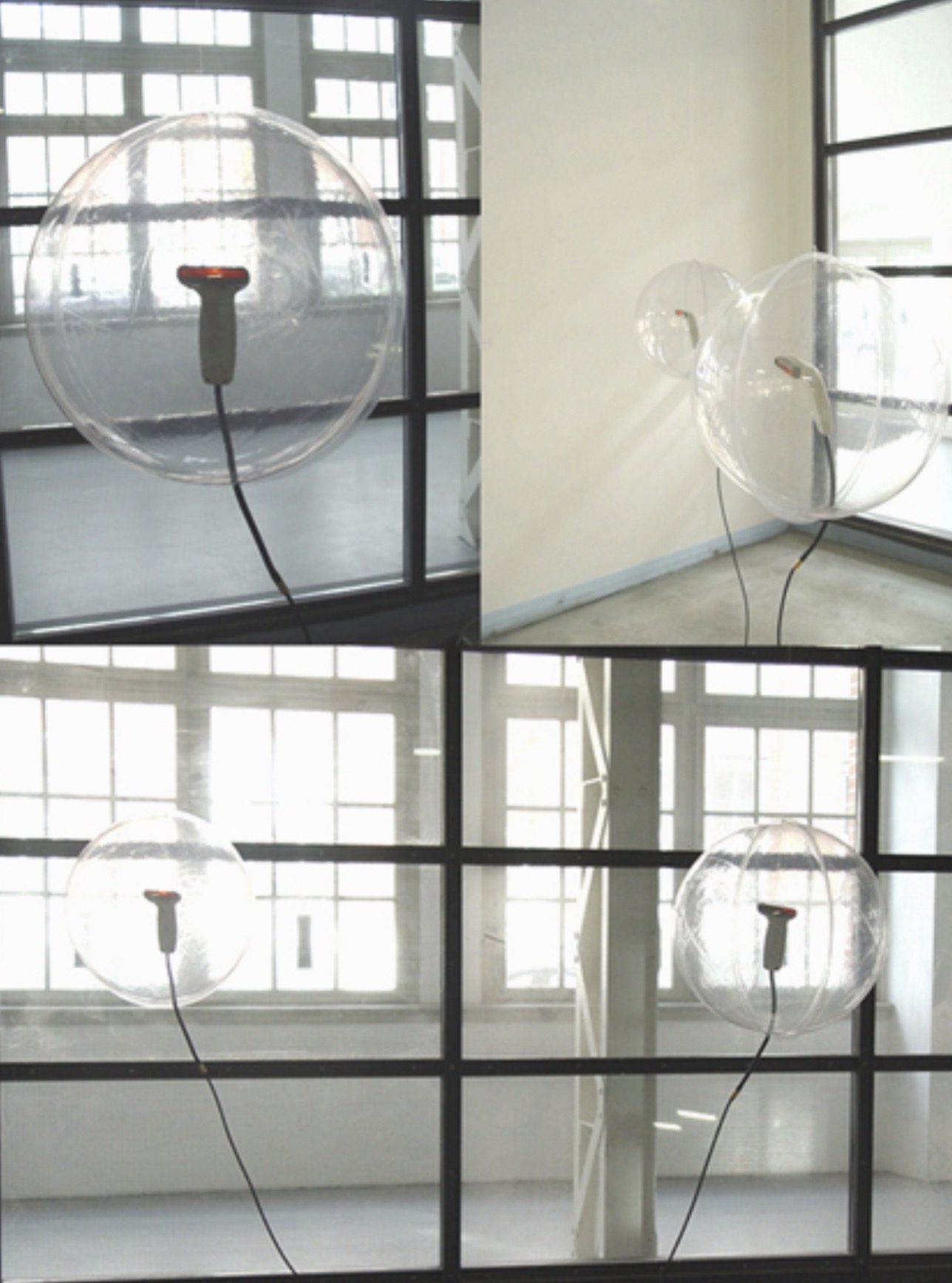
EYES — EverybodY is Enlightened Sometimes is a 2004 sculpture made from transparent plastic spheres and barcode scanners. The work turns the consumer-technologies of identification and scanning into suspended, bodily forms, reframing the act of reading labels as a quiet, speculative meditation on seeing, being seen, and the fragile promise of enlightenment embedded in everyday objects and consumerism.
2004 — Rudolfhalle, Berlin · Curatorial
b00d
Link copied
b00d (June 4–27, 2004, Rudolfhalle, Berlin) was a group exhibition of 16 artists from Kunsthochschule Berlin-Weißensee, initiated and curated by Hannes Bend with Kaspar König as mediator. The title was derived from the year 2004 through a conversion of letters into numbers (a=1, b=2, c=3, d=4…), producing a term — b00d (b-zero-zero-d) — that is neither linguistically comprehensible nor collapses into a stable meaning, while its visual appearance still suggests possible vocalization.
Positioned within the frequently investigated field of "art and language," the exhibition foregrounded dialogue among artists ahead of the concept — philosophical texts from Deleuze to Descartes threaded through the project — and probed the unstable borders between genres and between art and non-art. The foldable flyer, inspired by Buckminster Fuller's Dymaxion world map, already introduces encoded graphic structures that quietly anticipate concerns later expanded within ICE.
Participating artists: Andrea Lauermann, Sara Riel, Vincent Wenzel, Annett Fay, Michaela Schmidlechner, Elin Hansdottir, Hannes Bend, Heide Nord, Sofie Dederen, Franziska Klotz, Ute Ringel, Wannes Lecompte, Christl Mudrak, Catherine Hiley, Konrad Karcher, Tobias Binderberger.
2019 — present
Ventures as Creative Practice
Link copied
The ventures — Breathing AI, VitalSign AI, Optimizing AI, and Transforming AI — are extensions of the same creative and research inquiry that began in painting, sculpture, installation, and immersive systems.
Rather than separating art from entrepreneurship, the companies operate as applied forms of the practice: systems that continue to investigate perception, embodiment, adaptive environments, human state, and the possibility of technology that responds to people rather than exploiting attention.
· Patented bioadaptive interfaces
· rPPG / webcam-based vital sign detection
· Adaptive screens and human-state-aware systems
· Humane technology and physiological computing
· AI as an extension of artistic and perceptual research