Bioadaptive Technology
The Bio-Adaptive AI Stack: From Physiological Signals to Responsive Interfaces
Most teams that want to build human-state-aware software start at the sensor and stop at the dashboard. This is the architecture in between — five layers, what each one is responsible for, and the specific way each one fails.
In short
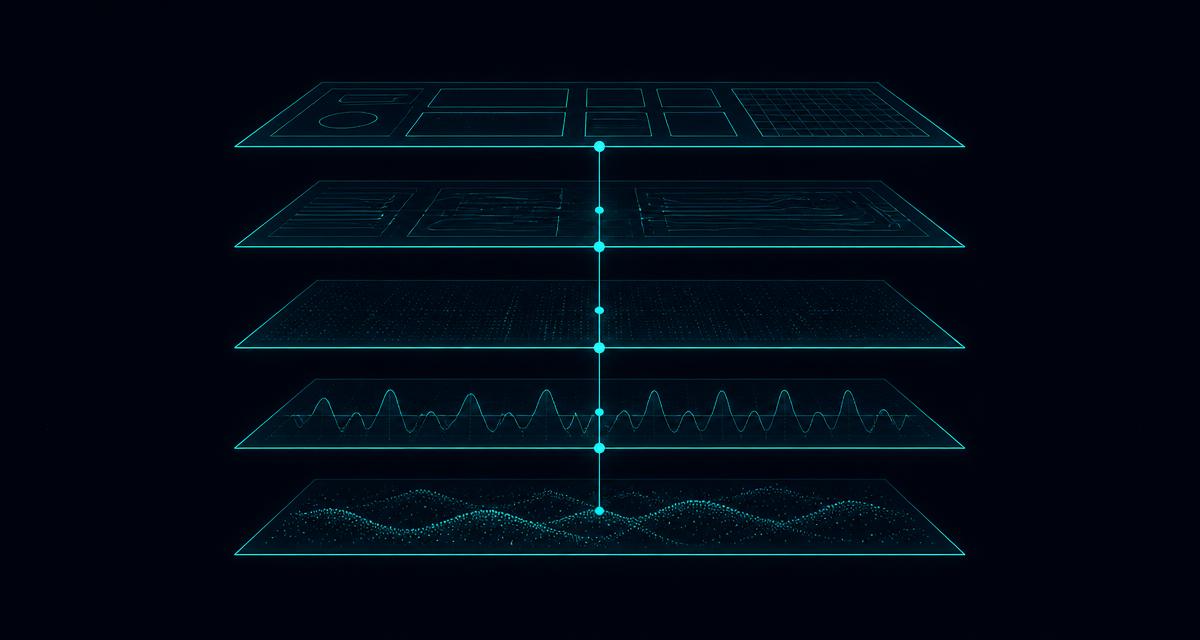
A bio-adaptive system has five layers. Capture acquires a signal from a camera, a wearable or interaction telemetry. Signal conditioning decides whether that signal is good enough to use. Interpretation compares it to the person’s own baseline and produces an estimate with a confidence value. Adaptation policy decides whether to change anything, and keeps the change small and reversible. Consent and evaluation governs the whole loop and measures whether it helped. Systems fail most often at layer three, because a raw physiological value is treated as a stable reading of an inner state.
The five layers
The architecture below is the one described in the adaptive-interface patent family and implemented, in different configurations, across four ventures. It is deliberately drawn as a loop rather than a pipeline. An interface that dims, slows or simplifies itself changes the person’s physiology, which changes the next reading. Any design that ignores this feedback will drift.
- L5
Consent and evaluation
Governs the whole loop: permission, retention, on-device processing, and measurement of whether the adaptation helped.
Fails when Added after launch, when the retention decisions are already irreversible.
- L4
Adaptation policy
Decides whether to change anything — and keeps changes small, reversible, rate-limited and gated on confidence.
Fails when Never built. The product renders a chart and leaves interpretation to the user.
- L3
Interpretation
Compares the signal against the person's own baseline and emits an estimate with an explicit confidence value.
Fails when A raw value is read as an inner state, with no baseline and no confidence.
- L2
Signal conditioning
Handles motion, illumination and dropout, and outputs a quality score saying how much to trust the measurement.
Fails when Bad data passes upward silently, and the system looks most confident when the signal has collapsed.
- L1
Capture
Acquires the raw signal: camera frames, a wearable stream, or interaction telemetry such as scroll cadence and typing rhythm.
Fails when The highest-fidelity sensor is chosen over the one people will actually use.
1. Capture
Capture is the acquisition of a raw signal: frames from a camera, a photoplethysmography stream from a wearable, or interaction telemetry such as scroll cadence, dwell time, typing rhythm and correction rate. Camera-based capture uses remote photoplethysmography, which recovers a pulse-rate waveform from minute colour changes in the skin caused by blood volume — a technique first demonstrated with ambient light in 2008.
The failure mode: choosing the highest-fidelity sensor rather than the one people will actually use. A chest strap outperforms a webcam on every signal-quality metric and is worn by almost nobody at a desk. The binding constraint on a deployed bio-adaptive system is usually adoption, not sensitivity. Interaction telemetry, which requires no hardware and no camera permission at all, is the most under-used capture channel in the category.
2. Signal conditioning
Conditioning answers one question: is this signal usable right now? It handles motion artefacts, illumination changes, frame drops, partial occlusion and the simple case of the person having left the room. Its most important output is not a cleaner waveform but a quality score — an explicit statement of how much the layers above should trust the next measurement.
The failure mode: silently passing bad data upward. A system with no quality gate produces its most confident-looking output at exactly the moment the signal collapsed. Camera-based capture in particular degrades unevenly across skin tones and lighting conditions; Nowara, McDuff and Veeraraghavan found systematically higher error rates for darker skin tones across the published literature. A conditioning layer that does not surface this becomes a fairness problem in the layers above it.
3. Interpretation
Interpretation converts a conditioned signal into something a policy can act on. This is where nearly every bio-adaptive project goes wrong, and the error is always the same shape: a raw value is read as a state. An elevated pulse rate is compatible with concentration, alarm, caffeine, a warm room, a flight of stairs, illness, delight and a badly fitted sensor. It is not a diagnosis, and it is not evidence of an emotion.
A correct interpretation layer does three things. It compares against a personal baseline accumulated over time, because between-person variation dwarfs within-person variation. It emits a confidence value alongside every estimate. And it describes its output in the narrowest defensible terms — a probabilistic estimate of physiological state under stated conditions — rather than a label such as “stressed” or “engaged” that the data cannot support.
This is the distinction from classical affective computing, which I set out at length in Somatic AI vs. embodied AI and affective computing. The useful question is not “what is this person feeling?” It is “has something changed relative to this person’s own baseline, and am I confident enough to act on it?”
4. Adaptation policy
The policy layer decides what, if anything, changes. This is the layer most projects never build. They stop at layer three, render a chart, and call it a wellbeing product — which transfers the entire interpretive burden onto the user and delivers a number they cannot act on.
A workable policy has four properties. Changes are small — spacing, contrast, pacing, information density, interruption timing — because large changes are disorienting and confound their own evaluation. Changes are reversible and visibly so. Changes are rate-limited, so the interface does not oscillate as the signal fluctuates. And changes are gated on confidence: below a threshold, the correct action is to do nothing.
The empirical support here is narrow but real and is task-level rather than clinical. Chiossi and colleagues found that adapting visual complexity to a physiological signal improved working-memory performance in VR, and Chen and Vertegaal showed that deferring interruptions using a mental-load estimate outperformed fixed scheduling. The specifics of what should change on a screen are covered in colour, typography and interaction.
5. Consent and evaluation
The fifth layer wraps the other four. Physiological data is among the most sensitive categories a product can touch, and the design decisions that matter are architectural rather than legal: process on-device where possible, retain derived features rather than raw frames, set a retention window before launch rather than after, and make the adaptation itself inspectable so the person can see what changed and why.
Evaluation belongs in the same layer because the loop makes ordinary measurement invalid. If the interface adapts, the baseline moves. Any honest evaluation therefore needs a non-adaptive comparison condition, a pre-registered outcome that is a task or experience measure rather than a health outcome, and a stated stopping rule. Building this before launch is what separates a pilot that produces an answer from one that produces a testimonial.
Where the ventures sit in the stack
The four ventures are not a portfolio of unrelated companies. Each occupies a different layer of the same architecture, which is why they share research and intellectual property.
- TransformingAI
Layers 3–5. The research and IP layer: the patent family, the reference architecture, and the interpretation and governance discipline the others inherit.
- VitalSign AI
Layers 1–2. Camera-based capture and conditioning, exposed as an API so a product team does not have to build a sensing pipeline.
- Breathing AI
Layers 3–4 in a consumer context. A shipped adaptation policy for the working day, with real-world adoption behind it.
- OptimizingAI
Layer 3 applied to research rather than adaptation: using physiological context to understand response to a product or prototype.
What to build first
If you are evaluating this for an organisation, the sequence that avoids the most wasted effort is: build layer four first as a rule-based stub with a simulated signal, and confirm that the adaptation is something people actually want. Then build layers one and two, and measure your quality-gate rejection rate under realistic conditions rather than in a well-lit demo. Only then invest in layer three. Most teams reverse this order, spend two quarters on sensing accuracy, and discover at the end that the adaptation they were sensing for was not valued.
If you want to see these layers rendered as an interface, see the loop demonstrated in simplified form.
Evidence behind this article
The layered architecture described here is disclosed in a granted patent family: US 10,423,893 (2019) and US 11,561,806 (2023), plus US 2019/0042981 and CN 111315278 B.
Primary — Public patent records
"Mindful Technologies: Research and Developments in Science and Art" was presented at the AAAI 2016 Spring Symposium at Stanford University.
Primary — AAAI bibliographic record
Each layer of the stack is occupied by working software across four ventures: TransformingAI, Breathing AI, VitalSign AI and OptimizingAI.
Company-reported — Hannes Bend, founder
Evidence & scope
- This is not a medical device architecture, and no medical, diagnostic or clinical claim is made about any layer of it.
- No layer of this stack measures an emotion. Interpretation produces a probabilistic estimate of physiological state with a confidence value, not a named feeling.
- The accuracy of any specific sensing implementation is not asserted here. Accuracy is a property of a configuration under stated conditions, not of a category.
- No claim is made that adaptation improves health outcomes. The evidence supports task-level effects such as workload and comprehension, which is a narrower claim.
Evaluating a bio-adaptive system for your organisation?
I work with teams on architecture reviews, pilot design and licensing of the underlying patent family — including deciding whether a bio-adaptive approach is the wrong tool for the problem.
Frequently asked questions
- What is a bio-adaptive AI system?
- A system that captures a physiological or behavioural signal from a person, interprets it against that person's own baseline, and changes something in the interface in response. The defining feature is the closed loop: the output changes the conditions under which the next measurement is taken.
- What are the layers of a bio-adaptive system?
- Capture, signal conditioning, interpretation, adaptation policy, and consent and evaluation. Most failed projects have a strong capture layer and no adaptation policy, so they display a number instead of changing anything.
- Do you need a wearable to build one?
- No. A standard webcam can recover a pulse-rate signal under adequate lighting and limited motion, and interaction telemetry alone carries useful information. Wearables raise signal quality but also raise the adoption cost, which is often the binding constraint.
- Where do these systems usually fail?
- At the interpretation layer. Teams treat a raw physiological value as a stable indicator of an inner state, without a personal baseline, a confidence estimate, or an account of what else could have produced the same reading.
- Is this the same as affective computing?
- It overlaps but differs in purpose. Affective computing has historically aimed to classify an emotional state. A bio-adaptive system does not need to name a state at all — it needs to decide whether a small, reversible change to the interface helps the person in front of it.
References
- Hannes Bendfeldt, "Adaptive Interface for Screen-Based Interactions" (US10423893B2, granted 2019)
- Hannes Bendfeldt, "Adaptive Interface for Screen-Based Interactions" (US11561806B2, granted 2023)
- Hannes Bend, Daniel Slater and Benjamín Alemán, "Mindful Technologies: Research and Developments in Science and Art", AAAI 2016 Spring Symposium, Stanford University
- Wim Verkruysse, Lars O. Svaasand and J. Stuart Nelson, "Remote plethysmographic imaging using ambient light"
- Ewa M. Nowara, Daniel McDuff and Ashok Veeraraghavan, "A Meta-Analysis of the Impact of Skin Tone and Gender on Non-Contact Photoplethysmography Measurements"
- Francesco Chiossi et al., "Adapting Visual Complexity Based on Electrodermal Activity Improves Working Memory Performance in Virtual Reality"
- Daniel Chen and Roel Vertegaal, "Using Mental Load for Managing Interruptions in Physiologically Attentive User Interfaces"
Layer names used in this article are descriptive engineering terms, not the claim language of the patents. Every factual claim is registered in the project evidence register; where a figure could not be sourced, it is absent rather than estimated.