Bioadaptive Technology · 17 August 2026
Heaven or Hell: Can a Smart Home Learn Your Nervous System?
A room that responds to your breathing is either the most attentive space you have ever been in, or the most watchful. The same architecture produces both. The difference is not technical.
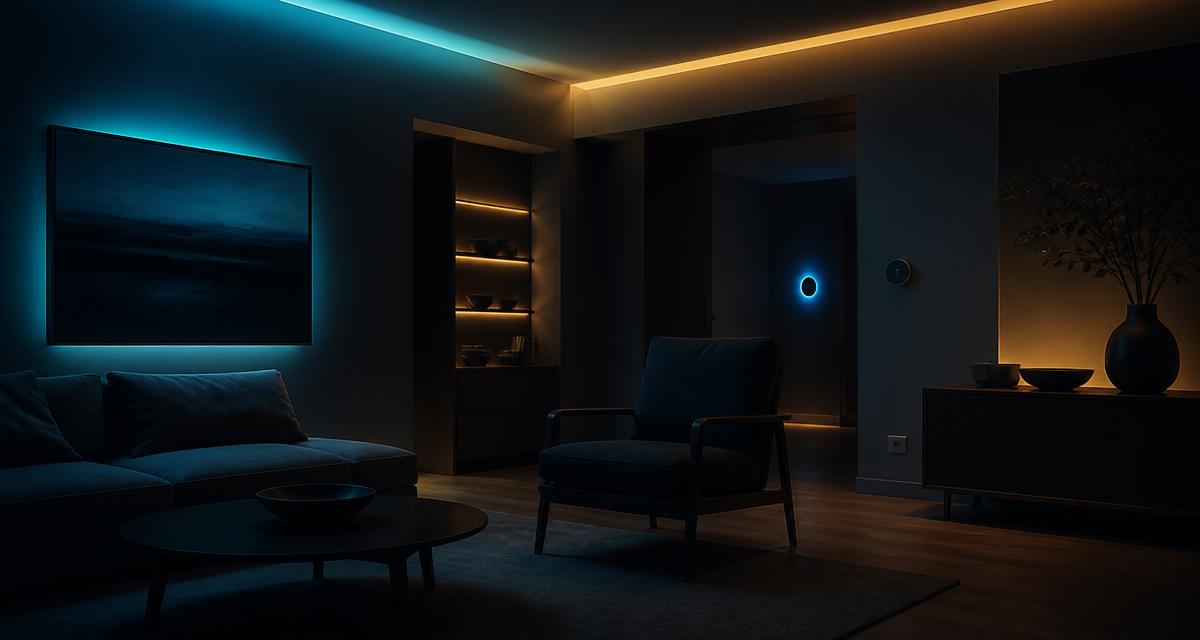
Editorial illustration for this essay — a generated image of an adaptive room. It is not documentation of an artwork or of a built installation.
Now put it in a house
A gallery enclosure is bounded: you enter, you leave, you consented at the door. A home is not. It is where you are unguarded, ill, grieving, arguing, in love, asleep. It contains people who never agreed to anything — children, guests, a cleaner, a partner who moved in after the sensors were installed.
The technical claim of a nervous-system-aware home is modest: from ambient sensing you can estimate pulse rate, breathing pattern and movement, and adapt light temperature, sound, and notification timing in response. That is a small set of signals and a small set of levers. What is not modest is the inference layer people want to bolt on top: mood history, stress scores, relationship analytics, a timeline of your body in your own hallway. As I argue in The Signal Is Not the Feeling, the signal never contained that meaning in the first place.
LAUREN, and the honesty of a human in the loop
Lauren Lee McCarthy’s LAUREN (2017) remains the sharpest study of this. McCarthy installed cameras, microphones and switches in volunteers’ homes and then acted as their smart-home assistant herself, remotely, for days: watching, anticipating, adjusting the lights, opening the door before they reached it.
Participants reported something the automation industry rarely admits — an intimacy that was genuinely better than a product, and simultaneously unbearable. A person watching is a person who can be embarrassed, negotiated with, told to stop. Replacing her with a model does not remove the watching; it removes the counterpart. LAUREN is not an argument against responsive homes. It is an argument that the responsiveness people actually want is relational, and that most of the discomfort concerns who holds the record.
A baseline that already exists
The floor is not hypothetical. NIST IR 8425, the profile of the IoT core baseline for consumer products, sets out what a connected home device should provide as a minimum: a unique identity, protected device and data configuration, secure and verifiable software updates, interface minimisation, logging the owner can access, and documentation of what the product collects and how it is disposed of.
The EU AI Act adds the second constraint: emotion recognition is prohibited in workplaces and educational institutions, subject to medical and safety exceptions. Other contexts are not exempt — depending on the use, they can carry transparency duties toward the people exposed to the system, high-risk obligations, or both. A home is not a workplace — unless it is, which for a live-in carer or a remote worker it very often is. Any serious domestic product has to answer that case rather than route around it.
Permission is not a purchase
In a gallery the enclosure has a door and a wall text. In a house, the person who bought the device is the only one who ever agreed to it. Everyone else — the child, the guest on the sofa, the carer, the partner who moved in two years later — inherits a decision that was made without them and is invisible unless someone explains it. A room that adapts to breathing is not a private purchase; it is a condition imposed on whoever walks in.
The honest version of that is unglamorous: the sensing belongs to whoever is present, and a household that cannot all agree does not have a working system. That single line kills most of the product roadmaps I have seen, which is a reasonable indication that it is the right line.
Refusal has to cost nothing
Most domestic technology punishes refusal quietly. Decline the sensing and the lights get dumber, the heating schedule breaks, the door stops recognising you. Once saying no makes the house worse, consent is theatre — people keep the sensing on the way they keep location services on, out of friction rather than agreement.
An adaptive home has to be designed so the unsensed state is fully functional and legible: you can see from across the room whether the house is listening to your body, and turning that off leaves everything else intact. If the off switch has a penalty attached, the design has already answered the title’s question, and not in the direction anyone would choose out loud.
Reversibility, and the thing nobody needs
The dangerous part of a nervous-system-aware home is not the adaptation. It is the archive. A room can respond to this breath without keeping last Tuesday’s, and a physiological log of a household is an asset nobody needs and everybody eventually leaks — into a divorce, an insurance file, a data breach, a rented flat’s next tenant. Adapt in the moment, keep the signal on the premises, and let people delete a house the way they leave one.
Under those terms I think the answer is yes: a home can respond to your nervous system and it can be good. Change permission, refusal or reversibility and the same hardware becomes the other thing. The enclosure never decided which — the people who specified it did, in advance, in details nobody standing inside would be able to see.
The question the artwork asks
Heaven or Hell is a proposal I wrote in 2020 and never built. It describes an enclosure whose light and sound would shift with the occupant’s own breathing and pulse — nothing diagnosed, nothing displayed, the room simply moving with them. In 2026 I visualized it digitally, so what exists is a concept and a set of rendered views. No one has stood inside it.
That is not an apology. It is the reason the piece is still a question. Were it built, I expect two people could leave it with opposite accounts — one describing being held, the other being watched — and no adjustment to the sensing would settle the disagreement, because the disagreement would be about authorship rather than accuracy. The title stays a question because I cannot answer it from the design alone, and neither can anyone selling a product built on the same premise.
The room-level question here is the same one explored in the bioadaptive AI demonstration.